


A large cohort of unemployed young people represents lost productive capacity for the economy.
Image: Davis Cetris | Pixabay
For many young South Africans, unemployment is no longer simply a period between leaving school and finding a first job. Increasingly, it is becoming a defining feature of early adulthood.
Statistics South Africa's latest labour market data shows that 4.7 million people aged between 15 and 34 were unemployed in the first quarter of 2026, while a further 10.6 million were outside the labour force altogether.
More than four in ten young people aged 15 to 34 were not in employment, education or training. These figures show a generation struggling to find a foothold in the economy.
Among those aged 15 to 24, the unemployment rate was at 60.9% in the first quarter, while unemployment among those aged 25 to 34 reached more than 40%. The broader youth unemployment rate, covering people aged 15 to 34, stood at 45.8%.
The challenge extends beyond the labour market.
In an opinion piece published by the University of the Witwatersrand, Professor William Gumede argued that South Africa's youth unemployment crisis has become a broader social and economic development challenge that affects economic growth, social stability and the state's ability to address systemic failures.
Gumede said South Africa's youth unemployment rate was among the highest in the world outside countries affected by war or civil conflict and argued that tackling the problem would require addressing societal, economic, democratic and state failures simultaneously.
“South Africa is suffering from multiple system failures, including societal, economic, democratic, and state failures. A national job creation strategy to provide jobs for youth should use unemployed youth to fix some of these system failures,” the professor said.
Elsewhere, research suggests that growth, persistent unemployment, and rising poverty are deeply interconnected, creating a cycle of exclusion and frustration for South Africa’s youth.
The latest Statistics South Africa data suggests the problem is worsening rather than improving.
The number of unemployed young people increased by 181,000 between the fourth quarter of 2025 and the first quarter of 2026, while the number of employed young people declined by 258,000. As a result, youth unemployment increased by two percentage points over the quarter.
For many young South Africans, the greatest challenge is not losing a job but securing a first opportunity.
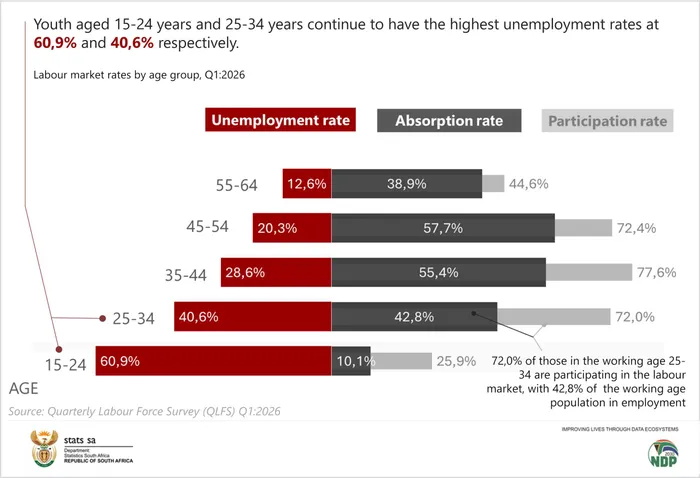
The labour market rate by age group.
Image: Statistics South Africa
Statistics South Africa previously found that nearly six in ten unemployed young people had no previous work experience, highlighting the difficulty many face in entering the labour market for the first time.
The latest figures also reinforce the link between education and employment prospects.
While youth unemployment remains elevated across all education levels, Statistics South Africa's labour market data continues to show significantly stronger employment outcomes among graduates than among people with lower levels of educational attainment.
Gumede noted that some unemployed youth may have completed post-school education, whether at SETAs or TVET colleges, either without technical or critically essential economic-related subjects, or if they have these subjects, the education was of inferior quality.
“Many unemployed with a university education lack STEM, or critical economic-related subjects,” the professor said.
Gumede explained that STEM, technical, vocational, and economically-critical education allows pupils or students to have a broader range of opportunities not only in South Africa, but also globally.
“Education cannot be a gateway to individual prosperity, unless it is of such a quality that recipients of such education obtain South African skills with which they can compete globally, in both emergency and developed markets.”
The consequences extend beyond individual households.
Gumede argues that a large cohort of unemployed young people represents lost productive capacity for the economy while also placing pressure on communities and public institutions.
The professor also suggests that any credible youth employment strategy should be linked to addressing broader national challenges and creating opportunities for young people to contribute to solving them.
IOL BUSINESS