

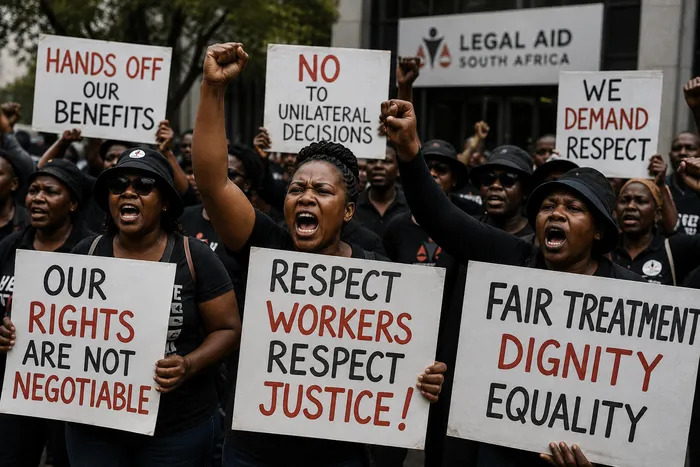
Legal Aid is facing the prospect of protected strike action after the Commission for Conciliation, Mediation and Arbitration (CCMA) issued a certificate of non-resolution. (Not an image of the actual threatened strike.)
Image: ChatGPT
Legal Aid is facing the prospect of protected strike action after the Commission for Conciliation, Mediation and Arbitration (CCMA) issued a certificate of non-resolution and signed off formal picketing rules in an escalating labour dispute involving retirement policies, working conditions and employee recognition.
The dispute between Legal Aid SA and the South African Legal Aid Workers Union (SALAWU) has now moved into a formal labour confrontation phase, with the union legally required to provide at least 48 hours’ notice before any strike action can begin.
The signed picketing rules reveal the potential scale of the action, with planned protest sites including Legal Aid offices across the country, magistrates’ courts, high courts, Parliament in Cape Town and the Department of Justice and Constitutional Development’s head office in Pretoria.
The rules, in IOL’s possession, specifically identify courts and offices in Johannesburg, Pretoria, Durban, Polokwane, Cape Town, Kimberley, Mthatha, Mahikeng, George and other centres.
However, the rules also stipulate that picketing at Legal Aid House in Braamfontein may only take place on the pavement outside the building, with protesters barred from blocking entrances or holding demonstrations inside the premises.
The looming strike could carry broader implications for the justice system because Legal Aid SA is a statutory body established under the Legal Aid South Africa Act of 2014 to provide legal representation and legal assistance to indigent and vulnerable people who cannot afford private legal services.
Its mandate includes providing constitutionally required legal representation at state expense, educating the public about legal rights and supporting access to justice for poor and vulnerable groups, including women, children and rural communities.
The organisation operates independently and is intended to strengthen public confidence in the legal system and administration of justice.
The dispute appears to have been triggered by a conflict over retirement age policies, although it has since broadened into wider grievances over salaries, staffing levels, governance and labour relations.

A banner on Legal Aid's website.
Image: Legal Aid
SALAWU claims that Legal Aid SA unilaterally enforced retirement at age 60 after employees had allegedly been led to believe amended human resources policies would increase the retirement age back to 65.
According to the union, some employees turning 60 received retirement notices in January and were allegedly not paid on the normal salary payment date.
The South African Lawyers and Allied Workers Union (SALAWU) said: “we emphatically state that we did not know where this came from and the same was never communicated, discussed and or agreed to by the employer and SALAWU. We view this conduct by the employer as the gross violation and unilateral change of employees’ conditions and terms of employment.”
SALAWU alleged that this change would cost someone who was on an annual “package” of R350,000 some R1.75 million within that five-year period.
The union also alleges that quarterly engagement meetings stopped after August 2025, salary benchmarking processes stalled, vacancies remained unfilled, bursaries were unpaid, and workloads worsened across the organisation.
The union further alleged that amended human resources policies had been awaiting approval from the ministers of justice and finance for nearly two years.
“The time has come to roll up our sleeve [sic], confront all those stands against interests of employees, and break loose the shackles unleashed on employees directly or indirectly by the above-mentioned institutions and management to a certain extent,” a letter to members of the union in IOL’s possession stated.
Legal Aid provides advice to those who cannot afford lawyers.
Image: Legal Aid
Legal Aid SA disputes the union’s version of events.
The organisation said the retirement age of 60 was formally approved by the board in 2018 and later approved by both the ministers of justice and finance in 2020, following consultation processes with employees.
The body also noted that employees due for retirement can “apply for an extension of employment on a year-to-year basis. Such applications are considered on their merits, taking into account factors including scarce skills requirements and financial implications.”
Five employees retired in January 2026, while a further 25 employees are expected to retire before the end of the current financial year.
Legal Aid SA also denied withholding salaries, saying affected employees were paid on 30 January in line with policy because salaries are normally paid in advance. “Accordingly, all employees who retired in January 2026 received their salaries on 30 January 2026,” it says.
The entity added that it engaged with the union, and meetings that didn’t happen were attributed to SALAWU. “Legal Aid SA remains committed to constructive engagement with SALAWU. Further discussions are scheduled for 29 May 2026, and the organisation remains confident that the matter can be resolved through continued engagement and the positive working relationship that exists between the parties.”
The organisation acknowledged the labour dispute had escalated to the CCMA but said contingency plans were being prepared to minimise disruption should industrial action proceed. “At this stage, the organisation does not foresee severe operational disruptions.”
It added that contingency arrangements involving judicare practitioners would be used where necessary.
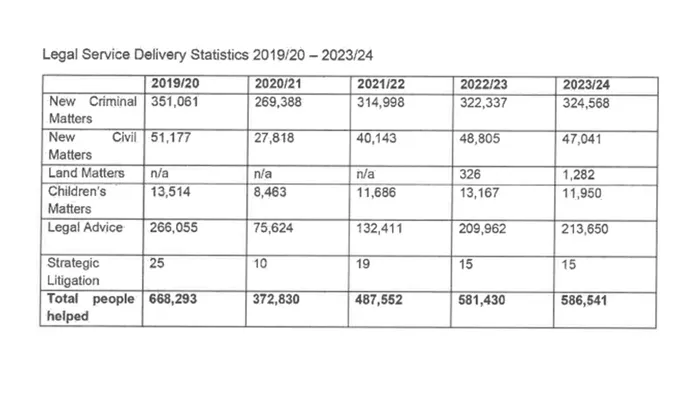
The amount of people Legal Aid has helped over the past few years.
Image: Legal Aid's performance plan
In addition to employees only being allowed to picket on the pavement outside the building and not prevent people from seeking help, they rules place other strict limits on any industrial action.
Pickets may take place only on pavements outside designated buildings and protesters are barred from blocking entrances or exits. Participants are also prohibited from intimidation, violence, carrying dangerous weapons or obstructing access to workplaces and courts.
The rules allow picketers to carry placards, chant slogans, distribute pamphlets and sing or dance during demonstrations.
A maximum of 500 employees may participate in picketing at Legal Aid House in Braamfontein at any given time, while up to 80 employees may picket outside local Legal Aid offices.
The CCMA certificate of non-resolution was issued after conciliation efforts failed earlier this month, formally opening the door for protected strike action under the Labour Relations Act.
IOL BUSINESS