


Consumer insolvencies are falling even though South Africans are battling debt, the cost of living, and have no room to save.
Image: ChatGPT
South Africans are showing fewer signs of financial distress in one of the country's most severe measures of debt, even as a growing body of evidence suggests many households remain under intense economic pressure.
Statistics South Africa's latest Statistics of Insolvencies report shows that just 61 individuals and partnerships were declared insolvent in June, less than half the 139 recorded in the same month last year.
The figure also marks a sharp decline from May, continuing a broader downward trend that has seen insolvencies fall 27.3% in the second quarter and 11.1% over the first six months of 2026.
So far, this marks the best month since last December, when only 31 people were declared insolvent – although this can be attributed to the overall shut down of SA Inc. from the middle of the month. Januarys the following year, in general, show insolvencies grow at least three-fold.
On the surface, the figures appear to point to an improving financial picture. However, they stand in contrast to a series of recent reports suggesting consumers are under growing pressure from higher living costs and persistent debt.
Statistics South Africa’s numbers show that the peak rate of insolvencies was 264 in November 2024 even as the South African Reserve Bank cut the interest rate by 0.25 percentage points and inflation came in at 2.9%.
By contrast, inflation was 4.7% in June this year with the central bank having hiked interest rates to 10.5% the month before. Research released this week found that the cost of living has overtaken interest rates as South Africans' biggest financial concern.
Debt counsellor DebtBusters has also reported continued demand from consumers seeking help to manage unaffordable debt before reaching crisis point, while the National Debt Counsellors' Association has warned that many households simply have nothing left to save after covering essential monthly expenses.
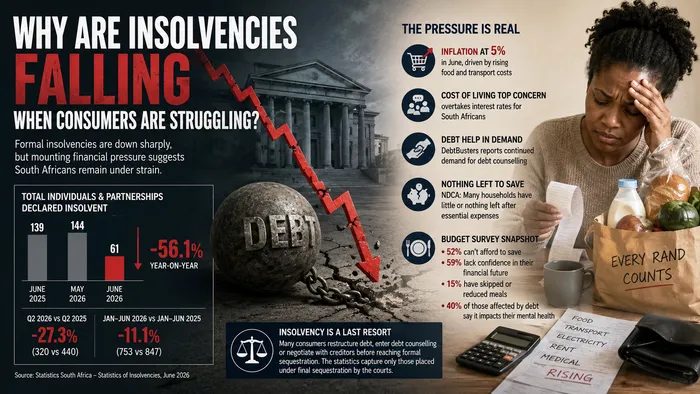
Insolvencies by the numbers based on Statistics South Africa data.
Image: ChatGPT
Budget Insurance's inaugural Financial Health Survey, released on Thursday, reinforces that picture.
Although more than a third of respondents said their financial wellbeing had improved over the past year, more than half said they could not afford to save.
Six out of every ten respondents lacked confidence that their financial situation would improve over the next 12 months, and a sixth said they had reduced or skipped meals to stretch their budgets. Among respondents affected by debt, four out of 10 said it had taken a toll on their mental health.
The apparent contradiction may lie in what the insolvency figures actually measure.
Statistics South Africa records only individuals and partnerships that have been placed under final sequestration by the courts after they are no longer able to meet their financial obligations.
The figures do not capture consumers who are restructuring debt, entering debt counselling, negotiating with creditors or finding other ways to avoid formal insolvency.
The provincial breakdown reflects where most insolvencies continue to occur. Gauteng accounted for 476 of the 753 insolvencies recorded during the first half of the year, followed by the Western Cape with 124 and KwaZulu-Natal with 66.
IOL BUSINESS