

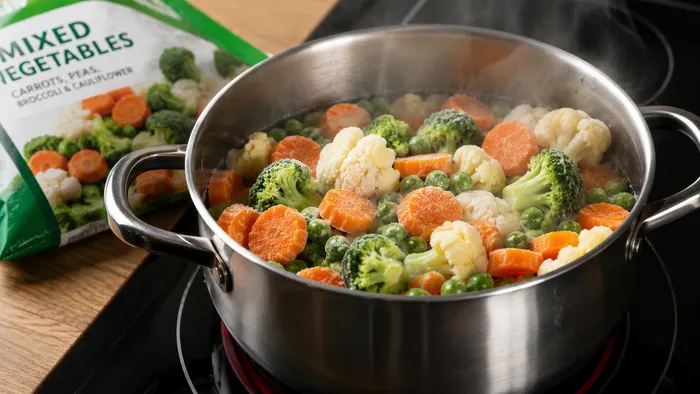
The import tariff on frozen mixed veggies stays the same, at 10%.
Image: ChatGPT
South African consumers could be spared higher prices for frozen mixed vegetables after the International Trade Administration Commission (ITAC) recommended that the import duty remain at 10%, rejecting an application for a sharp increase that could have added to grocery bills.
The recommendation follows an application by local producer Nature’s Garden to increase the customs duty on frozen mixed vegetables from 10% to 37% ad valorem. It was initiated by the former Minister of Trade, Industry and Competition, Ebrahim Patel, on 21 July 2023.
In a note for XA Global Trade Advisors, trade advisor Wongani Msiska said that while the domestic frozen vegetable industry continues to face challenges, raising the tariff would have had a disproportionate impact on consumers, particularly lower-income households, while providing limited additional protection to local producers.
The commission found that domestic production and demand declined between 2018 and 2022, largely because of electricity supply constraints and load shedding rather than import competition. It also noted that imports had declined over the review period, while local producers had maintained their market share, supported by a price advantage over imported products.
ITAC therefore recommended that the existing 10% duty be maintained.
“ITAC also indicated that it will continue monitoring import trends, domestic production and developments in the sector to assess whether any future tariff intervention may be warranted,” Msiska said.
The recommendation also comes as economists monitor forecasts for what could be one of the strongest El Niño events since 1950, even as the storm’s impact might not adversely affect inflation.
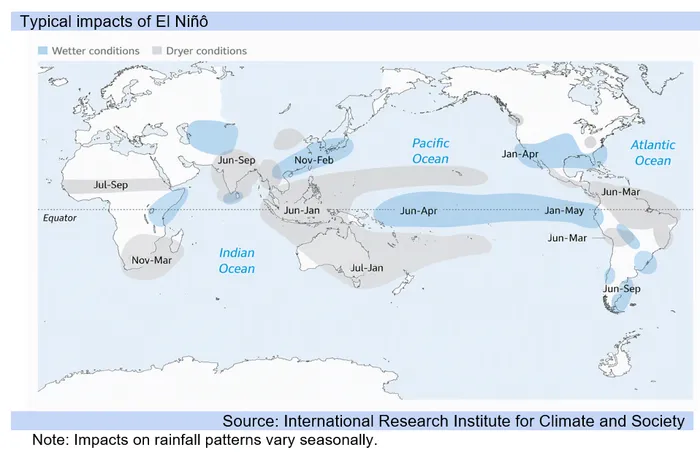
Impacts on rainfall vary seasonally.
Image: International Research Institute for Climate and Society
Investec chief economist Annabel Bishop, quoting the NOAA Climate Prediction Center, said forecasts indicate there is a 97% probability that the El Niño expected during the second half of 2026 and first half of 2027 will be among the strongest since 1950.
Bishop said South Africa’s most severe recent El Niño, in 2015/16, resulted in the country’s worst drought in 35 years and pushed food price inflation to 18.4%.
However, Bishop cautioned that higher food prices do not automatically translate into significantly higher inflation because the impact depends on which food categories are affected.
El Niño is a climate pattern characterised by the unusual warming of surface ocean waters in the central and eastern tropical Pacific Ocean, resulting in warmer global temperatures and increased rainfall and flooding.
During the 2015/16 El Niño, cereal price inflation accelerated from 4.7% year on year to 17.5%, while meat prices also made a meaningful contribution to inflation because both carry relatively large weightings in the consumer price index.
By contrast, fish and seafood prices also rose sharply but had almost no effect on overall inflation because the category carries a weighting of just 0.43% in the CPI basket.
“Food prices were not the main driver of the jump in CPI inflation in the 2015/16 El Niño period,” Bishop said, noting that food and non-alcoholic beverages contributed 3.4 percentage points of the overall increase in inflation.
Bishop added that food’s weighting in the consumer price basket has fallen over time, dropping to 18.23% from 25.66% in 2006 as household spending patterns have changed.
Food inflation came in at 1.9% in May year-on-year, a rate of growth that was substantially slower than several months ago. The next CPI print will be published next week.
IOL Business