


The rand has remained resilient against the US dollar despite ongoing global uncertainty.
Image: Manus
The rand has remained resilient against the US dollar despite ongoing global uncertainty, with analysts pointing to easing oil prices, stronger commodity prices, reduced expectations of further US interest rate hikes and easing Middle East tensions as the key drivers supporting the local currency.
The currency has traded around R16.20 to the dollar in recent days, strengthening from an average of R16.49 during the second quarter. Investec chief economist Annabel Bishop said the rand could test the R16.00 mark this week if positive momentum holds.
Nolan Wapenaar, head of fixed income at Anchor, said the rand's resilience was notable given the recent broad strength of the US dollar against other major currencies, with the euro currently trading around 4% weaker against the dollar than before the war.
Wapenaar attributed much of the rand's resilience to South Africa's improving terms of trade. "With oil prices coming down, our terms of trade are improving, giving more resilience to the rand," he said, adding that firmer gold, platinum and coal prices were also providing support.
Nkosinathi Nsibande, Fixed Income Specialist at Abax Investments, said weaker-than-expected US jobs growth and downward revisions to previous months' figures had eased concerns that the Fed would need to raise interest rates in the near term.
"The data alleviated concerns around the Fed needing to hike rates in the near term. This was evident in the drop in US Treasury yields and a sell-off in the US Dollar Index broadly benefitting emerging market currencies," Nsibande said.
Expectations that the US Federal Reserve may slow or pause interest rate hikes tend to support the rand because investors are more willing to buy higher-yielding emerging market assets such as South African bonds, increasing demand for the local currency.
Nsibande added that few domestic developments had been capable of moving the currency, contributing to recent stability.
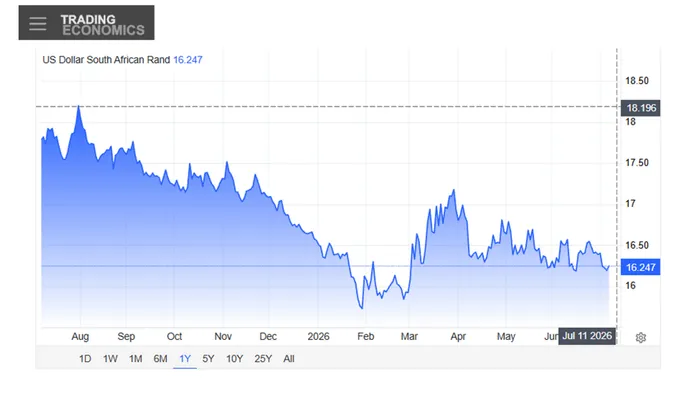
The local currency has traded around R16.20 to the dollar in recent days, strengthening from an average of R16.49 during the second quarter.
Image: Trading Economics
Bishop said financial markets had become more optimistic following continued negotiations between the United States and Iran, reducing concerns over disruptions to shipping through the Strait of Hormuz.
The improvement in sentiment had reduced demand for the US dollar as a safe-haven asset, Bishop said. "The US dollar in turn has weakened as its safe haven status has been used less, allowing for additional rand strength against the US dollar," she said.
Bishop noted that foreign purchases of South African bonds had also risen, showing an upward trend since mid-July as markets calmed - a development she expected to continue as appetite for conflict in the Middle East diminished.
South Africa's own recent interest rate increase has provided additional support, with Wapenaar noting that a less hawkish Fed would further benefit the rand.
Markets currently expect between one and two further 25 basis point hikes locally for the remainder of the year, with similar expectations in the US – though Bishop said US rate expectations were likely to ease further on growth concerns.
Fed Chairman Kevin Warsh has struck a careful balance, signalling commitment to price stability while calming markets on inflation, Bishop noted. She added that he had so far proved to be a steady hand, refusing to be drawn on the next rate decision while providing confidence on the broader outlook.
Analysts broadly agree the rand is likely to remain driven by international events rather than domestic fundamentals, with the next major test coming from upcoming Fed communications.
Yet, Bishop cautioned that the rand retained its propensity for volatility, with US interest rate direction remaining the key risk factor for the local currency.
IOL BUSINESS