

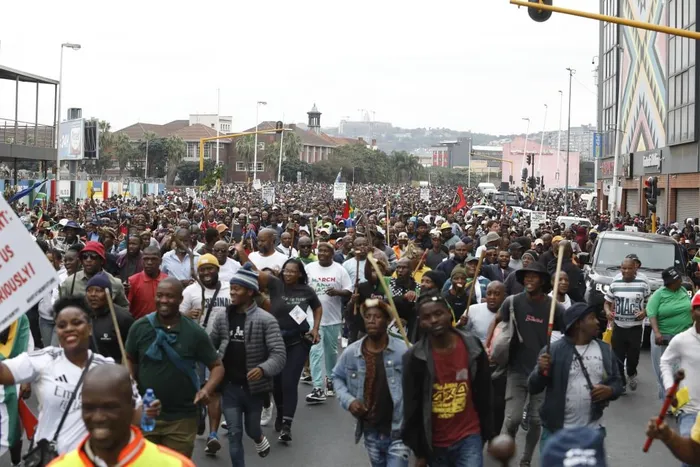
Investors were relieved yesterday after South Africa's anti-illegal immigration protests were fairly peaceful, with the local currency not reacting adversely.
Image: Doctor Ngcobo/ANA Studio
Investors were relieved yesterday after South Africa's anti-illegal immigration protests were fairly peaceful, with the local currency not reacting adversely.
Instead, the rand strengthened after thousands of demonstrators marched through cities including Durban, Johannesburg and Cape Town without the widespread violence or disruption some investors had feared.
The muted market reaction came despite heightened concern ahead of the demonstrations, which were organised by the March and March movement and centred on demands for government to remove undocumented immigrants from South Africa.
The campaign comes against a backdrop of persistently high unemployment, with youth unemployment remaining above 40%.
March and March leader Jacinta Ngobese-Zuma has since vowed that supporters will return to the streets every Thursday until government responds to the group's demands.
But analysts said investors ultimately viewed the peaceful outcome as reducing, rather than increasing, South Africa's immediate political risk.
"The rand strengthened after South Africa's anti-illegal immigration marches concluded without the widespread violence or disruption that many investors had feared," said André Botha, head of execution at TreasuryONE.
Botha added that the local unit appreciated despite a firmer US dollar and rising US Treasury yields following stronger-than-expected American labour market data, underscoring the resilience of investor sentiment towards South African assets."
Markets had unwound some of the domestic political risk premium that had been priced into the currency, although Botha cautioned that the rand would continue to be driven primarily by global factors such as US interest rate expectations, oil prices and broader investor appetite for risk.
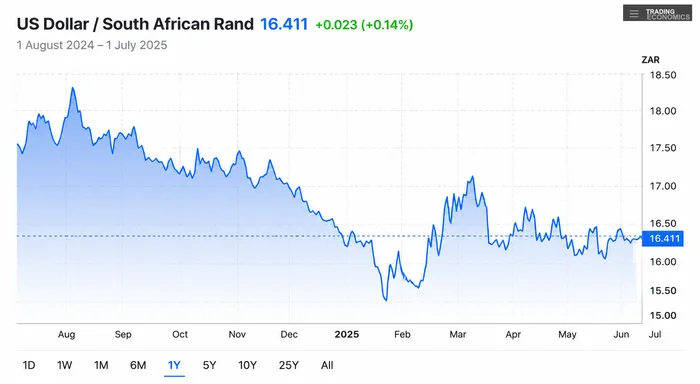
The rand has traded in a relatively narrow range of about R16 to R16.50 against the US dollar since May.
Image: Trading Economics
Ahead of the demonstrations, TreasuryONE currency strategist André Cilliers warned markets would be watching closely for disruption. "A peaceful day could allow the rand to recover further, while any escalation may quickly reverse recent gains," he said.
Botha told IOL yesterday that “the marches also serve as a reminder of South Africa's deeper structural challenges”.
Nolan Wapenaar, co-chief investment officer at Anchor, said financial markets had taken the protests in their stride. "We did not see an impact on markets from yesterday's events," he said.
Wapenaar said "I think the protests went off smoothly which is a positive. We are in an election year, so this is to be expected during 2026." He said investors had likely viewed the absence of major unrest as "a sigh of relief".
Abax Investments equity analyst Nkosinathi Nsibande said the market reaction was similarly subdued. "It was a slightly muted reaction in the market in terms of local bonds and the currency," he said.
"The overall outcome of the shutdown was much better than anticipated."
Nsibande said the rand had initially weakened slightly before strengthening later in the day, supported by month-end flows, while global drivers including oil prices and US interest rates remained relatively stable.
On Monday, Investec chief economist, Annabel Bishop, pointed out that the local currency was calm ahead of the protests. She added that the rand had firmed further in June, gaining each month on average since March.
According to Trading Economics, the currency has traded in a relatively narrow range of about R16 to R16.50 against the US dollar since May, with movements driven largely by international factors including oil prices, US monetary policy and geopolitical developments in the Middle East rather than domestic political events.
IOL BUSINESS