

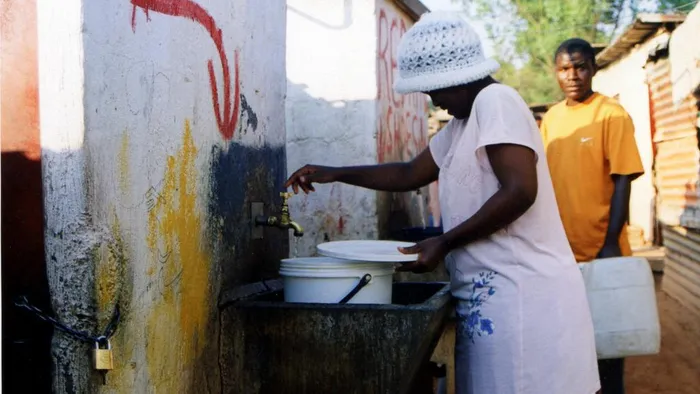
Millions more South Africans now receive municipal services than they did a generation ago, yet some communities continue to rely on infrastructure that many assumed had disappeared years ago.
Image: Nicola Mawson | IOL
The recent voter registration drive reminded Statistics South Africa of the upcoming local government elections in November 2026. A two-decade review of five financial indicators shows how municipalities fared at the time of previous elections.
One of the clearest changes over the past two decades has been the steady expansion of basic municipal services. As municipal budgets have grown, so too has the number of households receiving water, electricity, sanitation and refuse removal.
Municipal services continued to expand in 2023. Water services reached 15.8 million consumer units, up from 15.3 million a year earlier. Electricity connections increased from 12.9 million to 13.3 million, while sewerage and sanitation services grew from 13.5 million to almost 14 million. Refuse removal recorded the strongest growth, rising from 11.2 million to 11.8 million consumer units.
The figures reflect South Africa's growing population and continued urbanisation, but they also illustrate the increasing pressure on municipalities. Councils are expected not only to maintain ageing infrastructure but also to extend services to new housing developments, informal settlements and expanding urban areas while coping with rising operating costs.
Municipalities also remain one of the country's largest providers of social support through the free basic services programme.
In 2023, municipalities supplied free basic water to 2.5 million consumer units, free electricity to 1.85 million, free sewerage and sanitation to 2.19 million, and free refuse removal to almost two million households. The programme is intended to ensure poor households retain access to essential services even when they cannot afford to pay.
The extent of that support differs markedly across the country. For water, the Western Cape recorded the highest proportion of consumer units receiving free basic services at 41.1%, followed by KwaZulu-Natal at 22.2% and the Northern Cape at 20.6%. At the opposite end of the scale were Mpumalanga at 6.3%, North West at 7.4% and Limpopo at 8.3%.
Electricity showed similar disparities. More than a quarter of consumer units in the Western Cape received free basic electricity, compared with just 4.2% in Limpopo. These differences reflect not only varying levels of poverty but also differences in municipal revenue, local policies and the ability of councils to fund indigent support programmes.
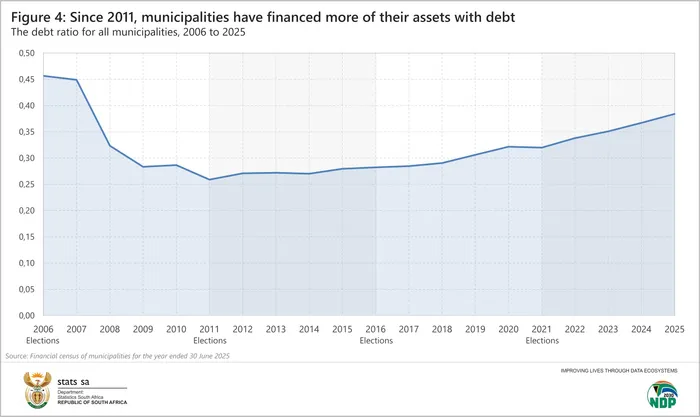
Municipalities are financing more of their assets with debt.
Image: Statistics South Africa
Millions more South Africans now receive municipal services than they did a generation ago, yet some communities continue to rely on infrastructure that many assumed had disappeared years ago.
Although Gauteng, KwaZulu-Natal, Limpopo and Mpumalanga reported no municipal bucket toilet systems in 2023, four provinces still relied on them. The Free State accounted for the largest number with 21,882 bucket toilet services, followed by the Eastern Cape with 11,228, the Northern Cape with 8,044 and North West with 3,279 — meaning more than 44,000 consumer units were still using municipal bucket sanitation in 2023.
There were signs of progress. The Eastern Cape reduced the number by almost 2,900 during the year, while the Free State cut the number by more than 500. However, the Northern Cape and North West both recorded increases, illustrating that progress has not been consistent across the country.
The figures highlight a recurring theme running through municipal finances over the past 20 years. While councils collectively manage far larger budgets than they did in 2006 and have extended services to millions more households, the benefits have not been shared equally.
Where some municipalities have expanded services and strengthened indigent support, others continue to grapple with ageing infrastructure, financial constraints and long-standing service delivery backlogs.
With South Africans set to return to the polls for local government elections in November, the data provides a reminder that the quality of municipal services still depends heavily on where people live.
IOL BUSINESS