

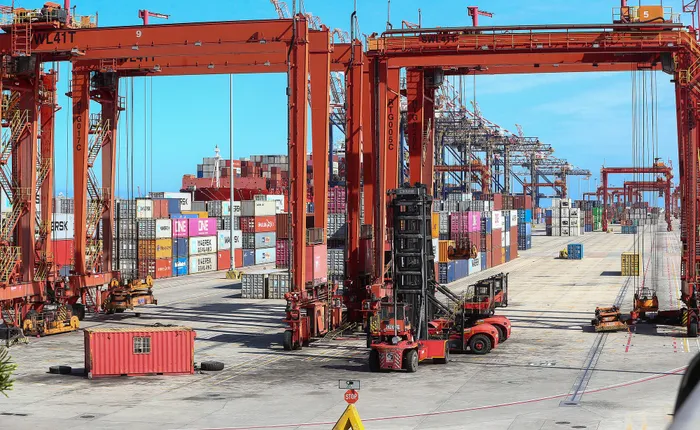
S&P's projection is significantly lower than National Treasury's estimation of 1.6% in 2026 and 1.8% over the medium term.
Image: Leon Lestrade / Independent Newspapers
South Africa’s economic growth outlook has been revised lower by S&P Global Ratings, which now expects the country to face slower expansion over the next two years amid rising inflationary pressure, rising energy costs and the likelihood of further interest rate increases.
In its latest Emerging Markets Economic Outlook released on Thursday, the agency cut South Africa’s 2026 gross domestic product (GDP) forecast by 0.2 percentage points to 1.3%, down from 1.5% projected in March. The 2027 forecast was also reduced by the same margin to 1.5%, according to Business Report.
The revised figures remain below National Treasury’s projections of 1.6% growth in 2026, 1.8% over the medium term and 2% by 2028. Finance Minister Enoch Godongwana has indicated that the government will reassess its growth assumptions ahead of the medium-term budget policy statement in October.
Last week, the World Bank also downgraded its 2026 South Africa forecast to 1.0%, citing weaker global demand, higher energy costs and elevated uncertainty.
While many economists still see growth of around 1.3% in 2026 as achievable, S&P emerging markets chief economist Elijah Oliveros-Rosen warned that inflationary pressures are expected to intensify in the second half of the year, driven largely by fuel and food costs.
“Our GDP forecasts for South Africa are now 20 bps lower for 2026 and 2027, at 1.3% and 1.5%, respectively. We raised our average inflation forecast to 4.3% from 3.5%,” Oliveros-Rosen said.
“We expect the central bank to hike interest rates at least one more time this year, since we expect inflation to exceed 5% in the second half of 2026.”
The downgrade forms part of a broader reassessment of emerging markets, where S&P expects inflationary pressures to remain elevated following disruptions linked to the Middle East conflict, as well as higher global energy and food prices.
“Compared with our March baseline, we have raised our inflation projections and lowered our growth forecasts for most EM economies in Europe, the Middle East, and Africa,” the agency said.
It added that energy inflation has increased across the region, particularly in Nigeria and Türkiye, while food inflation is expected to rise further due to higher transport and fertiliser costs.
The report also highlighted lingering uncertainty around global commodity markets, noting that while crude oil prices have eased since the recent US-Iran peace agreement, refined fuel costs are likely to remain elevated due to logistical constraints, infrastructure damage and the need to rebuild inventories.
Food inflation is also expected to remain a key risk, with S&P warning that higher fertiliser prices and El Niño weather conditions could push agricultural prices higher. South Africa was identified as particularly exposed to the weather pattern, which has historically brought drought conditions and reduced crop output.
Several emerging market central banks, including South Africa’s, have already tightened monetary policy in response to inflationary pressures linked to the conflict. While higher interest rates are helping to contain inflation, S&P warned they are also weighing on household spending and business investment.
The agency now expects South Africa’s benchmark repo rate, currently at 7%, to end 2026 at 7.25% before easing to 6.75% in 2027.
Despite the downgrade, South Africa’s growth outlook remains slightly stronger than the estimated 1.1% expansion for 2025. The economy recorded 0.5% growth in the first quarter of 2026, marking a sixth consecutive quarter of expansion.
However, the country continues to lag faster-growing emerging markets such as India, Vietnam and Indonesia, which are expected to expand by more than 5% in 2026, supported by strong domestic demand and investment linked to global technology supply chains and artificial intelligence development.
S&P expects South Africa’s medium-term growth to remain subdued, gradually improving to 1.8% by 2028 and 2029, while unemployment is projected to remain high at 31.8% in 2026 before easing marginally in later years.
IOL Business