

A developing super El Niño weather phenomenon poses a threat to consumers.
Image: Freepik
South Africans could face higher food prices and fewer interest rate cuts next year after leading international weather agencies confirmed that El Niño conditions have developed, prompting Investec to raise its inflation forecast for 2027.
“With food prices the largest single contributor to inflation, we have lifted our 2027 CPI inflation forecasts to 3.7% year-on-year from 3.3% year-on-year previously, while there is likely to be some upwards support as well from agrichemical price pressures,” said Investec chief economist Annabel Bishop of next year’s forecast.
The warning of disrupted rainfall patterns and rising temperatures a builds on concerns raised earlier this month that a potential "super" El Niño could push food inflation into double digits if drought conditions severely affected South Africa's summer grain crop.
Bishop said a number of leading climate authorities have now confirmed the return of El Niño, a weather pattern associated with drought conditions in South Africa that can disrupt agricultural production and drive up food prices.
Among those confirming the weather pattern are the US National Oceanic and Atmospheric Administration's Climate Prediction Center, the International Research Institute for Climate and Society and the World Meteorological Organization.
The revised outlook also has implications for interest rates. The higher inflation outlook has also changed Investec's view on monetary policy. Bishop said the revised inflation trajectory, while not extreme, reduced the likelihood of three 25 basis-point interest rate cuts.
Instead, Investec now expects the Reserve Bank is more likely to cut rates once or twice, depending on the severity and duration of the El Niño event.
Following last week's Monetary Policy Committee meeting, South African Reserve Bank Governor Lesetja Kganyago said policymakers had already been modelling the potential impact of a developing El Niño alongside escalating geopolitical tensions in the Middle East.
"The second included El Niño, a weather pattern that seems to be forming currently, and which typically brings drought to parts of South Africa," Kganyago said. He warned that all of the Reserve Bank's risk scenarios pointed to higher inflation and weaker economic growth.
"These scenarios underscore the importance of food, alongside fuel, in transmitting the ongoing geopolitical shock. They also show the additional risks from a severe El Niño."
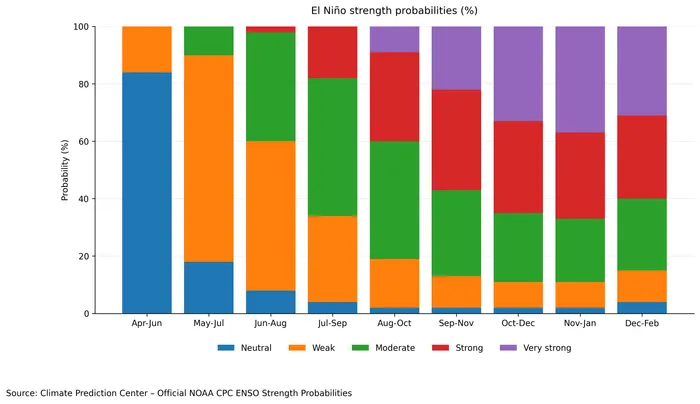
The probability of a high impact adverse weather cycle.
Image: MCB Group | Redrawn by ChatGPT
Kganyago said the Reserve Bank's modelling suggested that while a prolonged Middle East conflict could require two additional interest rate hikes, adding El Niño to the scenario would see interest rates remain higher for longer. In the most severe scenario, inflation could rise above 6%, requiring three additional rate increases.
Bishop said while South Africa's recent La Niña weather pattern had supported soil moisture and agricultural production, helping to keep food price pressures contained this year, attention was now shifting to 2027 as El Niño threatens the country's key planting and growing season.
South Africa's maize crop is expected to be among the most vulnerable. Bishop said maize, a staple food, could switch from being a source of food price deflation to becoming an inflation driver if drought affects domestic production while global corn prices also increase.
Bishop notes that “the El Nino is currently indicted to be moderate overall but does show a reported period of intensity from November this year to January next year, causing a drying out period for South Africa’s soil, with planting typically in October”.
The Climate Prediction Center expects El Niño conditions to strengthen into the Northern Hemisphere winter of 2026-27, which coincides with South Africa's rainy season and could damage newly planted crops.
The UN's Food and Agriculture Organization and the World Food Programme have also warned that the weather pattern could trigger another wave of climate-related disruption through late 2026 and into next year.
Bishop cautioned that forecasts remain uncertain because the duration and intensity of El Niño can still change. She added that developments in the Middle East, particularly the pace at which oil tanker traffic returns to normal through the Strait of Hormuz, would also influence South Africa's inflation outlook.
IOL BUSINESS