

A developing super El Niño weather phenomenon poses a threat to consumers.
Image: Freepik
South Africa's inflation outlook may improve in the coming months as easing oil prices filter through to lower fuel costs, but a developing super El Niño weather phenomenon poses a far greater threat to consumers and could push inflation into double digits next year.
This is according to Investec chief economist Annabel Bishop, who warned that significant risks remained for the inflation outlook beyond the immediate impact of fuel prices. "Upside risks persist for the inflation outlook in 2027, and in particular include a developing super El Nino weather phenomenon, which could push CPI inflation to double digits."
The MCB Group said that the expected 2026–2027 El Niño represents an additional layer of risk beyond the war in the Middle East rather than a standalone shock.
“By disrupting rainfall patterns, raising temperatures and affecting ocean productivity, it is likely to further destabilise agricultural output, intensify food price pressures and widen trade deficits, compounding existing macroeconomic vulnerabilities,” the financial services company said.
El Niño is a naturally occurring climate phenomenon characterised by unusually warm ocean temperatures in the central and eastern Pacific Ocean.
The weather pattern alters rainfall and temperature systems across the globe and is often associated with hotter and drier conditions in southern Africa.
During an El Niño event, weakened trade winds allow warm ocean water to shift eastwards, disrupting weather patterns worldwide.
While some regions experience flooding and increased rainfall, southern Africa frequently faces drought conditions that can reduce agricultural output and increase food prices.
The South African Reserve Bank recently flagged this weather phenomenon as potentially having a negative impact on inflation.
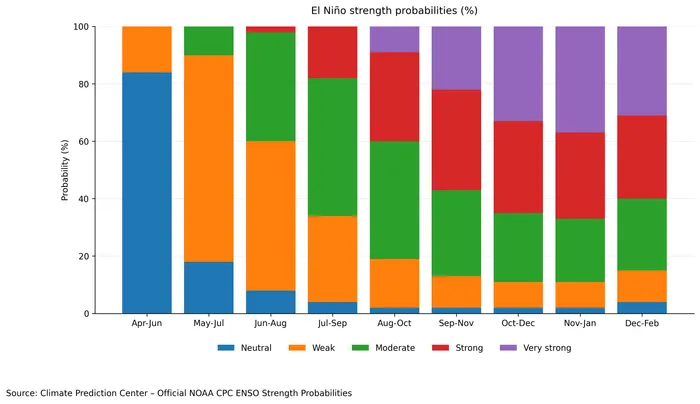
The probability of a high impact adverse weather cycle.
Image: MCB Group | Redrawn by ChatGPT
Agricultural economist Wandile Sihlobo has noted there could be agricultural-related risks during the next planting season.
"The expected El Niño weather phenomenon will impact the 2026-27 summer crop season, which we will plant from October 2026. Its impact on food price inflation will be more visible in 2027," Sihlobo said.
Sihlobo added that grain markets could begin pricing in drought risks before the full impact is felt. "By the end of 2026, we may start to see a slight uptick in grain prices if there are clear signs of a likely drought."
The potential inflationary impact extends beyond agricultural production. Sihlobo noted that higher fertiliser prices remain a concern for farmers, while fuel costs continue to play a major role in food prices because approximately 90% of South Africa's agricultural products and food are transported by road.
However, Sihlobo noted that South Africa remains in a strong position for now, with the country expected to record its largest-ever summer grain and oilseed harvest during the 2025-26 production season.
The latest estimates from the Crop Estimates Committee place the country's summer grain and oilseed harvest at 21 million tonnes, 3% higher than the previous season, supported by expanded plantings and favourable rainfall.
"Again, for now, we remain with ample food and agricultural supplies in South Africa," Sihlobo said.
This comes as the conflict in the Middle East is expected to wind down, with Bishop noting that this could bring relief at the fuel pumps and helping to contain inflationary pressures.
Bishop said a number of structural factors had helped limit increases in oil and petroleum product prices despite tensions in the Middle East.
These included weaker Chinese imports, increased petrol and diesel production by producers, OPEC+ quota increases, releases from strategic petroleum reserves and the growing use of alternative energy sources.
"The conflict in the Middle East region has seen some dampening down on reports from the US of a peace deal," Bishop said.
Iran has said no final agreement has yet been reached, but markets remain hopeful that a sustained decline in oil prices could translate into further reductions in South African petrol and diesel prices.
The impact of higher oil prices has already been felt across the economy.
Bishop said business confidence deteriorated sharply following the oil-price shock linked to the conflict, with 61% of businesses reporting dissatisfaction with prevailing conditions and profitability in the second quarter, up from 53% in the first quarter.
The confidence reading remained below the long-term average as businesses grappled with higher fuel costs and rising inflation.
Despite the volatility triggered by the conflict, South Africa's financial markets have recovered much of the losses recorded earlier this year.
"Volatility has been a feature for the bond, currency and equity markets, but they have regained a large part of March's losses, with further expected as the Middle East war ends on South Africa's improved investor climate," Bishop said.
IOL BUSINESS