


There are simple, yet effective, ways to keep your home warm this winter.
Image: ChatGPT
In many cases, South Africans can save more money by keeping heat inside their homes than by switching fuels or buying more powerful heating appliances. From electric blankets to door snakes, some of the cheapest winter upgrades can also be the most effective.
However, our previous analysis found that gas often remains cheaper than electricity for whole-home heating. For many households, the biggest savings may come from combining a more affordable heat source with simple measures that reduce the amount of heat needed in the first place.
Using the same theoretical 150m² three-bedroom home from our previous winter heating analyses, we examined which interventions deliver the biggest reductions in heating costs.
The results suggest that comfort and affordability do not necessarily have to be at odds.
The biggest saving comes from the bedroom.
In our earlier electricity-versus-gas comparison, three 400W panel heaters running overnight consumed approximately 288kWh of electricity a month. At an effective residential tariff of R3.20 per kWh, that equates to more than R920.
By comparison, three electric blankets used for two hours before bedtime consume only around 18kWh a month, costing roughly R58.
The difference is substantial. For households that rely on overnight bedroom heating, switching from panel heaters to electric blankets could reduce winter electricity costs by approximately R864 a month.
The reason is simple. An electric blanket heats the person directly rather than attempting to warm the entire room.

Here's how much you can save each month, depending on your home size, rooms, and the weather.
Image: ChatGPT
Many households have a spare bedroom, guest room or study that receives little use during winter.
In our model, a 400W panel heater running for eight hours each night consumed around 96kWh of electricity a month, costing approximately R307.
Simply turning off the heater and closing the door could eliminate that expense entirely. For larger homes with multiple unused rooms, the savings could be even greater.
Remote and hybrid work have become permanent features of life for many South Africans. Yet home-office heaters are easy to forget.
A 400W panel heater left running for an additional four hours each day after work consumes roughly 48kWh a month, adding around R154 to an electricity bill.
Unlike many energy-saving measures, the solution costs nothing. Switching off the heater before leaving the room immediately removes the expense.
Open-plan homes are popular for entertaining and family living, but they can be surprisingly expensive to heat.
A heater that is intended to warm a 30m² lounge often ends up heating adjoining dining rooms, kitchens and hallways as well.
In our model, increasing the heated area meant a 2kW oil heater needed to run for an additional two hours a day. That translated into approximately 120kWh of additional electricity consumption a month, costing around R384.
Closing doors, limiting the heated area and concentrating family activities in a single room can significantly reduce heating requirements.
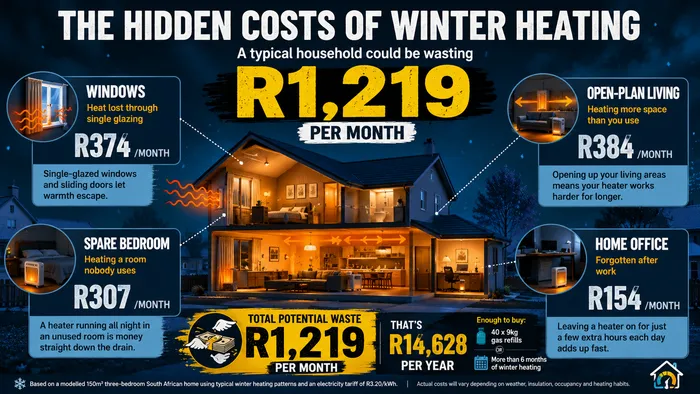
Here's how much electricity you could lose a month depending on your house size, the weather, and other relevant facts.
Image: ChatGPT
One of the biggest hidden costs identified in our previous analysis was heat escaping through windows and draughts.
Using a typical older South African home with single-glazed windows and a sliding glass door, we estimated that heat losses could be equivalent to roughly 117kWh of energy a month.
At current electricity tariffs, that represents around R374 worth of heat escaping through glass.
While replacing windows is expensive, smaller interventions can still help.
Closing curtains after sunset reduces heat loss through glass surfaces, while door snakes and weather stripping can reduce cold air entering through gaps beneath doors.
Combined, these measures could save households more than R200 a month in heating costs.
Fuel choice also matters. Our previous modelling found that heating a typical family home entirely with electricity cost around R2,285 a month.
Using a portable three-panel gas heater as the primary source of heating reduced that figure substantially in many parts of the country, particularly in warmer cities where heating demand is lower.
For households that spend most of their waking hours in a lounge or family room, gas can provide a cost-effective alternative to electric heating.
The findings suggest there is no single solution to winter heating costs.
Instead, the biggest savings often come from combining multiple small changes.
Heating occupied rooms rather than empty ones, reducing heat loss, using electric blankets and choosing the most appropriate fuel source can together save households hundreds, and in some cases more than a thousand rand, over the course of a winter month.
The cheapest way to stay warm this winter may not be buying another heater. It may simply be making better use of the heat you already have.
IOL BUSINESS