

As temperatures plunge across South Africa, many households focus on the obvious costs of staying warm: electricity bills, gas refills and the price of heaters.
Image: Freepic
As temperatures plunge across South Africa, many households focus on the obvious costs of staying warm: electricity bills, gas refills and the price of heaters.
But some of the biggest winter heating expenses have little to do with which heating appliance you use. South African households could be wasting more than R1,200 a month on winter heating without realising it.
From forgotten office heaters and unused bedrooms to draughty windows and open-plan living spaces, some of the biggest heating costs have little to do with the price of electricity or gas itself.
Using a model of a typical 150m² three-bedroom home, we found that common sources of heat loss and unnecessary heating could collectively add more than R1,200 a month to a winter energy bill.
The house consists of a 30m² open-plan lounge and dining room, a 13.5m² main bedroom, two 9.5m² bedrooms and a 9.5m² home office. The figure is illustrative and actual costs will vary depending on house size, weather conditions, occupancy and heating habits.
One of the most expensive mistakes may be heating rooms that nobody is using.
Take a spare bedroom fitted with a typical 400W panel heater. If the heater runs for eight hours a night throughout winter, it consumes about 96kWh of electricity a month. At an effective residential tariff of R3.20 per kWh, that translates into roughly R307 a month.
For many households, that is a room nobody sleeps in for most of the year. The same applies to home offices.
Remote and hybrid working have become permanent features of life for many South Africans. Yet it is easy to forget to switch off a heater after finishing work.
A 400W panel heater left running for an additional four hours a day consumes roughly 48kWh a month. That adds around R154 to a monthly electricity bill.
On their own, those costs may not seem excessive. Combined, however, a spare bedroom and a forgotten office heater could add more than R460 a month to winter heating costs.
Your electric blanket is costing less than you think to run. Here's the math.
Image: ChatGPT
The design of many South African homes creates another hidden expense.
Modern open-plan layouts are popular because they create larger living areas and improve natural light. During winter, however, they also increase the volume of air that must be heated.
A 2kW oil heater operating in a 30m² lounge may need to run significantly longer if fold-away doors are opened to adjoining spaces, effectively increasing the heated area from around 30m² to 50m² or more.
If that requires the heater to run for an additional two hours a day, electricity consumption rises by about 120kWh a month. At current tariffs, that amounts to approximately R384.
Run the math, it's cheaper to heat with gas.
Image: ChatGPT
Heat loss through windows can be even more costly. Many South African homes still rely on single-glazed windows and large sliding glass doors.
Using a typical older house with around 16m² of glazing, the difference in heat loss between single glazing and modern double glazing can exceed 480W on a cold winter evening.
Over an eight-hour period, that equates to almost 4kWh of additional energy. Over a month, the equivalent energy loss approaches 117kWh, representing roughly R374 worth of heating energy.
In effect, households may be spending hundreds of rand each month replacing heat that escapes through glass.
Smaller sources of heat loss also add up.
Gaps beneath exterior doors allow warm air to escape while drawing cold air into the home. Even modest draughts can force heating systems to work harder and remain on for longer.
Similarly, leaving curtains open after sunset allows warm indoor air to transfer heat to cold glass surfaces. Heavy curtains can help reduce those losses, although the savings are generally smaller than those achieved by addressing larger draughts and unused spaces.
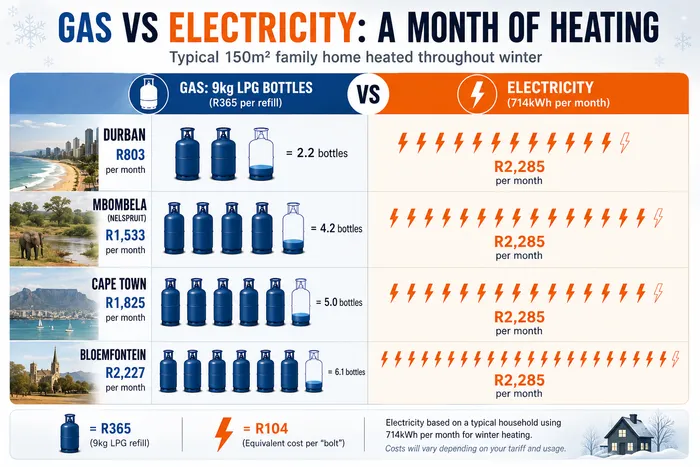
Perhaps the biggest surprise is how much heating demand comes from bedrooms. In our previous electricity-versus-gas comparison, overnight bedroom heating accounted for more than 40% of total household heating consumption.

How much for a 9kg gas bottle across South Africa.
Image: ChatGPT
Electric blankets provide an illustration of the difference.
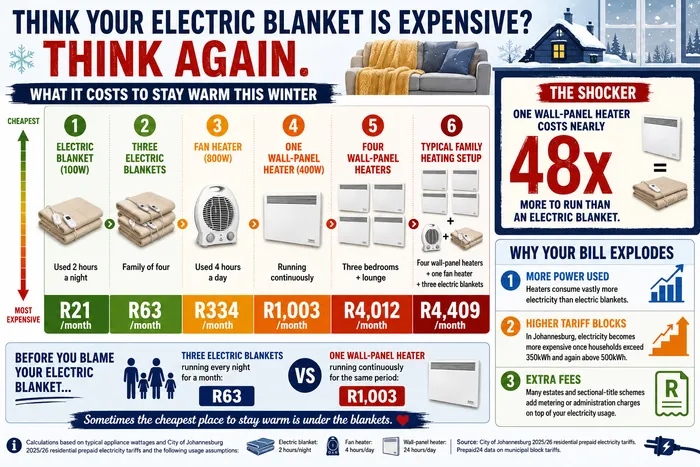
Three electric blankets used for two hours before bedtime consume about 18kWh a month, costing roughly R58. By comparison, three 400W panel heaters operating overnight consume around 288kWh, costing more than R920.
The comparison highlights a simple reality about winter heating. Many households focus on the cost of electricity or gas, but a significant portion of winter spending is often driven by behavioural choices, house design and heat loss.
In some cases, the cheapest way to reduce a heating bill may have little to do with changing energy sources and far more to do with stopping warmth from escaping in the first place.
IOL BUSINESS