


Earlier diagnosis, targeted interventions and sustained behaviour changes improve outcomes and reduce long-term risks.
Image: Freepik
South Africans are living longer and surviving serious illnesses at higher rates, Discovery Health data shows, although many also require years of ongoing treatment.
The result is a healthcare system increasingly shaped by a small group of members with complex medical needs, who account for a disproportionate share of spending.
Discovery Health says South Africans are living longer than they were a decade ago, but those extra years increasingly come with more complex health conditions that are reshaping healthcare demand and driving costs higher.
The company's HealthTrend2026 report found mortality among Discovery Health Medical Scheme members declined by 5.6% over the past decade, reflecting earlier diagnosis, improved treatment pathways and broader access to healthcare.
At the same time, more than half of members with chronic conditions now live with multiple overlapping illnesses, including cardiovascular disease, diabetes, cancer and mental health conditions.
The HealthTrend2026 Report by Discovery Health is based on more than 60 million life-years of clinical, lifestyle and behavioural data from Discovery Health Medical Scheme, covering over 2.7 million members.
Dr Ron Whelan, CEO of Discovery Health, says that the shift in the decline in the mortality rate and other health improvements is not accidental. Rather, “they reflect deliberate action across the system – earlier diagnosis, better clinical pathways, and focused support encouraging members to take control of their health,” he says.
“When the right care and the right behaviours come together, outcomes improve significantly,” says Whelan.
As mortality declines and life expectancy improves, healthcare demand is increasingly being driven by the long-term management of multiple chronic conditions.
“More members are living with chronic conditions over extended periods, reflecting better detection, treatment and long-term management. More than half of these members now live with multiple conditions, and those managing three or more have more than doubled,” the report said.
The report added that “cardiovascular disease, mental health conditions, diabetes and cancer dominate chronic care demand, together accounting for 84% of total chronic spend”.
The growing complexity of care is also concentrating healthcare spending among a relatively small number of members.
According to the report, the top 1% of Discovery Health Medical Scheme members, around 29,000 people, accounted for 33% of total healthcare spending in 2025, equating to almost R25 billion. The top 5% accounted for 63% of total healthcare spending, or nearly R47 billion.
These costs are largely driven by serious, often life-altering conditions such as cardiovascular disease and cancer, which together comprise a significant share of high-cost claims. Critically, many of these events are unpredictable, not confined to any age group, and can affect members at any stage of life.
“The value of a medical scheme is most evident in the moments members cannot anticipate,” says Dr Whelan. “Serious illness and major health events occur without warning. What matters is that members have access to the care they need and the financial protection required to safely navigate these events.”
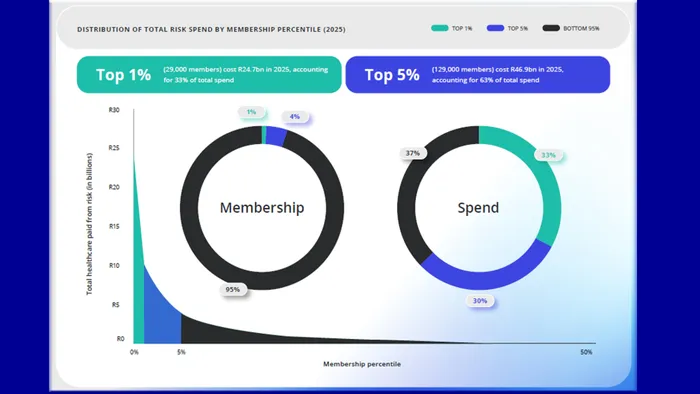
According to the report, the top 1% of Discovery Health Medical Scheme members, around 29,000 people, accounted for 33% of total healthcare spending in 2025.
Image: Discovery Health
The report found that mental health is emerging as one of the fastest-growing areas of healthcare demand.
Among members aged 18 to 30, the prevalence of mental health conditions increased by 80% over the past decade, with one in seven young adults now claiming for mental health conditions.
Discovery said the increase reflects improved access to care and earlier intervention rather than growing severity.
“This is one of the most important changes we are seeing in the data,” says Dr Ron Whelan. “More members, especially younger adults, are seeking help earlier. That is a positive shift. When mental health is identified and supported alongside physical health, outcomes improve and avoidable escalation is reduced.”
Whelan did note, however, that care for people with such illnesses “must shift earlier and become more preventive”.
Meanwhile, cancer outcomes improved substantially. Cancer mortality declined by 48% over the past decade, while life expectancy for oncology-registered members increased by 7.1 years.
“Earlier detection and better therapies are improving cancer outcomes in a way we have not seen before,” says Dr Whelan. “The focus is to continue advancing cancer care while ensuring long-term sustainability of access.”
Discovery argues these trends illustrate what it calls a "prevention dividend", where earlier diagnosis, targeted interventions and sustained behaviour changes improve outcomes and reduce long-term risks.
IOL BUSINESS