

Geopolitical risk is now a more important factor than it has been at any point in his career, central bank governor, Lesetja Kganyago, has said.
Image: ChatGPT
South Africa's economy delivered an unexpectedly strong start to 2026, with growth accelerating in the first quarter as agriculture rebounded, financial services expanded and nine of the country's 10 major industries recorded growth.
Gross domestic product (GDP) increased by 0.5% in the three months to March, up from 0.4% in the final quarter of 2025 and ahead of most economists' expectations. The year-on-year figure was 1.9%.
"The first quarter data, which largely predates the escalation of the Iran conflict and the associated oil price spike, showed relative resilience," said Shireen Darmalingam, economist at Standard Bank.
Ahead of the release of the numbers, Vishal Rama, Portfolio Manager at Prescient Investment Management, expected a modest expansion of around 0.2% to 0.4% quarter on quarter.
Johann Els, PSG Group senior economist, had forecast growth of 0.3% for the quarter.
Statistics South Africa's data showed the finance industry, the largest sector in the economy, was the biggest contributor to growth, expanding by 0.9% and adding 0.2 percentage points to overall GDP.
Agriculture grew by 3.9%, while trade and transport both expanded by 0.7%. Manufacturing was the only sector to contract, declining by 0.8%.
Agriculture's performance was particularly notable after a volatile period for the sector. Statistics South Africa attributed the increase primarily to stronger activity in field crops and horticulture products.
Darmalingam said favourable weather conditions had provided an additional boost during the quarter. "Performance in some sectors was supported by idiosyncratic factors. Notably, growth in the agricultural sector benefited from favourable weather during the quarter."
Els said, “agriculture was a little bit stronger than expected”. He added that the breadth of the growth was one of the most encouraging aspects of the report.
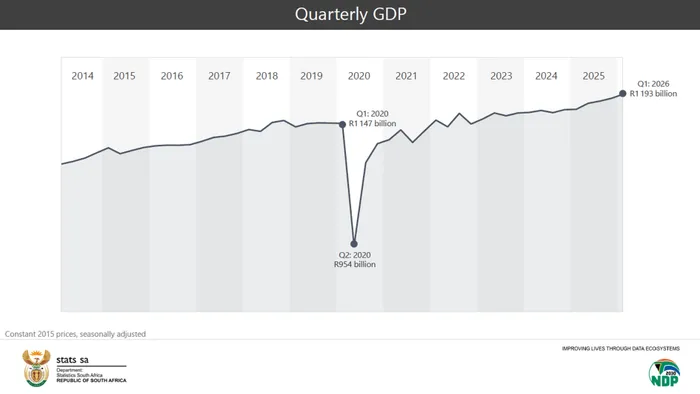
Quarterly gross domestic figures as per Statistics South Africa.
Image: Statistics South Africa
Manufacturing production had been expected to be negative, said Els. “Surprisingly, there was only one negative industry recorded when you look at GDP from the production side of the economy."
While mining's 0.7% growth was broadly anticipated given production trends during the period, Els said construction, trade, transport and finance all performed better than expected.
The finance sector's growth was particularly important because of its outsized role in the economy, said Els. "The financial sector, the biggest sector in the economy, was a nice positive contributor to the number."
The expenditure side of the economy painted a more mixed picture.
Household spending, which remains the largest component of GDP, grew by just 0.1% during the quarter. Government consumption rose 0.6%, while gross fixed capital formation, a key measure of investment, declined by 1.1%, Statistics South Africa’s data shows.
Darmalingam expects the conflict in the Middle East and the resulting increase in fuel prices to weigh on growth in the months ahead.
"Business confidence has already deteriorated in the second quarter, and we expect mounting pressure on consumers who were already under strain prior to the fuel price shock."
Darmalingam said higher fuel prices and interest rates were likely to worsen conditions from the second quarter onward, although South Africa continued to benefit from favourable terms of trade and ongoing structural reforms.
Els remains more optimistic than the consensus view, maintaining a forecast of 1.3% growth for 2026, up from about 1.1% last year. He expects the second quarter to reflect the impact of the conflict and higher fuel costs but believes easing structural constraints and stronger leading indicators should support activity later in the year.
“We now know that the second quarter will likely have a significant, negative, impact due to the war,” said Els, which he attributed to higher fuel prices while noting that sentiment was turning negative.
Last month, the South African Reserve Bank lowered its expectations for economic growth for the year, although it didn’t indicate the precise figure in the Monetary Policy Statement.
Recently, central bank governor, Lesetja Kganyago, said: “Looking at our economic outlook, I can tell you that geopolitical risk is now a more important factor than it has been at any point in my career.”
IOL BUSINESS