

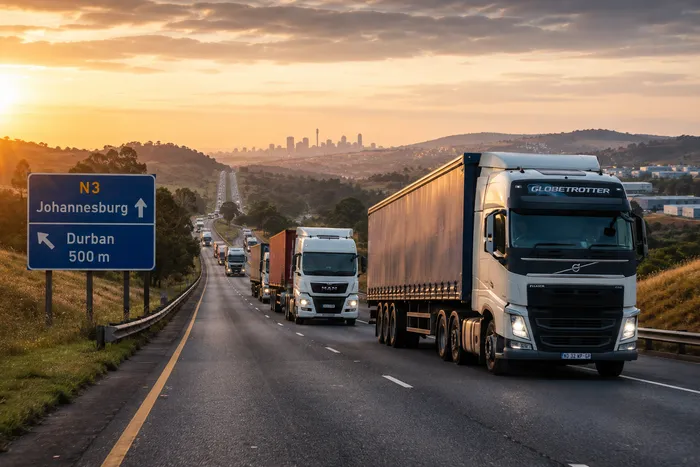
National Treasury has warned that logistics bottlenecks, weak public infrastructure and the outbreak of foot-and-mouth disease remained risks to the outlook.
Image: ChatGPT
South Africa's economic growth outlook has weakened in recent months, with business confidence falling sharply and economists lowering their forecasts as higher fuel costs, inflation pressures and global uncertainty weigh on the economy.
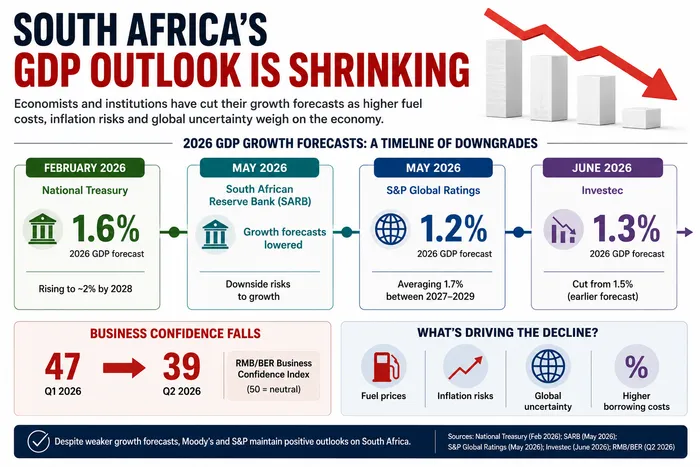
The latest sign came this week when Investec revised its 2026 gross domestic product (GDP) growth forecast lower to 1.3% from 1.5%, citing the impact of higher oil prices on the trade account as well as weaker investment prospects.
The downgrade comes as the RMB/BER Business Confidence Index fell to 39 in the second quarter from 47 previously, remaining below the neutral 50 level that separates optimism from pessimism.
According to Investec, the survey was conducted between 14 and 25 May, after two monthly fuel price increases totalling R6.33 a litre for petrol and R13.52 a litre for diesel but before the diesel decline this past Wednesday, although petrol did increase by R1.43 a litre.
Investec said realised business conditions deteriorated sharply to negative 24 from negative 3, while expected business conditions dropped to negative 24 from 4 amid uncertainty and rising fuel prices.
Confidence in Gauteng fell to 26 from 41, while confidence among new vehicle dealers dropped to 49 from 67. Manufacturers were the only sector to record an improvement, although confidence remained in depressed territory at 31, up marginally from 30.
With another petrol price increase expected at the time the survey was compiled, businesses became increasingly concerned about the impact of higher transport and operating costs on economic activity.
“Interest rate hikes, with one this month and another expected in July, will impact consumers with a lag of up to two years, without a reversal in the rise in borrowing costs, and consumer sentiment has been affected,” said Investec chief economist Annabel Bishop.
The weaker outlook follows warnings from the South African Reserve Bank in May that growth forecasts had been lowered because of rising global uncertainty and pressure on household disposable income.
The central bank said higher fuel prices and weaker household finances were expected to weigh on both consumer spending and investment, which it identified as key drivers of growth.
"Growth forecasts for South Africa have been lowered amid higher global uncertainty and reduced disposable income," the South African Reserve Bank governor Lesetja Kganyago said in May.
The bank also cited severe flooding in parts of the Western Cape, Eastern Cape and North West as a risk to economic activity, while noting that the increasing frequency of extreme weather events highlighted the threat posed by climate change.
Despite the challenges, the Reserve Bank said South Africa's economy remained intact, supported by ongoing reforms and favourable export prices.
South Africa's economic outlook is on a downward trendline.
Image: ChatGPT
The more cautious tone marks a shift from National Treasury's outlook in February. At the time, Treasury projected economic growth of 1.6% in 2026, improving from an estimated 1.4% in 2025 and rising to 2% by 2028.
Treasury nevertheless warned that logistics bottlenecks, weak public infrastructure and the outbreak of foot-and-mouth disease remained risks to the outlook.
In May, S&P Global Ratings forecast South Africa's economy would grow by 1.2% in 2026 before averaging 1.7% between 2027 and 2029 as structural reforms gradually support economic activity.
Moody's, which recently assigned a positive outlook to South Africa's sovereign credit rating, expects growth to improve gradually to around 2% by 2028.
Both ratings agencies have noted that stronger economic growth will be needed to reduce unemployment and ease ongoing social pressures.
While growth expectations have softened, South Africa continues to benefit from positive outlooks from two major credit rating agencies, reflecting confidence in fiscal discipline and the country's reform programme.
Investec noted that government finances are unlikely to be directly affected by fuel levy relief measures, although weaker economic growth and higher inflation could weigh on revenue collection.
For now, economists and businesses appear aligned on one point: higher fuel costs, elevated uncertainty and slower growth are likely to make trading conditions more challenging during the remainder of 2026.
IOL BUSINESS