

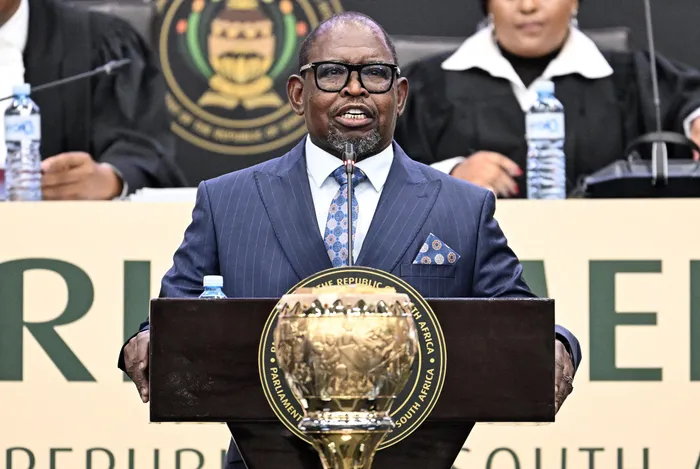
Finance minister Enoch Godongwana needs to steer South Africa through another fiscal shock.
Image: GCIS
Rising oil prices linked to escalating tensions in the Middle East are once again putting pressure on South Africa’s economy, reviving a familiar pattern of external shocks feeding through to inflation, the rand and household costs.
In April, government responded by lowering the tax on the price of fuel by R3 a litre at a cost of R6 billion to the fiscus. Even though the situation seems to have stabilised somewhat with oil coming off and the rand relatively stronger, another government buffer would further impact revenue collection.
For the year to March, the South African Revenue Service collected a record net revenue of R2.010 trillion, exceeding the National Treasury’s estimate. This historic milestone represents 8.4% growth, driven by strong corporate tax and VAT collections.
SARS aims to collect R2.127 trillion in the following financial year, representing a projected growth of 5.8%.
This is not the first financial shock South Africa has needed to deal with.
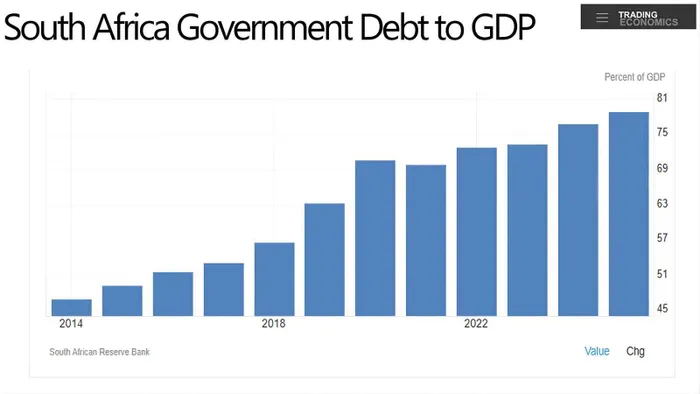
South Africa's debt-to-GDP ratio is expected to come under control in the medium-term.
Image: Trading Economics
Since 1994, the economy has weathered a series of global and domestic shocks, from the Asian financial crisis and early-2000s rand collapse to the global financial crisis, policy missteps such as the 2015 Nenegate episode, ratings downgrades, the Covid-19 pandemic and, more recently, the ongoing energy crisis.
Each has tested the country’s fiscal position. What has changed is how much room there is to respond.
In the late 1990s, South Africa was hit by the Asian financial crisis, which triggered capital outflows from emerging markets and sharp currency volatility. This was followed by the early-2000s rand crisis, when the currency weakened significantly amid global uncertainty and domestic pressures.
At the time, the country was still building its post-apartheid macroeconomic framework.
Under Trevor Manuel, government focused on fiscal discipline, reducing debt and establishing policy credibility.
This approach proved critical during the 2008 global financial crisis, when relatively low debt levels allowed for counter-cyclical spending without undermining investor confidence.
The period after the global financial crisis marked a shift.
During his tenure, Pravin Gordhan sought to stabilise public finances, but growth slowed and debt levels began to rise. The eurozone crisis and domestic labour unrest, including prolonged mining strikes, added to economic pressure in the early 2010s.

The removal of Nhlanhla Nene and his brief replacement by Des van Rooyen triggered a sharp market reaction.
Image: Joshua Roberts | Reuters
The fragility of the fiscal position became more apparent in 2015.
The removal of Nhlanhla Nene and his brief replacement by Des van Rooyen triggered a sharp market reaction, with the rand weakening and bond yields spiking.
The episode, widely referred to as Nenegate, highlighted the impact of policy uncertainty on investor confidence and marked a turning point in South Africa’s fiscal trajectory.
Although Pravin Gordhan was reappointed shortly afterwards and moved to restore stability, the economy remained under pressure.
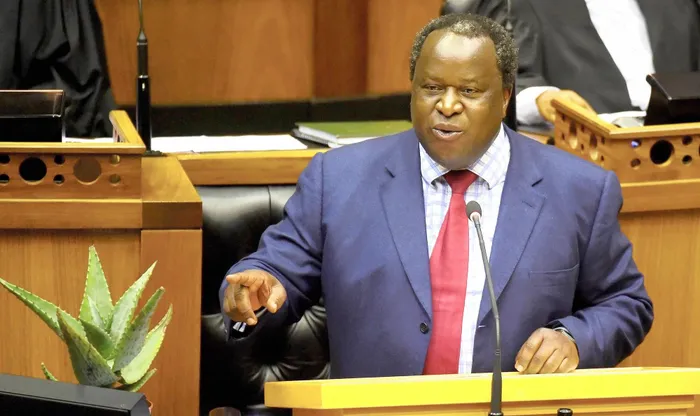
Former finance minister, Tito Mboweni died an unhappy man following the establishment of the Government of National Unity.
Image: Phando Jikelo | African News Agency
This was followed by South Africa’s downgrade to junk status in 2017 under Malusi Gigaba, which raised borrowing costs and reduced fiscal flexibility.
By the time Tito Mboweni took office, the focus had shifted to stabilisation in a low-growth environment. The COVID-19 pandemic forced a sharp expansion in government spending, with a large fiscal support package introduced to cushion the economic collapse.
This helped limit the immediate impact but pushed debt significantly higher.
Gross government debt has climbed to about 74% of gross domestic product, more than double the levels seen in the early 2000s, according to National Treasury.
The consolidated budget deficit is projected to narrow from 4.5% of gross domestic product in 2025/26 to 3.1% by 2028/29, as government continues efforts to stabilise public finances, National Treasury said.
Gross loan debt is expected to stabilise at 78.9% of GDP this year, while debt-service costs are projected to rise in nominal terms from R420.6 billion in 2025/26 to R469.3 billion by 2028/29, before easing slightly as a share of revenue, National Treasury said.
Under Enoch Godongwana, fiscal policy has centred on consolidation, supported in part by commodity-driven revenue gains. However, structural constraints, including electricity shortages and logistics bottlenecks, continue to weigh on growth.
At the same time, the ongoing energy crisis has become a defining domestic shock, reducing economic output and increasing costs for businesses and households.
This leaves South Africa more exposed to external pressures.
Higher oil prices feed directly into fuel costs, which in turn affect transport, food prices and broader inflation. This raises the likelihood of tighter monetary policy and places additional pressure on already strained households.
Where previous shocks were absorbed from a position of fiscal strength, current pressures are being managed with tighter constraints and less policy flexibility.
IOL BUSINESS