

The local currency's movements are heavily dependent on external factors.
Image: ChatGPT
While the rand has steadied in recent days, its recent movements highlight how quickly sentiment can shift in response to global developments.
After sharp volatility following the escalation of the Iran war in late February, the currency has traded in a narrower range thanks to truces – albeit fragile – in the Middle East, hovering around R16.40 against the US dollar.
“It's been a quiet few days for the rand, with fewer trades than usual keeping it stuck in a tight range,” says Wichard Cilliers, head of Market Risk at TreasuryONE:
This relative calm follows weeks of heightened uncertainty, during which the currency saw more pronounced swings as global risk sentiment deteriorated.
Trading Economics data shows the currency vacillating between R16.50 a few days after war broke out before hitting more than R17 to the greenback and then stabilising at the current range over the past few days.
The website noted that the onset of the conflict triggered a risk-off response from investors, driving increased volatility in the rand as markets reacted to shifting expectations around oil prices, inflation and global growth.
As tensions escalated, South Africa’s exposure as a net oil importer became more evident, with higher energy prices feeding into concerns around inflation and the broader economic outlook.
More recently, sentiment has begun to stabilise.
Investec chief economist Annabel Bishop said this shift is also reflected in market indicators.
“The one-month implied volatility for the rand against the US dollar is at a six-week low, nearing the territory at the start of the war, as market optimism increases as the ceasefire holds and financial market indicators see incremental gains,” she said.
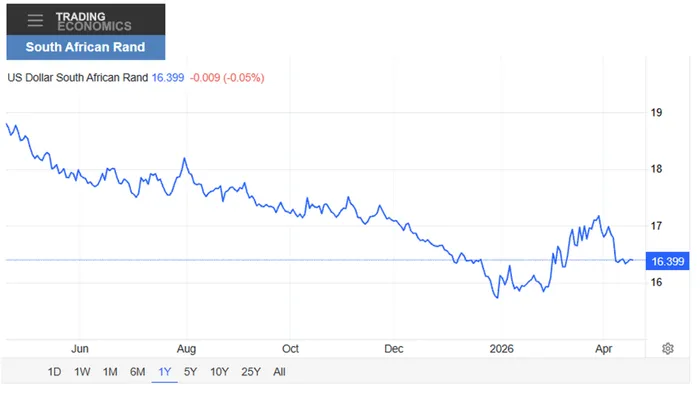
The rand has recently stabilised to around R16.40 on the back of signs that the Middle East war could temper.
Image: Trading Economics
The rand has held close to its strongest levels since early March, supported by a weaker US dollar and elevated precious metals prices, reflecting renewed optimism around a potential resolution to the conflict, Trading Economics said.
This suggests that, while uncertainty remains, markets have begun to price in a more stable near-term outlook, at least relative to the sharp swings seen earlier in the conflict.
Oil prices, a key transmission channel for the rand, have also eased from earlier highs.
Brent crude has declined from around $112 per barrel to about $94, although it remains well above pre-conflict levels of roughly $65, Bishop said.
The moderation in oil prices, together with a firmer rand has helped to reduce pressure on local fuel price under-recoveries, which had surged in the early stages of the conflict.
“South Africa is currently in line for further fuel price increases, but is only halfway through the month, with the final under-recoveries crucial for the fuel price change on 6 May, and so too for that month’s inflation figures and interest rate decision,” said Bishop.
With the declining oil and international gasoline prices, the under recovery in South Africa’s fuel prices has continued to diminish and is now below R3.00/litre for petrol, at R2.80/litre, and R8.51/litre for diesel with a stronger rand, said Bishop.
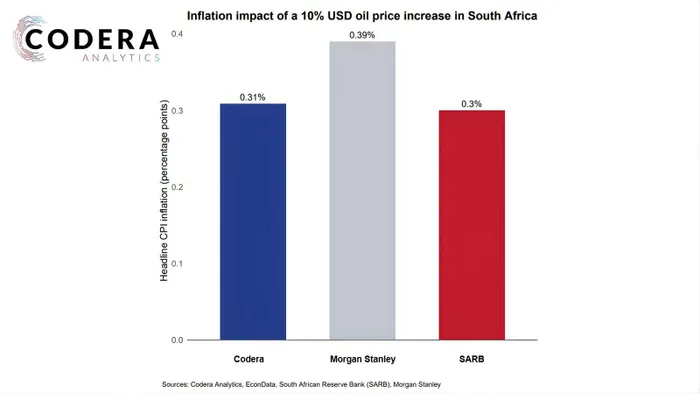
Codera Analytics, estimates that a 10% increase in the US dollar price of oil raises headline inflation by about 0.3 percentage points.
Image: Codera Analytics
However, the easing in prices does not remove the broader risk to inflation.
“Global tensions and elevated fuel costs have clouded South Africa’s inflation outlook, increasing the risk of broader inflationary pressures in the coming months that could influence the trajectory of interest rates,” said Trading Economics.
Jurgens Fourie, a data scientist at Codera Analytics, estimates that a 10% increase in the US dollar price of oil raises headline inflation by about 0.3 percentage points over time, highlighting the sensitivity of inflation to energy costs.
This relationship underscores how movements in global energy markets continue to feed directly into domestic price pressures, even when the rand itself appears relatively stable.
Bishop expects consumer inflation to rise to around 3.6% this year, above the central bank’s target midpoint, largely due to higher fuel costs stemming from the conflict.
This is feeding into expectations for interest rates, with markets currently pricing in at least one 25 basis point increase this year, and the possibility of a second later in the year, although Bishop noted that forward rate agreements can be volatile.
In this context, the rand’s stability is closely tied not only to global sentiment, but also to how inflation and monetary policy expectations evolve in response to energy prices.
Despite the recent stabilisation, external structural risks remain.
Lisette IJssel de Schepper, chief economist at the Bureau for Economic Research, said that even if tensions ease, energy markets are unlikely to normalise quickly.
IJssel de Schepper noted that infrastructure damage, particularly to liquefied natural gas facilities, could take years to repair, while hundreds of ships remain stuck in the Strait of Hormuz, creating logistical backlogs that will take time to clear.
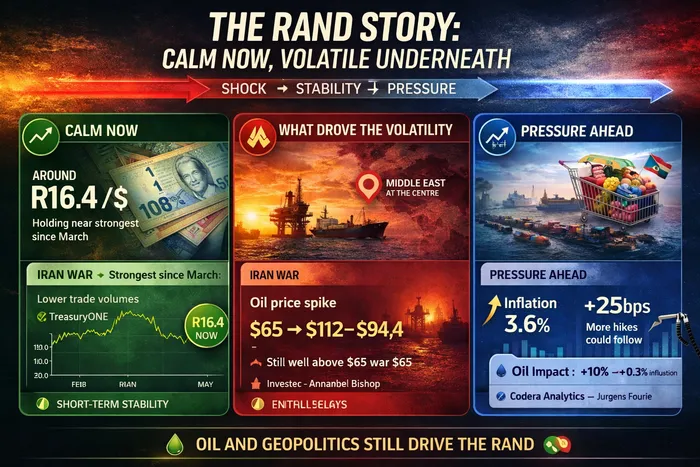
The story behind the rand's recent movements.
Image: ChatGPT
Oil supply recovery is expected to be gradual, as production needs to be brought back online and constraints around storage, transport and insurance persist, keeping markets tight and price volatility elevated, said IJssel de Schepper.
This suggests that even in a de-escalation scenario, the conditions that drove recent volatility may take time to unwind.
“As a result, even in a de-escalation scenario, supply is likely to recover only gradually, keeping energy markets tight and price volatility elevated for some time. Renewed hostilities – or even a late-night social media post - could easily turn the more positive sentiment around,” said IJssel de Schepper.
While the rand has found some footing for now, its recent movements reflect a broader reality: stability remains fragile, and global factors, particularly oil prices and geopolitical developments, continue to play a decisive role in shaping its path.
IOL BUSINESS