


Market commentators are hoping to see an improvement in South Africa's finances when Finance Minister Enoch Godongwana presents the National Budget on Wednesday.
Image: ChatGPT
South African markets are entering National Budget week on a cautiously stable footing, supported by improving fiscal expectations, softer inflation and the extraordinary rise in gold prices, analysts and economists said ahead of Finance Minister Enoch Godongwana stepping up to the podium on Wednesday.
The Bureau for Economic Research (BER) said the broader tone remains measured. “Markets head into budget week in a cautiously constructive mood,” it said.
BER added that “softer inflation, a firmer rand and a commodities windfall have improved the near-term fiscal picture and eased pressure on borrowing costs”.
The medium-term picture also helps explain the mood. Over the past five years, global gold prices have more than doubled, the JSE has delivered strong gains despite volatility, and the rand has weathered repeated shocks linked to global rate cycles, commodity swings and domestic risk events.
Against that backdrop, Wednesday’s National Budget is expected to show a slightly better fiscal trajectory than previously projected.
Wichard Cilliers, head of Market Risk at TreasuryONE, said economists are looking for National Treasury to outperform its earlier deficit forecasts.
“South Africa’s Budget on Wednesday is expected to deliver a slightly better fiscal picture than previously projected,” said Cilliers.
Cilliers explained that economists want National Treasury to improve the gross domestic product deficit as well as move towards stabilising debt sooner rather than later.
“There’s also an expectation that government will hit its goal of stabilising debt this fiscal year, helped by stronger-than-expected revenue, with high gold and precious-metal prices giving the tax take a lift,” he said.
Shaheed Patel, consultant in Tax and Exchange Control, and Dehal Jivan, candidate attorney at CMS South Africa, said debt stabilisation remains Treasury’s primary objective.
“Government’s primary objective remains the stabilisation of national debt, which is projected to peak at 77.9% of gross domestic product for 2025/2026,” they said.
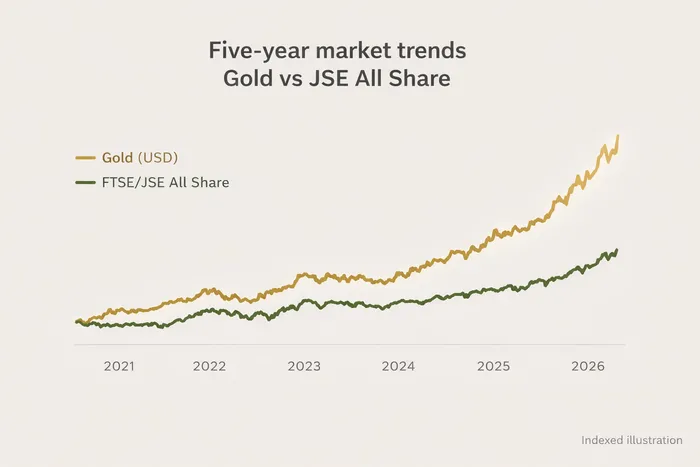
Both the JSE and gold have rallied over the past five years.
Image: ChatGPT
Gold’s rally has boosted mining profits, lifting corporate income tax and royalty flows to the state, said Kristof Kruger, senior fixed income trader at Prescient Securities.
“Heading into Budget 2026, we expect a broadly investor-friendly tone – but this year there is a clear swing factor: gold,” said Kruger.
Kruger added that “the sharp rally, with spot prices above $4,900 per ounce, has likely boosted mining tax receipts, corporate income tax, royalties and South African Reserve Bank reserve valuations”. This, he said, was “a buffer Treasury simply did not have a year ago”.
A higher gold price improves export earnings and increases the value of reserves held by the South African Reserve Bank, indirectly supporting the country’s financial position.
Markets are also alert to potential policy adjustments.
“Markets will watch closely for signals on capital flow rules, investment conditions and the broader reform agenda.”
If the fiscal numbers land near expectations, ratings agencies could respond positively.
“Most economists surveyed see Fitch potentially shifting South Africa’s outlook to positive at its next review, with a smaller group expecting the same from Moody’s,” said Cilliers, referring to the two ratings agencies that haven’t yet revised South Africa’s investment grade.
Last year, S&P upgraded the country’s investment grade – making it more attractive and immediately boosting the rand – for the first time in more than two decades.
Pate and Jivan said investor confidence has strengthened.
“This shift was further validated by a credit rating upgrade from S&P,” they added, referring to S&P Global Ratings.
Equity markets have shown a mixed but generally positive trend.
Bianca Botes, director at Citadel Global, said on Friday – days ahead of the National Budget – that the JSE remained constructive despite softer daily moves.
“South African equities were softer on Thursday but constructive on the bigger trend,” said Botes. She added that performance has varied across sectors.
“The JSE has been rotating – strength in industrials, financials, telecoms and retailers offset by resources – with attention now on the 25 February Budget,” said Botes, referring to the FTSE/JSE All-Share Index.
IOL BUSINESS