


Children are often exposed to multiple forms of exploitation during the human trafficking process.
Image: Freepik
Human trafficking has become one of the most deeply entrenched criminal enterprises in South Africa.
Estimates suggest that as many as 250,000 people may have fallen victim to human trafficking in the country, according to a Human Sciences Research Council study.
The Global Slavery Index estimates that about 155,000 people are living in modern slavery conditions, which include trafficking, forced labour and sexual exploitation.
Unlike counterfeit goods or other illicit markets, human trafficking does not leave obvious physical evidence.
Instead, it relies on exploitation that is deliberately hidden, making the true scale of the crime difficult to measure.
Researchers and law-enforcement agencies consistently warn that official figures capture only a fraction of what is occurring.
South Africa is classified as a source, transit and destination country for human trafficking.
Victims are recruited locally, trafficked within the country, and moved across borders into and out of South Africa.
This positioning reflects the country’s role as a regional economic hub, as well as its porous borders and high levels of inequality.
Human trafficking typically involves the exploitation of people through force, fraud or coercion for purposes such as forced labour, sexual exploitation, domestic servitude and child trafficking.
Victims are often recruited through promises of legitimate employment, education opportunities or romantic relationships, only to find themselves trapped in exploitative situations.
As with other illicit markets, economic vulnerability is a central driver.
High levels of poverty, unemployment and inequality increase susceptibility to traffickers, particularly among women, children and migrants.
Recruitment increasingly takes place through informal networks and social media platforms, where false job offers and deceptive relationships are used to gain trust.
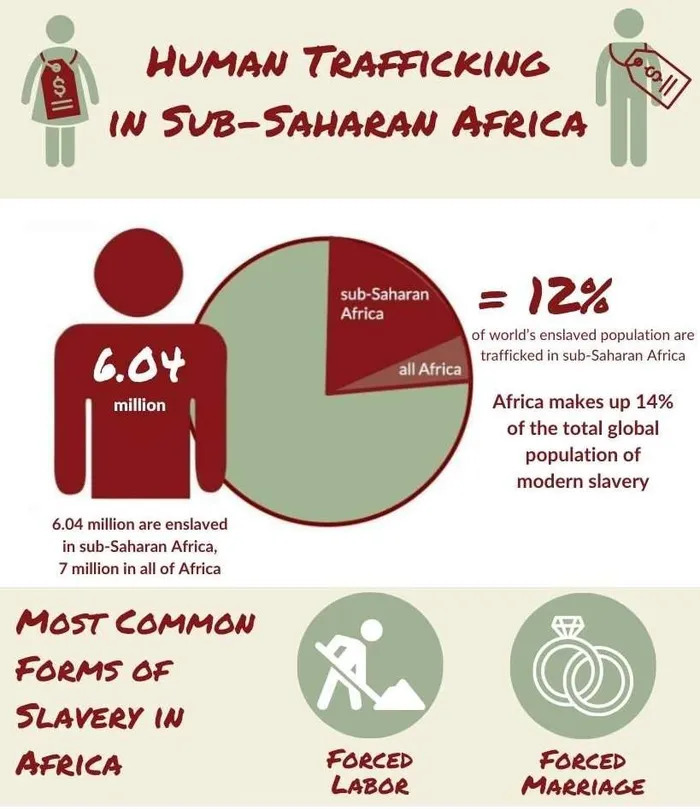
Human trafficking in sub-Saharan Africa.
Image: asec-sldi.org
In some cases, traffickers promise lucrative telesales, data capturing, or call centre jobs in Thailand, but the hiring process is far from legitimate.
Instead, recruiters conduct informal interviews through WhatsApp video calls and text messages, creating a false sense of security, the 2024 National Human Trafficking Hotline report said.
“To further entice victims, traffickers cover the costs of passports, visas, flights, and even ‘accommodation’.”
Children are particularly vulnerable within this system.
“Children are often exposed to multiple forms of exploitation during the trafficking process. Reducing the vulnerability of children should be afforded more attention,” Dr Monique Emser of the University of KwaZulu-Natal has said.
Academic research from the University of South Africa indicates that women and children make up the majority of identified victims, although men are also trafficked, particularly for forced labour.
Data suggests that around 55.5% of identified victims are female and 44.5% male, with many victims falling within the 10-to-25-year-old age group.
The 2024 National Human Trafficking Hotline report provides more specific insight into reported cases: women accounted for 94.5% of reported victims, while sexual exploitation made up 61.8% of reported cases.
The same data showed that 69.1% of identified victims were South African nationals, challenging the perception that trafficking primarily affects foreign nationals.
Cross-border trafficking nonetheless remains a significant feature. Victims identified in South Africa have come from countries including Mozambique, Zimbabwe, Malawi, Zambia, Nigeria, eSwatini and the Democratic Republic of Congo, USAID data has shown.
Emser has noted that “human trafficking is prevalent throughout the Southern African region, and South Africa remains an attractive destination for transnational victims”.
South Africa’s transport networks, border crossings and urban centres make it a key node in regional trafficking routes.
The National Human Trafficking Hotline lists Cape Town, Johannesburg, and Durban as among the top cities where trafficking activity is most frequently identified.
Victims may be exploited in sectors such as agriculture, construction, domestic work, informal trading and the sex trade, often in environments that are difficult for authorities to monitor.
According to experts, trafficking does not occur in isolation but overlaps with other forms of crime and social harm.
“The collection of evidence from these sources indicates that human trafficking is indeed a serious, pervasive and systemic problem in South Africa that seamlessly intersperses with other crimes and social phenomena," a USAID report on human trafficking in South Africa found.
This, it noted, included gender-based violence, prostitution, organised crime, missing persons, irregular migration, child abuse and labour disputes, to name a few.

Human trafficking in sub-Saharan Africa.
Image: asec-sldi.org
The hidden nature of the crime makes detection and prosecution particularly challenging. According to USAID, between 2007 and 2022, South Africa recorded only 77 convictions of traffickers, despite estimates suggesting hundreds of thousands of victims over that period.
South Africa does have a legislative framework criminalising human trafficking. The primary legal instrument for combating trafficking is the Prevention and Combating of Trafficking in Persons Act.
Yet, investigations are complex, victims are often fearful of reporting abuse, and cases frequently collapse due to lack of evidence or coordination between agencies. “A primary difficulty is gathering sufficient admissible evidence,” said LegalClarity.
Researchers and civil-society organisations have pointed to under-reporting, weak data collection and limited specialist capacity within law-enforcement agencies as key constraints.
The United States Trafficking in Persons Report has previously noted that South Africa does not fully meet the minimum standards for the elimination of trafficking, despite efforts to increase investigations, prosecutions and international cooperation.
Weak data systems continue to hamper a clear understanding of the scale and patterns of the crime.
Organised criminal networks play a central role in sustaining trafficking operations. Trafficking is driven by high profits and relatively low risk.
Victims can be exploited repeatedly over long periods, generating ongoing income for traffickers, while the likelihood of detection and conviction remains limited.
The impact of human trafficking extends well beyond individual victims. It places pressure on social services, undermines labour protections, distorts legitimate economic activity and erodes confidence in the state’s ability to protect vulnerable communities.
In this sense, trafficking functions as both a human rights violation and an economic crime.
As with other illicit markets, addressing human trafficking requires more than legislation alone
Operating largely out of sight, human trafficking continues to thrive alongside illegal cigarettes and illicit alcohol – profitable, adaptable and difficult to dismantle.
IOL BUSINESS