


South Africans have endured a prolonged period of economic strain.
Image: Vitaly Gariev | Uspash
Financial pressure is increasingly taking a toll on South Africans' mental health and home life as rising living costs and mounting debt leave many households struggling to cope.
DebtBusters' fifth annual Money Stress Tracker found that home-life stress has reached its highest level since the survey began, with home life stress hitting 42%; up by more than a third compared to 2025, and the highest recorded level since the survey started in 2022.
“We think this is an important indicator of acute stress in terms of how much of your money is coming in and going out almost immediately,” said Benay Sager, executive head of DebtBusters.
Overall, 72% said they were experiencing financial stress, which is a slight decrease from last year – a trend that has continued since 2023 when this level was at 78%. Sager pointed out during a conference call that this was the time of “infamous load shedding” and high inflation, especially on food.
Clinical psychologist Andrea du Plessis said prolonged financial pressure had evolved from an occasional challenge into a chronic psychological burden. "Financial stress is no longer an occasional challenge – it has become a constant psychological state," she said.
Du Plessis said chronic financial pressure could impair concentration, decision-making and emotional regulation, while many people remained in a heightened state of alert even when they were not actively dealing with bills or debt.
"When we bring it into the home that is supposed to be our sanctuary, our safe space, then we don't have any space anywhere that we feel safe," she said.
Du Plessis added that “safety as such is not just only that we feel safe at home or at work, but also internally. If we don't feel psychologically safe internally, then that is quite a problem”.
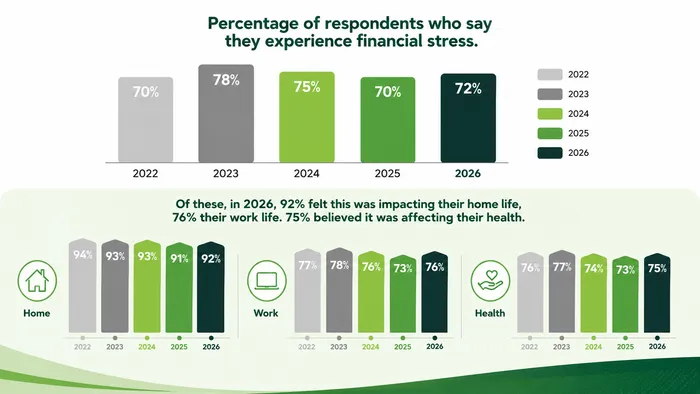
DebtBusters' fifth annual Money Stress Tracker found that home-life stress has reached its highest level since the survey began.
Image: DebtBusters (redrawn by AI)
The survey also found that more than half of the 18,000 respondents were spending more than 40% of their take-home pay servicing debt, up five percentage points from last year – a figure DebtBusters says is generally regarded as unsustainable as this leaves consumers with little room to cope with rising living costs or unexpected expenses.
DebtBusters’ index follows a National Debt Counselling Association (NDCA) saying rising living costs and debt repayments are leaving many households with little or no disposable income to save.
The association's warning is reflected in TransUnion's latest Consumer Pulse Study, which found that 39% of South Africans expect to miss at least one bill or loan repayment.
At the same time, the cost of living has overtaken interest rates as the biggest source of financial anxiety. Concerns about inflation rose 28% over the past year, while worries about electricity costs almost doubled, increasing by 99%, reflecting the growing pressure on household budgets.
The problem was not poor financial discipline but negative cash flow, where essential monthly expenses such as housing, vehicle finance, insurance, school fees, municipal accounts and debt repayments exceeded monthly income, said NDCA chairperson René Moonsamy.
The survey found younger South Africans continued to report the highest levels of financial stress, while women were more likely than men to say money worries were affecting their wellbeing.
Three-quarters of respondents aged under 35 years say they are anxious or stressed about their finances, while the survey attributed high stress among women to the need to prioritise more immediate concerns, such as being emotional caretakers. Home-life stress for women has reached a five-year high.
Sager said the findings reflected the cumulative impact of several years of financial pressure on household finances.
"South Africans have endured a prolonged period of economic strain, with higher living costs, elevated debt burdens and persistent pressure on household finances," he said.
Despite the challenges, the survey found consumers were becoming more willing to seek professional help.
The proportion of respondents who said they would consider debt counselling increased from 36% last year to 40% this year, suggesting greater recognition that financial problems often require intervention rather than simply waiting for circumstances to improve.
IOL BUSINESS