


Employers are willing to pay a premium for people with sufficient skills and experience
Image: Towfiqu Barbhuiya | Unsplash
South Africans buying their first homes now earn 64% more than the average formal-sector worker, highlighting a widening salary gap between those entering the property market and ordinary earners.
The gap has grown sharply over the past four years, with the average salary of first-time homebuyers increasing by 15.5% in real terms, compared with growth of just 2.8% in average formal-sector salaries.
The figures are contained in BetterBond's July Property Brief, which says affordability for first-time buyers is fundamentally linked to earnings. "It seems clear from these data sets that employers are willing to pay a premium for people with sufficient skills and experience," the report said.
The stronger earning power comes as first-time buyers face rising property prices and higher borrowing costs.
The average purchase price for a first-time buyer reached a record R1.4 million in the second quarter of 2026, with average house prices for the group increasing by 9% year on year. In real terms, prices paid by first-time buyers increased by 4.5%.
Stephan Potgieter, CEO of BetterHome Group Mortgage Origination and BetterBond, said stronger earning power had helped first-time buyers weather the higher-cost environment.
"This is a boon for the property market, as this stronger earning power has helped many first-time buyers absorb higher borrowing costs and rising property prices, supporting continued demand for homeownership," Potgieter said.
"While sluggish economic growth has meant that salary growth has only marginally outpaced inflation since 2021, the overall upward trend in incomes has provided an important cushion for aspiring homeowners navigating a higher interest rate environment."
The income divide has widened even as the broader economy has struggled to generate strong growth. BetterBond's data shows the average income of all homebuyers rose to just below R69,000 a month during the 12 months to June 2026.
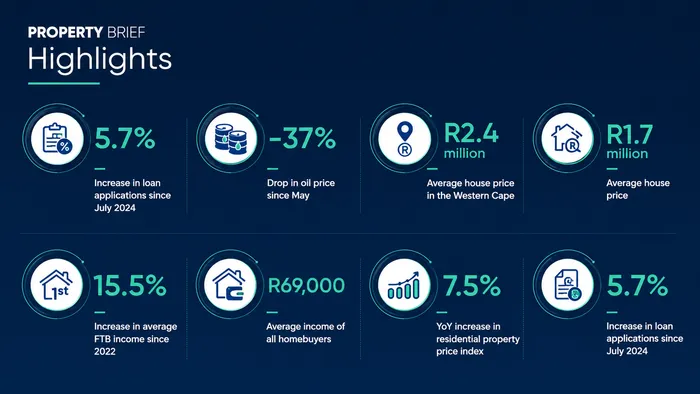
A snapshot of BetterBond's July Property Brief.
Image: BetterBond
At the same time, higher interest rates have put pressure on home loan activity. The South African Reserve Bank's decision in May to increase the prime lending rate from 10.25% to 10.5% contributed to a decline in home loan applications during the second quarter.
Year-on-year growth in applications declined by 1.6%, although application levels remained 5.7% higher than two years ago.
There has, however, been some relief for buyers trying to accumulate the upfront cash needed to purchase a home. The average deposit required from first-time buyers has fallen by 29%, from R230,000 in March 2024 to R163,000 in June this year.
Banks also adopted a more accommodating approach to deposit requirements during May and June, according to the report.
Since April, when the average deposit required from all buyers climbed above R300,000, requirements have fallen by 16% for all buyers and 12% for first-time buyers. Potgieter described the decline as "a welcome shift, especially for first-time buyers who may have affordability challenges."
Despite the pressure from borrowing costs, house price growth has accelerated.
Exceptionally high interest rates restricted average annual house price growth to just 1.5% between the second quarter of 2023 and the first quarter of 2025, resulting in negative growth after inflation.
"Since then, the nominal growth of house prices has outperformed inflation by a considerable margin," Potgieter said.
Regional house price data also points to sustained demand, with four regions recording double-digit annual price growth. Mpumalanga led with growth of 13.7%, followed by the Western Cape at 13%. The average Western Cape home price reached R2.4 million during the 12 months to June.
BetterBond economist Dr Roelof Botha said an improving economic backdrop and lower fuel prices could provide some relief from further interest rate increases.
"In contrast to the nervous socio-political milieu, June provided an impressive array of good news on the economics front, most notably in the form of lower fuel prices," Botha said. He said easing food inflation and lower oil prices could help reverse the recent rise in inflation and reduce the likelihood of further interest rate increases.
South Africa's economy grew by 1.4% year on year in the first quarter of 2026.
IOL BUSINESS