

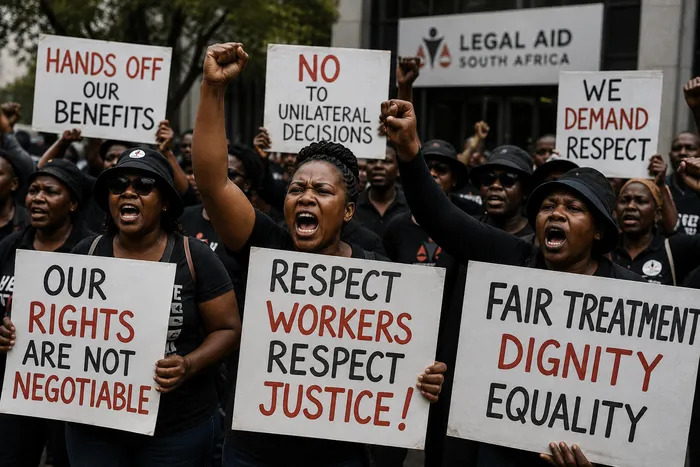
Legal Aid faced protected strike action after the Salawu filed a notice of action with the Commission for Conciliation, Mediation and Arbitration.
Image: ChatGPT
Nearly seven years after Legal Aid South Africa employees first formally raised concerns over salaries, workloads, career progression, staffing, labour relations and governance, many of those issues continue to feature in the latest dispute.
When employees submitted a memorandum in 2019, they raised concerns ranging from salaries, workloads, staffing levels and career progression to labour relations, governance, acting appointments and workplace practices.
The memorandum also acknowledged Legal Aid SA’s budget constraints while arguing that resources should be redirected from what employees described as unnecessary expenditure.
The South African Legal Workers Union (SALAWU) maintains that retirement became the catalyst rather than the cause of the current dispute.
The union argues that while some progress has been made since 2019 – with aspects such as life insurance policies, funeral cover, and payment of professional or registration fees resolved during previous processes – many longstanding concerns remain unresolved.
The latest labour dispute culminated in a two-day protected strike in June, centred on Legal Aid SA’s decision to discontinue an interim retirement extension that had allowed some employees to continue working beyond the organisation’s official retirement age of 60.
Legal Aid SA said an R813 million reduction over the medium-term expenditure framework had forced it to discontinue the arrangement, saying it could no longer afford the extension under its current funding allocation and that retaining it would have placed additional pressure on an already constrained budget.
SALAWU said employees retiring at 60 face reduced earnings, pension implications and changes to medical benefits, estimating that an employee earning R350,000 a year could lose up to R1.75 million over five years because of the earlier retirement age.
The strike followed months of failed attempts to resolve disputes through the Commission for Conciliation, Mediation and Arbitration, with the union saying employees had reached breaking point.
The dispute widened further ahead of the industrial action after Legal Aid SA suspended remote working arrangements as part of contingency plans aimed at minimising disruptions to court operations. Legal Aid’s contingency plans showed it was prepared for the strike to continue indefinitely.
The dispute plays out against a backdrop of severe financial constraint.
In May, Legal Aid SA told Parliament it required additional funding to fill vacant posts and that a lack of fiscal help would affect service delivery.
Presenting the organisation’s budget challenges, Legal Aid executives said a R261 million budget reduction had forced difficult staffing decisions.
Management told MPs that “346 positions would not be replaced if they leave, would not be filled when there’s retirement and so forth”, representing a 22% reduction from the approved establishment.
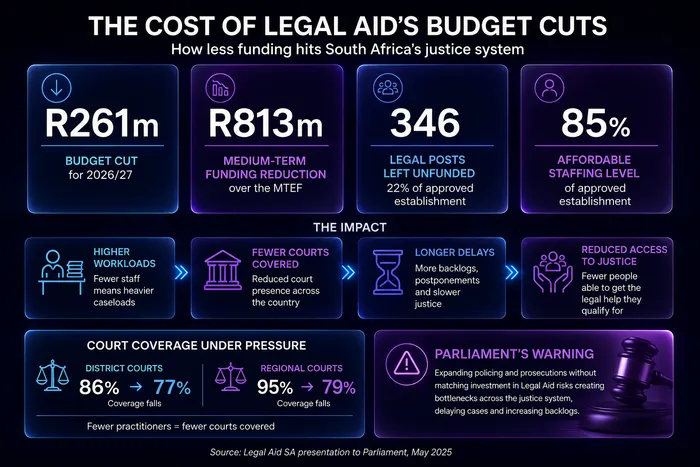
Legal Aid SA faces severe budget constraints.
Image: ChatGPT
“It means that we won’t be able to deliver services efficiently and at the right quality because our staff will then have higher caseloads,” Legal Aid SA said.
Management added that growing workloads could also “compromise the mental health of the staff”.
Legal Aid SA described its finances as a “shoestring budget”, telling MPs: “From our point of view, our budget is a shoestring budget. You can’t really manoeuvre too much because we don’t have a buffer.”
Executives appealed to the portfolio committee on justice and constitutional development to assist in addressing the budget reduction challenges, saying Legal Aid SA required at least R261 million for the 2026/27 financial year to restore staff capacity and sustain service delivery.
As of Tuesday, talks had been extended by another two weeks, with SALAWU warning it would grant no further extensions as negotiations entered a new phase.
In an update to members, SALAWU said it had rejected Legal Aid SA’s response to the memorandum of grievances handed to the employer, Parliament and the Minister of Justice and Constitutional Development during the strike.
“We confirm that Legal Aid SA (Management / Board) sent us a ‘response’ which we outrightly rejected,” the union said.
The union said Legal Aid SA had informed it that the organisation had requested a meeting with the Minister and proposed meeting SALAWU on 10 July, and that the Minister had requested a further two weeks to respond to the memorandum.
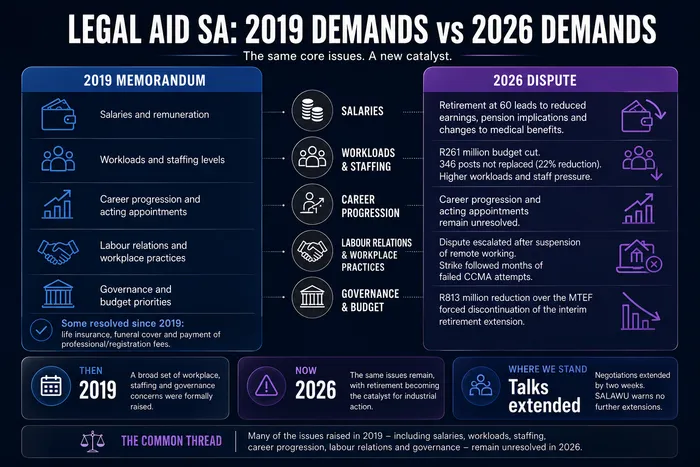
Legal Aid SA demands then and now.
Image: ChatGPT
In response to questions from IOL, Legal Aid SA confirmed it had submitted a response to SALAWU’s memorandum on 26 June and said engagements were continuing.
“Legal Aid SA confirms that a response to SALAWU’s Memo was submitted to the Union on 26 June 2026. The entity confirms that engagements with SALAWU and all relevant stakeholders, including the Minister of Justice and Constitutional Development, are continuing. Several meetings have been scheduled as part of this ongoing engagement process,” it said.
The entity added: “As these engagements are active and ongoing, it would not be appropriate for Legal Aid SA to comment on the specific matters raised in the Union’s communication or on the substance of the discussions at this stage.”
IOL BUSINESS