


If your dog genuinely helps you earn an income, check if you can claim vet bills.
Image: ChatGPT
With tax season upon us, many people are looking at ways to legally limit their exposure to the taxman, with entrepreneurs – or provisional taxpayers – having more leniency when it comes to claiming expenses.
For many salaried employees, tax season is relatively straightforward, with employers deducting Pay-As-You-Earn tax throughout the year. Entrepreneurs, however, must estimate their taxable income while ensuring they claim every legitimate deduction but nothing they can't justify to the South African Revenue Service (SARS).
At the start of this month, auto assessments opened, with submissions for other taxpayers open from 13 July. Taxpayers who receive auto assessments have until 12 July to review and accept or query them.
Non-provisional taxpayers have until 23 October 2026 to submit their returns. Provisional taxpayers – including many entrepreneurs, freelancers, investors and landlords – have until 22 January 2027 to file.
SARS applies a relatively simple test to business deductions: an expense must generally be incurred in producing income and relate directly to the taxpayer's trade. Personal, private and domestic expenses are generally not deductible, while expenses with both business and personal use may usually be claimed only to the extent they relate to earning income.
Deductions do not mean SARS reimburses you for the amount spent. Instead, they reduce your taxable income, so the value of the deduction depends on your marginal tax rate.
Just as with salaried employees, entrepreneurs face tax brackets. Up to R245,000 of income is taxed at 18%, with a scale above that meaning that breaking the R1 million ceiling results in R251,258 plus 41% of any taxable income above R857,900 being paid as tax.
Before looking at unusual deductions, entrepreneurs should make sure they are taking advantage of the basics.
Retirement annuities, pension funds and provident funds remain among the most effective ways of reducing taxable income, subject to legislative limits.
Tax-free savings accounts don't reduce taxable income immediately, but investment growth within them is free of tax on interest, dividends and capital gains.
Medical scheme tax credits, approved charitable donations, and every legitimate business expense should also be reviewed before filing.
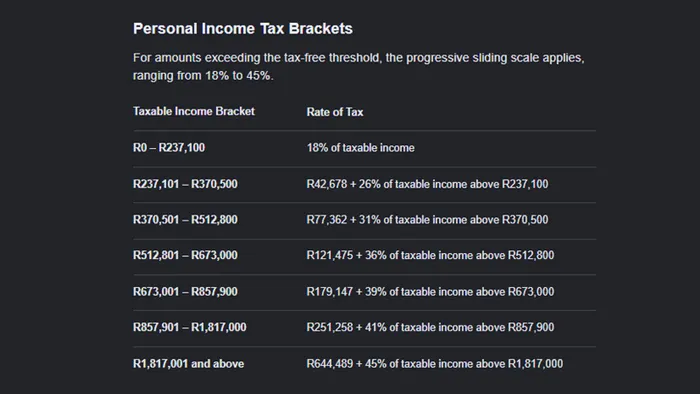
Tax tables
Image: SARS
My home office? It depends. SARS allows qualifying home office deductions, but only where the workspace meets its requirements. A dedicated area used exclusively and regularly for business is generally required, and if part of the home is used for both personal and business purposes, only the qualifying business portion may be claimed.
My cellphone? Probably, but not all of it. If you use your cellphone for both work and personal calls, SARS generally expects only the business-use portion to be claimed.
Coffee with a client? Possibly. Buying coffee doesn't automatically make it a business expense. The meeting should be directly connected to earning income, and the expense should be properly supported.
My laptop? Usually yes. Computers and other equipment used to generate income may qualify, although some assets are claimed over time through wear-and-tear allowances rather than as an immediate deduction.
My dog? This is where things get interesting. A family pet would almost certainly not qualify. However, if an animal genuinely forms part of producing business income, such as regularly appearing in commercial advertising, is used professionally in productions, or is a working animal essential to the business, the circumstances are different.
If Fido spends most of the day sleeping on the couch, don't expect SARS to pay for the vet bill. As with every deduction, the taxpayer would need to demonstrate that the expense was incurred in producing income.
Opening another company? Having more than one company isn't, on its own, a tax-saving strategy. There may be legitimate commercial reasons for operating separate businesses through different entities. However, creating structures purely to reduce tax could fall foul of South Africa's anti-avoidance rules.
Legal & Tax, a South African tax and legal advisory firm, distinguishes between legitimate tax planning, tax avoidance and tax evasion.
While taxpayers are entitled to structure their affairs efficiently and make use of deductions provided for in law, tax evasion – including failing to declare income or inflating deductions – is illegal. South Africa's anti-avoidance rules also allow SARS to disregard arrangements entered into primarily to obtain a tax benefit.
Latita Africa, a financial and tax consultancy, similarly notes that taxpayers can legally reduce their tax burden through retirement fund contributions, tax-free savings accounts, approved charitable donations and qualifying business deductions but every claim should be properly substantiated and supported by records.
IOL BUSINESS