

Depending on the data, New York either has 146 or 66 billionaires.
Image: ChatGPT
Owning $1 billion sounds straightforward, but the world's biggest wealth rankings don't all measure fortunes the same way. From family homes and private companies to where someone lives, the rules vary more than most people realise.
The world's three biggest wealth rankings – compiled by Forbes, Hurun and New World Wealth for Henley & Partners – all aim to identify the world's richest people.
Depending on which report you read, New York is home to anywhere between 66 and 146 billionaires. The city has not changed. The methodology has.
Forbes counts 123 billionaires in New York. Hurun puts the figure at 146. Henley & Partners counts just 66, less than half of Hurun's figure. They are all examining many of the same individuals. The difference is not arithmetic. It is methodology.
All three organisations start with the same threshold: a net worth of at least $1 billion. How they calculate that net worth, however, differs considerably.
Henley & Partners' wealth rankings, based on research by New World Wealth, focus on private investable wealth. That includes listed and unlisted shareholdings, cash, bonds and investment property, but excludes an individual's primary residence unless it generates income.
Hurun takes a broader approach, including owner-occupied homes alongside listed and unlisted shares, investment property, cash, funds, bonds and insurance. Forbes also values listed and private businesses, property and other assets, using market data, company filings and interviews to estimate overall net worth.
Those definitional differences matter enormously when the same person is being assessed. A billionaire whose wealth is tied up in a family home, for instance, may qualify under Hurun's methodology but not under Henley's.
Calculating a fortune is relatively straightforward when most of the wealth is tied to shares listed on a stock exchange. It becomes more complicated when fortunes are built on privately owned businesses.
Without a public market price, researchers must estimate the value of those companies using financial information, comparable businesses and other publicly available data. As those estimates shift, so can an individual's billionaire status - and their ranking within it.
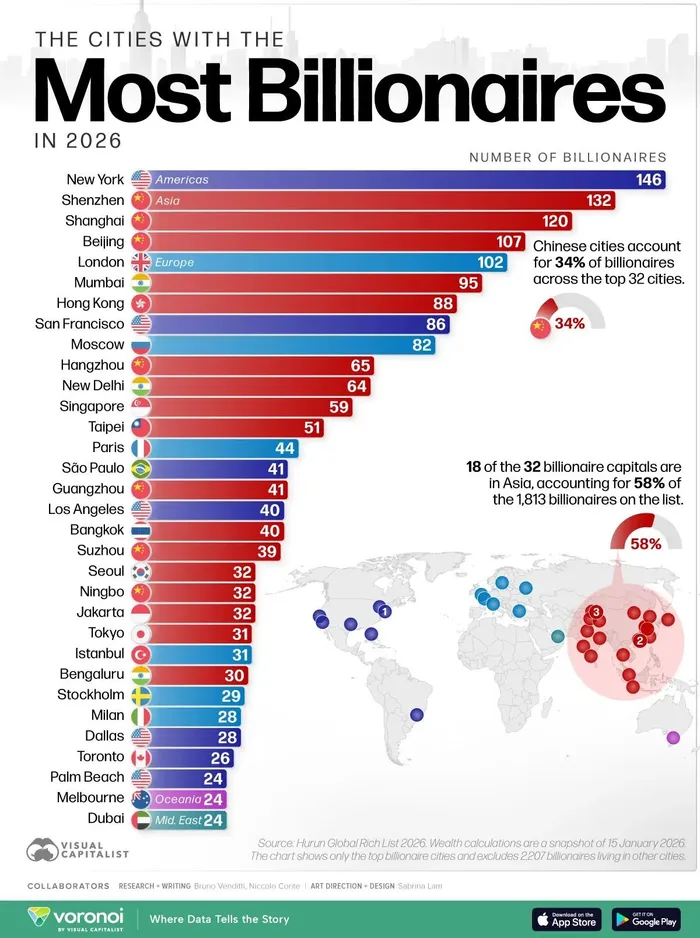
The cities with the most billionaires.
Image: Voronoi
Even deciding which city to credit can produce different answers. Henley's rankings are based on where wealthy individuals reside.
Hurun allocates billionaires according to their long-term residence or primary business headquarters. Forbes determines where billionaires "call home" through its own reporting.
For billionaires with homes in several countries or who divide their time between business centres, those definitions can produce very different results.
Beyond New York, the rankings tell similarly varied stories. Hurun places Hong Kong and Moscow joint second with 74 billionaires each, followed by Mumbai (69) and Beijing (68).
Henley's report ranks the Bay Area at 82 when measured as a broader metropolitan region, with Tokyo second globally by millionaire population and London, Singapore and Los Angeles also featuring prominently.
The divergence comes down to what counts as wealth, where someone is deemed to live, and how to value assets that have no public price.
IOL BUSINESS