


Smart heating solutions can save as much as R2,000 this winter.
Image: ChatGPT
With electricity, gas and other fuels inflation reaching 9.4% in May and fuel inflation surging 28.7% year-on-year, many households are facing a familiar winter dilemma: how to stay warm without sending monthly bills soaring.
This comes as the consumer price index accelerated to 4.5% in May, approaching its highest level in almost 22 months as fuel, transport and energy costs continued to place pressure on household budgets.
Saving electricity during the cold months, however, is less down to selecting an appliance that sucks up more power and more either moving to a warmer part of the country or implementing changes so that energy is used more efficiently.
Yet calculations based on common household heating habits suggest many families could save between R800 and R2,000 a month by focusing on the biggest energy consumers in their homes rather than simply switching heaters.
For all our calculations, we used the example of a typical 150m² three-bedroom home with a 30m² open-plan lounge and dining area, a 13.5m² main bedroom and two 9.5m² bedrooms.
Some simple hacks to cut back on spending on your geyser.
Image: ChatGPT
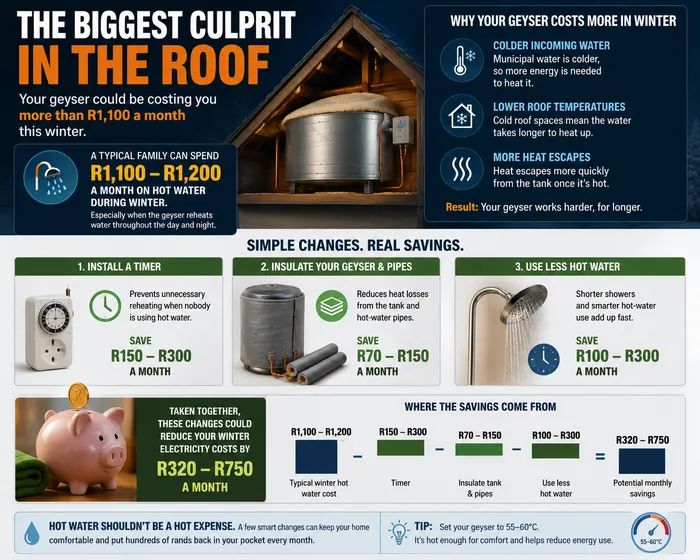
The biggest culprit is often not the heater in the lounge but the geyser in the roof, an appliance quietly costing more than R1,100 a month
Many South Africans only think about their geyser when there's no hot water. During winter, however, it can become one of the biggest drivers of household electricity consumption as colder incoming water and lower roof-space temperatures force it to work harder.
A typical family can spend between R1,100 and R1,200 a month on hot water during winter, particularly when a geyser is left to reheat water throughout the day and night.
According to Lloyd Willemsen, founder of Thingwala, winter amplifies the problem. “Incoming municipal water is colder and roof-space temperatures are lower. More energy is required to heat the water to the desired temperature, and heat escapes more quickly from the tank once it has been heated.”
Fortunately, some of the biggest savings can come from relatively inexpensive interventions. Installing a timer can save between R150 and R300 a month by preventing unnecessary reheating when nobody is using hot water.
A geyser blanket and insulated hot-water pipes can reduce heat losses and save another R70 to R150 a month while reducing shower times and overall hot-water consumption can save a further R100 to R300 a month.
Taken together, these changes could reduce winter electricity costs by between R320 and R750 a month.
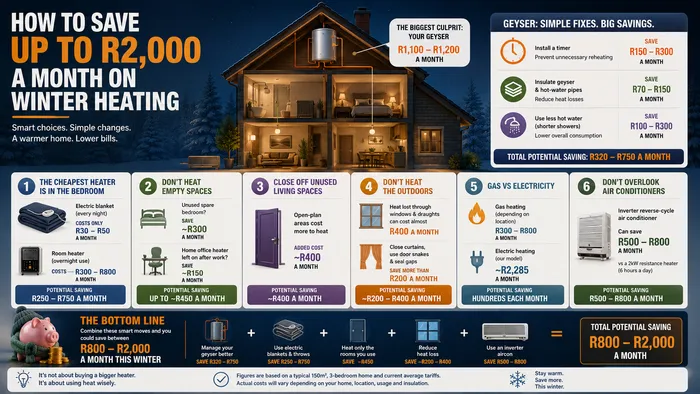
While consumers often debate fan heaters, oil heaters and gas heaters, the cheapest electrical heating appliance is often already in the bedroom. A typical electric blanket consumes about 100W of electricity. Used every night through winter, it may cost between R30 and R50 a month to operate.
By comparison, a room heater can easily add between R300 and R800 a month to an electricity bill. That means a household switching from overnight room heating to an electric blanket could save between R250 and R750 a month.
Heated throws offer similar benefits. Costing roughly R40 to R70 a month to run, if they're replacing a heater costing R300 R800, they can save between R200 and R700 a month compared with conventional room heating because an electric blanket heats the person directly rather than attempting to warm the entire room.
Heating empty rooms is one of the easiest ways to waste electricity. In the modelled home, simply switching off the heater in an unused spare bedroom could save about R300 a month, while remembering to turn off a home-office heater after work rather than leaving it running could save another R150 a month. In larger homes with multiple unused rooms, those savings can add up quickly.
Simple wats to save on electricity and gas as winter bites.
Image: ChatGPT
Modern open-plan homes are comfortable but expensive to keep warm because one heater often ends up heating adjoining kitchens, dining rooms and hallways. In the modelled home, heating a larger open-plan living area instead of containing warmth in a single room added almost R400 a month to electricity costs.
Closing doors and concentrating family activities in one heated room can reduce both electricity use and heating time.
When it comes to room heating, operating time is often more important than the type of heater used. A typical 2kW fan heater used for two hours a day can cost between R180 and R250 a month.
Increase usage to four hours a day and the cost rises to between R350 and R500 a month. Run the same heater for most of the evening and monthly costs can approach R1,000.
Oil heaters are often viewed as cheaper alternatives, but their monthly operating costs can still range between R250 and R600 depending on size and usage. Panel heaters generally sit at the lower end of the scale, costing between R150 and R450 a month to operate.
The difference is often not the efficiency of the appliance itself but how long it remains switched on.
Gas remains a popular option for households looking to heat larger living spaces.
Depending on refill prices and usage patterns, a gas heater can cost between R300 and R800 a month to operate during winter. In many cases, gas can be cheaper than running electric room heaters for long periods.
Using current gas refill prices and residential electricity tariffs, a model of a typical three-bedroom South African home suggests gas can often cost less than electricity when used as the primary source of winter heating.
The comparison follows earlier analysis showing that a 9kg gas bottle costs roughly the same across much of South Africa, with refills averaging around R365 despite regional pricing differences.
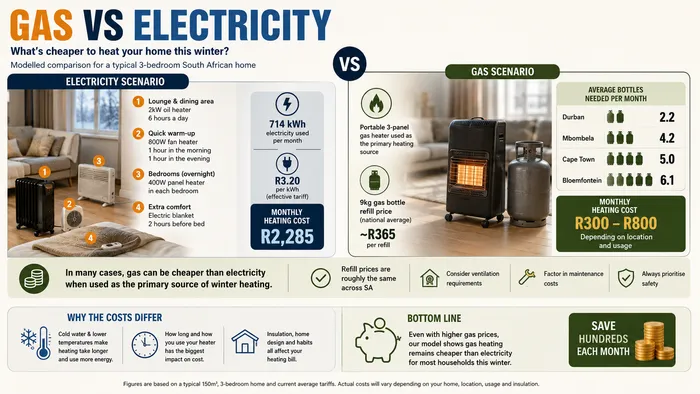
For the electricity scenario, the lounge and dining area were heated using a 2kW oil heater for six hours a day. An 800W fan heater was used for one hour in the morning and one hour in the evening to quickly warm occupied areas during the coldest parts of the day.
The difference between using and gas versus electricity can be substantial.
Image: ChatGPT
At the same time, each bedroom was heated overnight using a 400W panel heater, while electric blankets were used for two hours before bedtime.
Under those assumptions, the household consumed approximately 714kWh of electricity a month. At an effective residential tariff of around R3.20 per kWh, that translates into a monthly heating bill of about R2,285.
The gas comparison used a portable three-panel gas heater as the primary heating source, with consumption adjusted for typical winter conditions in different parts of the country.
The amount of gas used varied depending on geographical location, with Durban, Mbombela, Bloemfontein each needing different numbers of average bottle a month:
Despite these variations – and the increase in the price of gas – this product remains cheaper than what comes out of the wall given those price increases too. However, consumers should also consider ventilation requirements, maintenance costs and safety considerations.
Windows, sliding doors and draughts quietly allow warmth to escape throughout the evening. In an older home with single glazing, the value of that lost heat can amount to almost R400 a month.
While replacing windows is expensive, simply closing curtains before sunset, using door snakes and sealing gaps around doors can recover more than R200 a month in otherwise wasted heating costs.
Perhaps the biggest lesson from winter energy calculations is that reducing heat loss can save more money than changing heating technology.
Simple measures such as closing curtains at sunset, sealing draughts, using door snakes and keeping unused rooms closed can often be implemented for less than R200.
Yet they can save between R50 and R200 a month by reducing the amount of heating required.
Roof insulation can have an even greater impact. Not only can it reduce heat loss from a geyser installed in the roof space, but it can also help keep a home warmer during winter and cooler during summer.
Depending on the size and condition of the property, roof insulation could reduce energy costs by between R100 and R400 a month.
Inversion aircons can produce electricity savings when used for heating.
Image: ChatGPT
One appliance that may not often be considered overlooked is the reverse-cycle air conditioner.
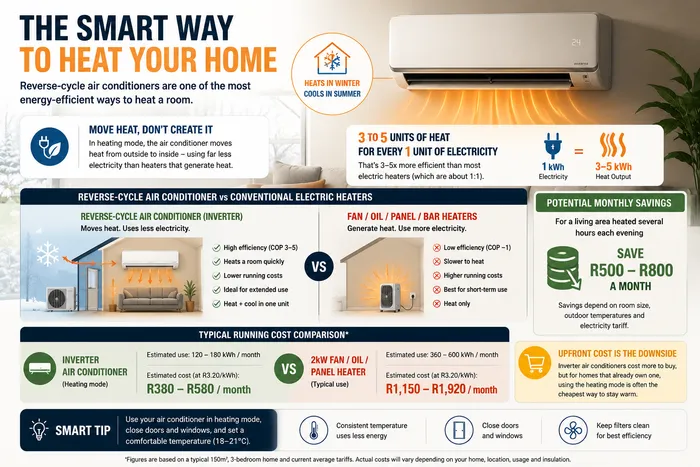
Although air conditioners are commonly associated with cooling, modern inverter models are among the most energy-efficient ways to heat a room because they move heat rather than generate it through an electrical element.
A quality inverter air conditioner can produce three to five units of heat for every unit of electricity consumed, making it significantly cheaper to operate than fan heaters, bar heaters and many oil heaters over extended periods.
Unlike fan, oil and panel heaters, which generate heat directly, reverse-cycle air conditioners move heat from outside to inside, making them far more efficient. For a household heating a living area for several hours each evening, switching from a conventional electric heater to an inverter air conditioner could reduce heating costs by between R500 and R800 a month, depending on the size of the room, outdoor temperatures and electricity tariff.
The drawback is the upfront purchase price, but for households that already own an inverter air conditioner, using the heating mode can often cost less than relying on portable electric heaters.
A household that installs a geyser timer, insulates its geyser and pipes, shortens shower times, addresses heat loss and uses electric blankets instead of heating entire rooms could potentially save between R800 and R2,000 a month during winter.
With electricity, gas and other fuels inflation now running at 9.4%, those savings could become increasingly important as temperatures continue to fall.
The calculations suggest that the biggest opportunities to cut winter energy bills do not necessarily come from buying new appliances. Instead, they come from managing the appliances already in the home, reducing heat loss and using heat where it is needed most.
Caveat: The comparison should be viewed as illustrative rather than definitive. Actual costs will vary depending on weather conditions, insulation, occupancy levels, house design, heater efficiency and how long heating systems are used.