

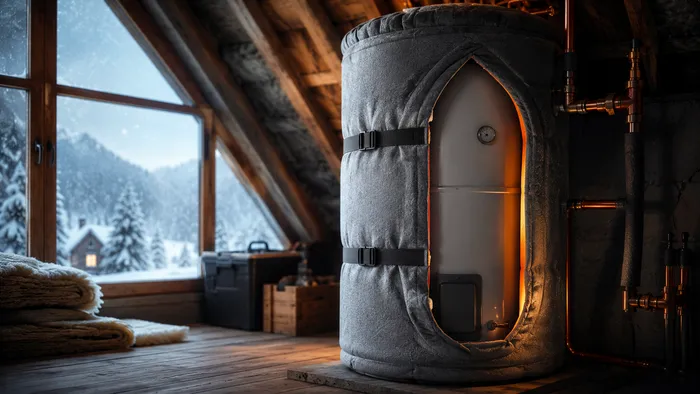
Insulating your geyser can push your bills down.
Image: ChatGPT
Stopping your geyser from driving up your electricity bill this winter
Many South Africans only think about their geyser when there’s no hot water. During winter, however, it can become one of the biggest drivers of household electricity consumption as colder incoming water and lower temperatures force it to work harder.
Yet many homeowners have little idea when their geyser is heating, how often it switches on, or how much electricity is being used simply to keep water hot.
The problem becomes more pronounced during winter. “Incoming municipal water is colder and roof-space temperatures are lower. More energy is required to heat the water to the desired temperature, and heat escapes more quickly from the tank once it has been heated,” said Lloyd Willemsen, founder of Thingwala.
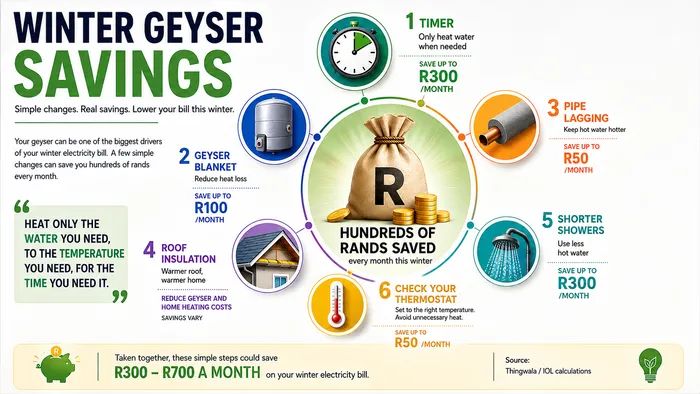
For homeowners looking to reduce electricity costs, he recommends a simple principle: “Heat only the water you need, to the temperature you need, for the time you need it.”
The biggest savings often come from controlling when a geyser heats water. Installing a timer can prevent a geyser from repeatedly reheating water throughout the day and night when nobody is using it.
For a typical family, that could save between R150 and R300 a month during winter, depending on usage patterns and electricity tariffs.
Reducing heat loss is another relatively inexpensive intervention. Installing a geyser blanket and insulating exposed hot-water pipes can slow the rate at which heat escapes, reducing the frequency with which the geyser element needs to switch on.
Together, these measures could save households between R70 and R150 a month while costing relatively little to install.
You can get massive savings a month from controlling the heat that leaks out of your house.
Image: ChatGPT
Roof insulation can offer a double benefit. Not only can it help reduce heat loss from a geyser installed in the roof space, but it can also help keep the home warmer during winter and cooler during summer. While savings vary significantly between homes, the benefits extend well beyond the geyser itself.
Homeowners can also save money by reducing the amount of hot water they use. Cutting just a few minutes from daily showers, reducing the number of baths and fixing dripping hot-water taps can make a noticeable difference.
Depending on usage patterns, households could save between R100 and R300 a month through behavioural changes alone.
Homeowners should also review thermostat settings. While water temperatures need to remain high enough for safety and hygiene reasons, unnecessarily high settings increase both electricity consumption and heat losses.
Homeowners with solar water-heating systems should avoid assuming that the system is operating optimally.
“Solar geysers can deliver substantial savings on water-heating costs, but they are not a fit-and-forget solution,” Willemsen said. If the solar side of the system underperforms or develops a fault, the electrical element can quietly take over much of the heating load, reducing the savings homeowners expect.
According to Willemsen, one of the biggest challenges is that many homeowners simply do not have visibility into what their geyser is doing.
“Most homeowners know how much electricity they use each month, but very few know when their geyser is heating, what temperature it is at, or how quickly it cools down.
Willemsen added that “better visibility often reveals opportunities to reduce unnecessary heating, especially when routines change. The easier it is for homeowners to monitor and adjust their water heating, the easier it becomes to avoid unnecessary energy consumption.”
Taken together, a timer, basic insulation measures and reduced hot-water consumption could save some households between R300 and R700 a month during winter.
“Understanding where energy is going and having the visibility and control to act on that information, often leads to lower electricity costs,” Willemsen said.
IOL BUSINESS