

What's cheaper? Gas or electricity?
Image: ChatGPT
With temperatures plunging across much of South Africa, many households face the same question each winter: Is it cheaper to heat a home with gas or electricity?
The answer may surprise consumers who assume electricity is automatically the cheaper option.
Using current gas refill prices and residential electricity tariffs, a model of a typical three-bedroom South African home suggests gas can often cost less than electricity when used as the primary source of winter heating.
The comparison follows earlier analysis showing that a 9kg gas bottle costs roughly the same across much of South Africa, with refills averaging around R365 despite regional pricing differences.
To compare the two energy sources, we modelled a typical 150m² three-bedroom home with a 30m² open-plan lounge and dining area, a 13.5m² main bedroom and two 9.5m² bedrooms.
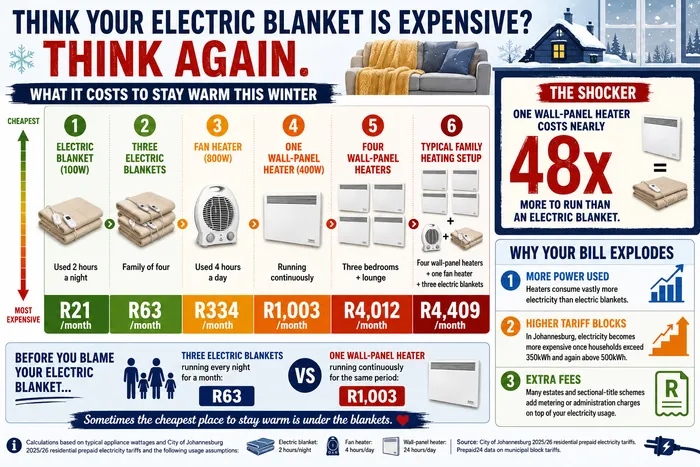
For the electricity scenario, the lounge and dining area were heated using a 2kW oil heater for six hours a day. An 800W fan heater was used for one hour in the morning and one hour in the evening to quickly warm occupied areas during the coldest parts of the day.
At the same time, each bedroom was heated overnight using a 400W panel heater, while electric blankets were used for two hours before bedtime.
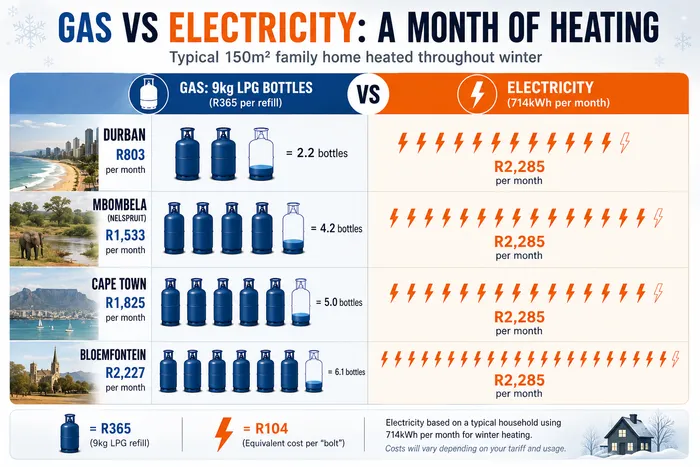
Under those assumptions, the household consumed approximately 714kWh of electricity a month. At an effective residential tariff of around R3.20 per kWh, that translates into a monthly heating bill of about R2,285.
The gas comparison used a portable three-panel gas heater as the primary heating source, with consumption adjusted for typical winter conditions in different parts of the country.
Run the match, it's cheaper to heat with gas.
Image: ChatGPT
The results varied significantly by location.
Durban emerges as the most affordable of the cities modelled. While Durban residents may disagree, average winter temperatures remain considerably higher than those experienced inland.
Under the model, a household relying on a gas heater for around six hours a day could make a 9kg cylinder last about 13.6 days. That translates into roughly 2.2 cylinders a month and a monthly heating bill of around R803.
Mbombela tells a different story. Winter afternoons regularly climb above 20°C, creating the impression that heating demand should be limited.
But temperatures can fall sharply after sunset, with overnight lows often dropping to around 6°C. Those large day-night temperature swings mean households still spend a significant amount on heating.
Based on the theoretical house, a 9kg bottle would last about 7.1 days, requiring around 4.2 cylinders a month. At current prices, that translates into a monthly heating bill of roughly R1,533.
Cape Town's challenge is different again. Rather than cold nights alone, the city contends with repeated winter cold fronts that bring rain, wind and prolonged periods of damp weather.
The Mother City’s winters, generally from June to August, are often known for a mild Mediterranean climate with cool, wet, and occasionally stormy weather, although cold fronts push those temperatures down dramatically.
Even when temperatures are not drastically lower than elsewhere in the country, homes can feel colder for longer periods, encouraging households to run heaters for extended stretches.
Under the model, a 9kg bottle would last about six days, meaning a household could consume around five cylinders a month at a cost of roughly R1,825.

How much for a 9kg gas bottle across South Africa.
Image: ChatGPT
Bloemfontein sits at the opposite end of the scale.
Winter overnight temperatures regularly fall to around freezing, with frost a common feature during the coldest months.
While daytime temperatures often recover into the high teens, households frequently face long periods of heating demand during mornings and evenings.
That means, for our house in Bloemfontein, a 9kg cylinder would last just 4.9 days. That works out to around 6.1 cylinders per month, and a monthly heating bill of approximately R2,227.
In all four cities, gas either matched or beat the electricity scenario.
The difference was most pronounced in Durban, where gas heating cost almost two-thirds less than electricity. Even in Bloemfontein, the coldest location modelled, gas remained marginally cheaper than the all-electric scenario.
The findings highlight an often-overlooked aspect of home heating economics.
While electricity may appear cheaper on a per-unit basis, heating multiple bedrooms throughout the night can consume large amounts of energy. In the modelled household, overnight bedroom heating accounted for more than 40% of total electricity consumption.
Your electric blanket is costing less than you think to run. Here's the math.
Image: ChatGPT
The comparison should be viewed as illustrative rather than definitive. Actual costs will vary depending on weather conditions, insulation, occupancy levels, house design, heater efficiency and how long heating systems are used.
Households that heat only occupied rooms or rely primarily on electric blankets may achieve substantially lower electricity costs than those modelled. Likewise, households using gas only occasionally may consume far fewer cylinders than assumed.
The results nevertheless suggest that for households seeking to heat an entire family home through winter, gas remains a surprisingly competitive option.
IOL BUSINESS