

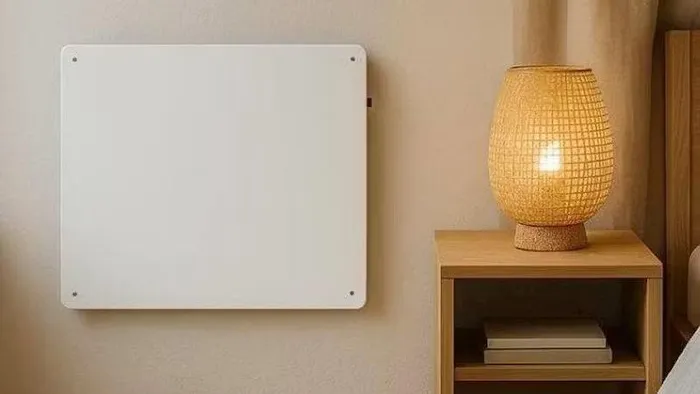
Three electric blankets running every night for a month can cost less than a single wall heater running continuously for a day or two.
Image: OneDayOnly
As temperatures plunge across South Africa, many households are bracing themselves for higher electricity bills.
Elevated power bills shouldn’t be a surprise given the colder weather ahead this week, and the coldest night so far hitting us last Thursday. However, a power bill that doubles or triples month-on-month is a shocker.
Electric blankets are often the first suspects when winter power costs spike, but the numbers suggest consumers may be blaming the wrong appliance, which is often quietly heating the room and chewing budgets.
A typical electric blanket costs about R21 a month to run if it is switched on for two hours every night. Even a household using three electric blankets would spend only about R63 a month on keeping beds warm.
By contrast, a single 400W wall-panel heater running continuously could add about R1,000 a month to an electricity bill.
Assuming four 400W wall-panel heaters run around the clock during winter, one in each bedroom and another in a living area, the cost could climb to roughly R4,000 a month before other heating appliances are considered.
Add a small 800W fan heater used for four hours a day in a kitchen or living area and a family's monthly heating bill could exceed R4,400.
In Johannesburg, residential prepaid customers pay R2.6645 per kilowatt-hour for the first 350 units bought each month, R3.0564 for the next 150 units and R3.4826 for every unit above 500kWh, before fixed service and capacity charges are added.
That means the more heaters a household runs, the more likely it is to move into higher tariff blocks where every additional unit costs more.
A household spending around R4,400 a month on winter heating would quickly find itself paying the highest tariff on much of its electricity consumption.
Johannesburg is far from unique. According to Prepaid24, more than 85% of the municipalities it services use block or step tariffs, where electricity becomes progressively more expensive as consumption rises.
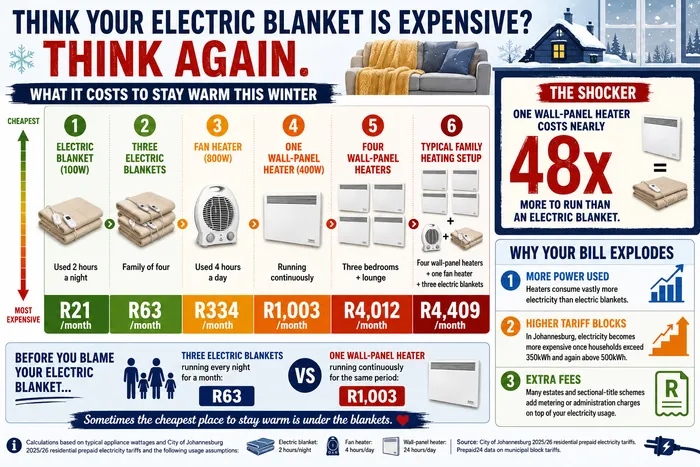
Your electric blanket is costing less than you think to run. Here's the math.
Image: ChatGPT
For residents of sectional-title complexes and estates, the final bill may climb even further. Many developments use private metering companies to manage electricity purchases and billing.
Costs are recovered through fixed monthly charges, percentage-based administration fees or other service charges linked to electricity purchases.
Depending on the service agreement, these charges can add a few percentage points to a monthly electricity bill or a fixed fee for each meter.
The result is that higher winter electricity consumption can have a knock-on effect beyond the cost of the power itself, particularly for households relying on room heaters to stay warm.
The irony is that one of the cheapest forms of heating is often blamed for rising electricity bills. A family could run three electric blankets every night for a month and still spend less than the cost of operating a single wall-panel heater for a couple of days.
Using Johannesburg's highest residential prepaid tariff as a guide, three electric blankets would cost about R63 a month to operate, compared with roughly R1,000 for a single wall-panel heater running continuously.
For many households, the cheapest place to stay warm this winter may literally be under the blankets.
Especially if one considers that, since 2021, electricity tariffs have risen by 85%, petrol prices by 36%, and inflation by 27%, while average take-home pay for incoming debt counselling clients increased by only 25%.
IOL BUSINESS