


African high-net-worth wealth rose 7% in 2025, driven by stronger gold prices and international investment, according to Capgemini's World Wealth Report
Image: Gemini/Ai
Africa's wealthy continued to accumulate assets in 2025 as rising precious metals prices and international investment helped lift high-net-worth wealth across the continent.
According to Capgemini's World Wealth Report 2026, African high-net-worth wealth rose 7% during the year, while the population of wealthy individuals increased 4.1%.
Capgemini said the growth was driven by rising precious metals prices, including gold, as well as long-term capital investment flowing into the region from international investors.
The gains came as global high-net-worth wealth rose 8.7% to a record $98.3 trillion in 2025, while the number of high-net-worth individuals increased 7.9%.
The increase represented the strongest annual growth in high-net-worth wealth in five years, according to Capgemini's World Wealth Report 2026.
For context, the International Monetary Fund projects global gross domestic product will reach approximately $126.3 trillion in 2026, meaning the world's wealthy now control assets equivalent to nearly four-fifths of annual global economic output.
Africa's 7% increase in wealth placed it ahead of Latin America, where wealth grew 5.1%, and well ahead of the Middle East, where wealth declined by 1.5%.
The Asia-Pacific region recorded the strongest growth globally at 10.5%, followed by North America at 9.9% and Europe at 8%.
Africa's wealthy population remains small by global standards, but the continent is home to some of the world's largest personal fortunes.
According to Forbes, Nigerian industrialist Aliko Dangote is Africa's richest person, with an estimated net worth of $28.5 billion, followed by South Africa's Johann Rupert and family at $16.1 billion.
Other members of the continent's billionaire ranks include Nigeria's Abdulsamad Rabiu ($11.2 billion), South Africa's Nicky Oppenheimer and family ($10.6 billion) and Egypt's Nassef Sawiris ($9.6 billion).
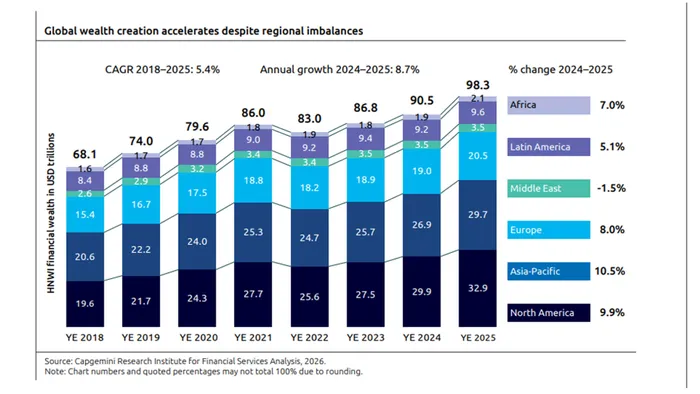
African high-net-worth wealth rose 7% during the year, while the population of wealthy individuals increased 4.1%.
Image: Capgemini's World Wealth Report 2026
The report found that ultra-high-net-worth individuals, defined as those with investable assets exceeding $30 million, continued to outperform other wealth groups for a second consecutive year.
Their wealth increased 9.7% in 2025, compared with 8.7% growth among mid-tier millionaires and 7.8% among those with between $1 million and $5 million in investable assets.
Despite representing only around 1% of the high-net-worth population, ultra-high-net-worth individuals accounted for 34.8% of total high-net-worth wealth globally.
The scale of wealth accumulation among the world's richest individuals has also accelerated sharply. According to Forbes' real-time billionaire rankings, Elon Musk topped the global list with an estimated net worth of $839 billion, more than three times that of second-placed Larry Page at $257 billion.
Google co-founder Sergey Brin ranked third at $237 billion, followed by Amazon founder Jeff Bezos at $224 billion and Meta chief executive Mark Zuckerberg at $222 billion.
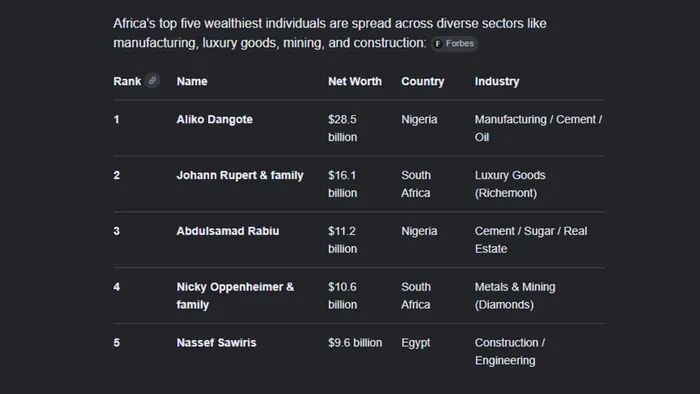
Africa's most wealthy people.
Image: Forbes
Capgemini said wealthy investors continued to shift assets towards public markets during the year.
Equity allocations increased by three percentage points to 25% of portfolios, reflecting continued market strength, while fixed-income allocations rose to 20% as bond markets stabilised and delivered their strongest returns since 2020.
The report found that strong corporate earnings and broad market gains helped support wealth creation across most major regions during 2025.
While Africa's wealthy remain a small part of the global high-net-worth population, the continent's combination of rising commodity prices and continued international investment helped ensure it remained one of the stronger-performing regions in a year of record global wealth creation.
IOL BUSINESS