

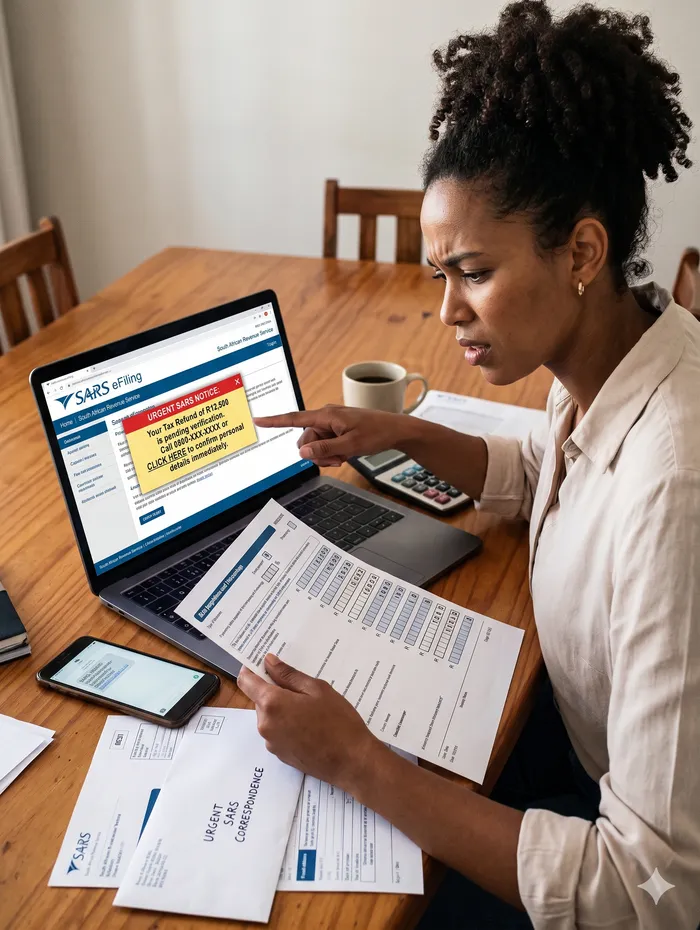
South Africans have once again been warned, as tax season approaches, that scammers are stepping up efforts to impersonate the South African Revenue Service (SARS)
Image: Image: Gemini
South Africans have once again been warned, as tax season approaches, that scammers are stepping up efforts to impersonate the South African Revenue Service (SARS) in a bid to steal personal and financial information.
According to Thalia Pillay, co-founder and CEO of Orca Fraud, tax season is a peak period for scam activity, as criminals take advantage of increased communication between the revenue service and taxpayers to make their messages appear more convincing.
"Check your SMS inbox or email inbox. There’s a good chance a message claiming to be from SARS is already waiting for you. Whether it’s a tax refund you never filed for or an urgent settlement demand designed to trigger panic," Pillay said.
"Tax season brings a predictable spike in messages claiming to be from SARS. Most South Africans with a smartphone will receive at least one this year"
According to Pillay, these are some of the most common scam types currently in circulation during the filing period:
An SMS or email claims you owe a specific tax amount that is urgent and due by a set date, often including payment instructions and a bank account number.
SARS has documented this exact scam and is clear on the rules: it will never request banking details by post, email, or SMS, and it will never provide a bank account number for payment.
A message claims a refund has been issued and instructs you to click a link to verify details or link a credit card to receive it.
SARS has said it will never ask for credit card details. Refunds are paid into the bank account linked to your eFiling profile. Any message using external links or non-official domains is a scam.
A more threatening message: SARS has issued a letter of demand, a court summons is imminent, blacklisting may follow. A link or attachment leads to a phishing site designed to harvest your information.
SARS has specifically flagged this type. It will not send you hyperlinks to other websites, including to banks or legal notices. Any genuine legal action from SARS is visible in your eFiling profile, not delivered via a link in an unsolicited message.
You're prompted to confirm your compliance status, update your banking details, or complete your auto-assessment via a link. The destination is a proxy website that mimics the eFiling interface.
SARS does not send links to external websites for compliance purposes. If you need to complete an auto-assessment or update your banking details, go directly to sars.gov.za and log in. Do not use a link from a message to get there.
Pillay added that "as of May 2025, SARS moved entirely to digital correspondence, discontinuing physical mail for all system-generated letters".
"That means more legitimate SARS communication landing in inboxes and SMS threads — which also means more plausible cover for scams designed to look like it. When you're expecting to hear from SARS, a message that looks like SARS is easier to act on without checking"
IOL Business