

Eskom electricity tariffs have increased by more than 1,500% since 2000, making electricity roughly 16 times more expensive than it was at the start of the century.
Image: File
South Africa exported almost twice as much electricity as it imported in 2024 as load-shedding eased dramatically but electricity prices remained elevated.
According to Eskom operational data, the utility exported 14,532 gigawatt-hours of electricity last year while importing 7,570 gigawatt-hours, largely from Mozambique’s Cahora Bassa hydroelectric scheme.
That means Eskom exported about 92% more electricity than it imported during the year. The utility remained a net exporter of electricity, with net exports of 6,962 gigawatt-hours.
Eskom’s 2025 annual report said Mozambique remained South Africa’s biggest regional electricity trading partner for both imports and exports.
“We serve primarily local and a few international customers using energy we generate, together with energy purchased from IPPs and power imported from neighbouring countries. Mozambique remains our most significant trading partner for both imports and exports,” Eskom said.
The utility said international electricity sales rose by 40% year-on-year because neighbouring countries required emergency support during regional shortages and drought conditions that reduced generation elsewhere in southern Africa.
“Non-firm exports are only possible when supply is not constrained and when loadshedding is not required,” Eskom said. The utility also said improved generation performance allowed it to increase exports into the region.
Eskom concluded or extended electricity supply agreements with Botswana, Namibia and Zambia during the year.
The export and import figures emerged alongside new Statistics South Africa data showing coal still overwhelmingly dominates South Africa’s electricity system.
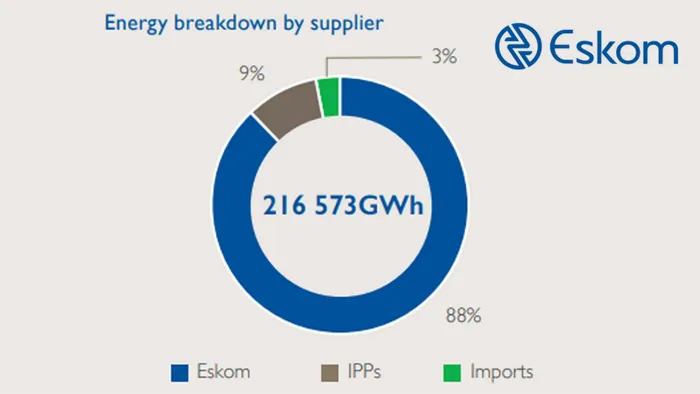
Eskom imported 3% of its power needs in 2025.
Image: Eskom 2025 annual report
Coal accounted for 83% of local electricity generation in 2024, although renewable energy sources have gradually increased their share over the past decade. Coal’s contribution to electricity generation has declined from 90% in 2016 to 83% in 2024.
Renewable energy, including wind, solar and hydroelectric power, accounted for 9% of electricity generation in 2024, up from just 2% in 2016.
Eskom’s generation fleet also remains heavily coal-based.
Coal-fired stations account for about 40,544 megawatts of installed capacity, compared with 6,281 megawatts from renewable sources, 3,414 megawatts from diesel and gas, 2,724 megawatts from pumped storage, 1,860 megawatts from nuclear and 600 megawatts from hydroelectric generation.
Coal generation increased by 7% between 2023 and 2024 to 177.9 terawatt-hours because of improved energy availability at coal-fired stations. According to Eskom’s 2025 annual report, coal and other generation costs accounted for roughly R91 billion, or 55% of the utility’s primary energy costs.
At the same time, diesel-powered generation fell sharply by 48% as improved coal performance reduced reliance on emergency diesel generation.
Wind energy showed the strongest longer-term growth among renewable sources. Statistics South Africa said wind generation increased from 6,512 gigawatt-hours in 2021 to 10,450 gigawatt-hours in 2024, representing annual growth of 17.1%.
South Africa’s electricity supply is also slowly becoming more diversified. Eskom still supplied about 88% of the country’s electricity in 2025, while independent power producers contributed about 9% and imports accounted for around 3%.
Independent power producers accounted for R45.6 billion of Eskom’s 2025 power costs, while its diesel-powered open-cycle gas turbines cost R13.3 billion. Electricity imports cost R6.6 billion and nuclear generation cost R7.3 billion.
The figures come against the backdrop of steep electricity tariff increases over the past two decades.
Eskom electricity tariffs have increased by more than 1,500% since 2000, making electricity roughly 16 times more expensive than it was at the start of the century. Those increases have consistently outpaced consumer inflation.
IOL BUSINESS