


Making an informed choice about university isn’t just about what you want to study.
Image: Freepik
Choosing a degree and university is one of the biggest decisions that learners and their families will have to make.
Tuition fees vary across universities and programmes, and different degrees open doors to very different careers.
Here’s a quick guide to the main degree types, what you might study, potential careers, who it might suit, and how to make sense of the costs.
Bachelor of Arts (BA)
What it is: A BA is a broad, humanities-focused degree covering subjects like languages, history, sociology, psychology, media, and the arts. Many universities offer different streams, such as digital arts, drama, or development studies.
Potential careers
Would suit you if…
Bachelor of Commerce (BCom)
What it is: A BCom focuses on business, finance, economics, and management. Specialisations include accounting, marketing, human resources, econometrics, and supply chain management.
Potential careers
Would suit you if…
Bachelor of Science (BSc)
What it is: A BSc is science-focused and can cover natural sciences, technology, or mathematics. Common fields include biology, chemistry, physics, computer science, environmental science, and mathematics.
Potential careers
Would suit you if…
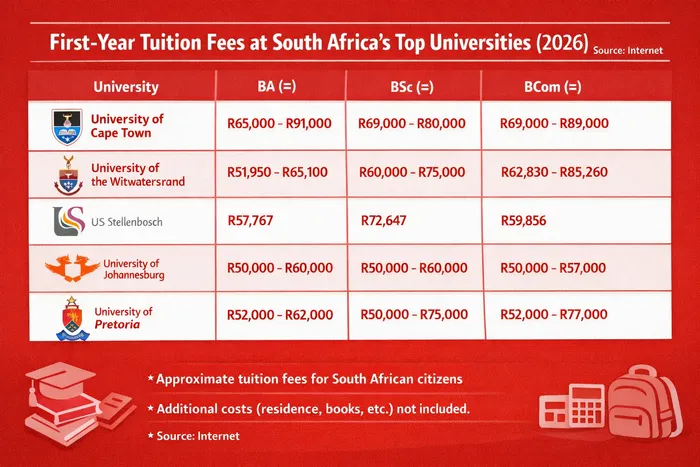
Here's what some degrees will cost you this year.
Image: ChatGPT
Making sense of the numbers
Tuition is only part of the cost. Fees vary depending on:
Understanding these factors helps families plan for the total cost of studying, not just the headline tuition figure.
How you can pay for university
Bank loans
Scholarships
Bursaries
Government support (NSFAS)
Making an informed choice isn’t just about what you want to study – it’s about understanding career options, personality fit, costs, and funding opportunities. Giving school leavers this guidance helps them plan smarter and reduces financial and career surprises down the line.
IOL BUSINESS