

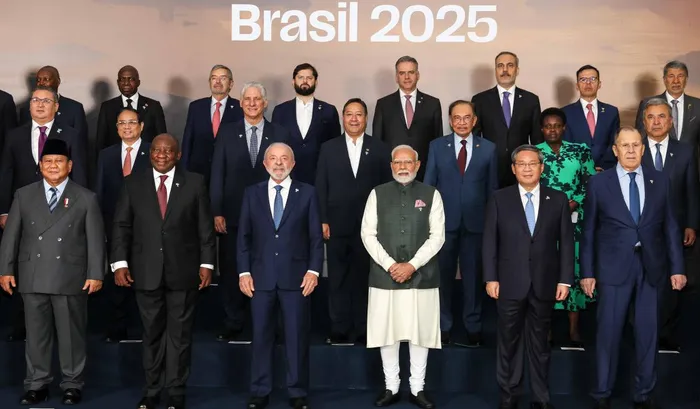
The group has evolved into an important global south voice. But long-term credibility will depend on something far more tangible: whether it can translate declarations into productive investment and industrial growth, argues the writer.
Image: GCIS
Tafadzwa Chibanguza
When leaders gather in India for the BRICS 2026 Summit this September, they will do so at a pivotal moment for the global economy. Trade patterns are shifting. Supply chains are being redesigned. Manufacturers are rethinking where they invest, produce and source critical goods. For countries willing to move decisively, this disruption presents an opportunity to reshape their industrial future. That is precisely where BRICS can distinguish itself.
The group has evolved into an important global south voice. But long-term credibility will depend on something far more tangible: whether it can translate declarations into productive investment and industrial growth. For the South African BRICS Business Council’s Manufacturing Working Group, that means focusing on a single priority: building a pipeline of high-impact, bankable manufacturing projects that can attract investment and deliver measurable economic outcomes.
For too long, industrial cooperation has centred on identifying opportunities. The next chapter must be about execution. Factories are not built on declarations. They are built on commercially viable projects backed by robust feasibility studies, sound governance, financial modelling and credible risk management. Without that preparation, even the most promising ideas struggle to attract capital. This is one of the biggest gaps across emerging markets. There is no shortage of manufacturing potential; there is a shortage of investment-ready projects that meet the expectations of development finance institutions, commercial lenders and private investors.
Institution like the NDB (BRICS Bank), supported by blended finance and risk-sharing mechanisms, can play a catalytic role by reducing investment risk and crowding in private capital. Finance alone is not enough. Industrial growth is built on partnerships that combine capital with technology, skills development, logistics and market access. Manufacturing is uniquely positioned to bring all of these elements together. A successful manufacturing investment strengthens entire value chains. It creates demand for suppliers, develops technical capabilities, supports innovation and generates long-term employment across multiple industries.
Those ripple effects are exactly what emerging economies need as they seek more resilient and diversified growth. South Africa’s capabilities in advanced engineering, automotive production, mining equipment, chemicals, agro-processing and industrial technologies position us as more than a manufacturing economy. They position us as a strategic industrial partner within BRICS. South Africa also has an opportunity to become a manufacturing and export platform for companies looking to expand into African markets. As global manufacturers diversify their production footprint, partnerships with countries such as China can support greater localisation, technology transfer and industrial investment, particularly in sectors ranging from textiles and footwear to advanced manufacturing.
Combined with South Africa’s logistics network, financial services expertise and access to the African Continental Free Trade Area (AfCFTA), this creates a compelling value proposition for export-oriented production. The aim is not to compete with fellow BRICS members. It is to build complementary industrial ecosystems where each economy contributes its comparative strengths while strengthening regional supply chains.
I believe that there should be a shift beyond facilitating dialogue. We must identify strategic projects, connect investors with opportunities, foster cross-border partnerships and help create the confidence that unlocks long-term investment. Ultimately, success will not be measured by the number of communiqués issued after the Summit. It will be measured by factories commissioned, industrial parks expanded, technologies transferred, supply chains strengthened, exports increased and sustainable jobs created.

Tafadzwa Chibanguza is the chair of the BRICS SA Business Council Manufacturing Working Group.
Image: LinkedIn
* Tafadzwa Chibanguza is the chair of the BRICS SA Business Council Manufacturing Working Group.
** The views expressed do not necessarily reflect the views of IOL or Independent Media.
BUSINESS REPORT