

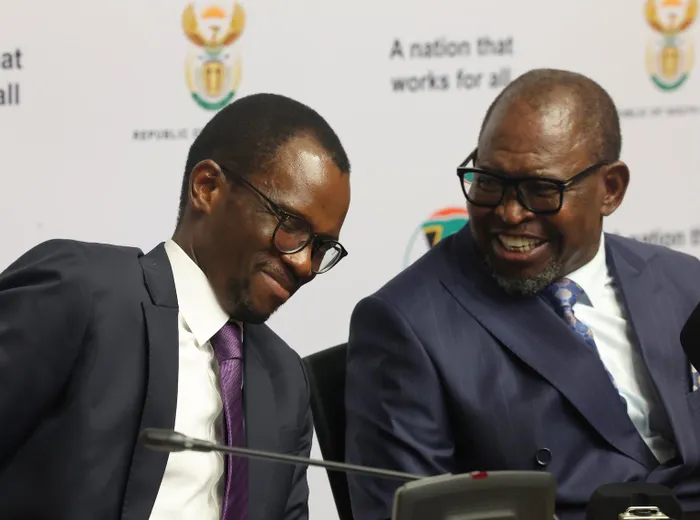
Finance Minister Enoch Godongwana and his deputy David Masondo. Treasury said the loan, together with funding secured from other multilateral development partners, has allowed government to meet its $3.2bn foreign currency borrowing requirement for the 2026/27 financial year.
Image: GCIS
In a significant vote of confidence in South Africa's reform agenda, the World Bank has approved a $1.5 billion (about R27 billion) loan to help government confront chronic challenges in electricity supply, freight logistics and water infrastructure that have long constrained economic growth.
Reforms supported by the new financing are expected to help create the equivalent of almost 600,000 more and better-paid jobs by 2032, according to World Bank Group economic modeling of how the reforms ripple through the broader economy.
The funding package arrives as government intensifies efforts to remove key infrastructure bottlenecks, improve service delivery and stimulate investment across critical sectors of the economy.
The Development Policy Loan, signed between the National Treasury and the World Bank, is the fourth such agreement between the two institutions since 2022 and forms part of a broader programme aimed at strengthening South Africa's infrastructure network and improving the performance of essential public services.
National Treasury said on Tuesday that the financing would support reforms in the electricity, freight and logistics, and water and sanitation sectors.
"The loan will help South Africa implement necessary interventions and reforms aimed at advancing reforms in the electricity, freight and logistics sectors, and addressing pressing challenges in the water and sanitation sector," Treasury said in a statement.
The funding is anchored on three key reform pillars: strengthening energy competitiveness and security, improving freight transport services, and delivering more efficient water and sanitation services.
Most of the nearly 600,000 projected jobs impact are expected to come from the reforms in the electricity and transport sectors which together are expected to support the equivalent of around 280,000 jobs by 2027, rising to over 560,000 by 2032.
Policy reforms will improve management efficiency and scale up private investment in rail, ports, and energy infrastructure, lowering business costs and supporting additional investment and employment in other sectors.
These reforms are intended to remove key obstacles to investment and economic activity while improving the delivery of essential public services.
Finance Minister Enoch Godongwana said the financing was aligned with its borrowing strategy, which aims to raise funding at the lowest possible cost while maintaining long-term debt sustainability.
"This program reflects our government's determination to remove the infrastructure constraints that have held back growth and job creation for too long," Godongwana said.
"Working with the World Bank Group, we are deepening reforms already delivering results in energy and transport, while for the first time tackling the governance and investment gaps in our water sector that affect millions of households, particularly the poorest."
The loan carries a 15-year maturity, including a three-year grace period, with an interest rate of the six-month Secured Overnight Financing Rate (SOFR) plus 1.35%.
According to Treasury, the concessional terms will help contain the government's debt-servicing costs compared with more expensive market borrowing.
The World Bank financing also enables South Africa to complete its foreign currency borrowing programme for the current fiscal year.
Treasury said the loan, together with funding secured from other multilateral development partners, has allowed government to meet its $3.2bn foreign currency borrowing requirement for the 2026/27 financial year.
Treasury thanked the World Bank for its continued support, saying the partnership would help maintain momentum behind structural reforms that are considered essential for raising economic growth and expanding employment.
Satu Kahkonen, World Bank Group division director for South Africa, said the country has shown that sustained reform can turn around even deep-seated infrastructure crises.
"By extending this support to water and sanitation for the first time, we are helping ensure the benefits of reform reach every household, while these efforts together are expected to help create almost 600,000 jobs and attract much-needed private investment."
South Africa has increasingly relied on financing from multilateral institutions to support reforms while accessing funding on more favourable terms than those typically available in international capital markets.
The latest agreement comes as government continues implementing Operation Vulindlela reforms designed to improve network industries, reduce infrastructure constraints and boost private-sector investment across key sectors of the economy.
BUSINESS REPORT