

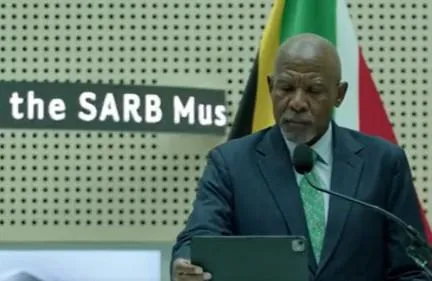
Sarb Governor Lesetja Kganyago speaking at the launch ofthe new museum and renovated head office campus in Pretoria on Friday.
Image: Sarb YouTube screengrab
The South African Reserve Bank (Sarb) has officially opened its new museum and renovated head office campus in Pretoria, with President Cyril Ramaphosa using the occasion to reaffirm the importance of the central bank’s independence and its role in supporting economic growth and financial stability.
The museum forms part of the Sarb’s commitment to transparency and accountability, opening its work to the public to enhance understanding of the central bank’s role in the economy. This will further serve to bring the institution closer to the public, fostering greater engagement and trust.
Speaking at the launch on Friday, Sarb Governor Lesetja Kganyago said the museum was created to make the institution more accessible to the public and to improve understanding of the role it plays in the economy.
“Today is about more than buildings. It is about opening our institution to the people of South Africa as we approach the Sarb’s 105th anniversary at the end of this month,” Kganyago said.
He noted that central banks are often viewed as distant and difficult to understand, adding that the museum would help explain the Reserve Bank’s work and strengthen public accountability.
“Strong institutions depend not only on sound governance and clear mandates, but also on public trust. That trust is strengthened when people understand how institutions work, why they exist and who they serve,” he said.
The museum features exhibits tracing Southern Africa’s economic history from ancient barter systems through colonialism and apartheid to democracy.
It also houses archaeological artefacts dating back 75,000 years, a numismatic collection spanning more than 300 years and South Africa’s first minting press, which is still operational after 134 years.
Kganyago said the facility would serve as both an educational resource and a repository of the country’s economic heritage.
“The museum will be a place for young people to learn about our history while also gaining practical insights into the world of economics and central banking,” he said.
The launch also provides public access for the first time to the Sarb’s extensive corporate art collection, which includes more than 1,200 works by South African artists.
Current exhibitions include ZA@WORK, which celebrates ordinary workers, and Her Currency: Stories of Heritage, Identity, Memory and Power, featuring works by renowned artists including Esther Mahlangu, Helen Sebidi and Mary Sibande.
In his keynote address, Ramaphosa described the museum as an important public education initiative that would help South Africans better understand the role of the Reserve Bank.
“It is a great privilege to join you for the launch of the South African Reserve Bank Museum. This is a proud day, not only for the Reserve Bank, but for our country,” he said.
“We are opening the doors of an institution whose work shapes the lives of every South African.”
Ramaphosa said the museum would contribute to improving financial and economic literacy, particularly among young people.
“Our young people will be able to walk through these halls and understand how an economy works, how money holds its value and why the institutions that safeguard it matter,” Ramaphosa said.
The launch comes as South Africa prepares to mark the 30th anniversary of its Constitution later this year. Ramaphosa used the occasion to highlight the constitutional mandate of the central bank and defend its operational independence.
“On the 30th anniversary of the adoption of our democratic Constitution, it is important that we reaffirm the constitutional role of the Reserve Bank: to protect the value of the currency in the interest of balanced and sustainable economic growth,” he said.
“The Constitution requires the bank to perform its functions independently and without fear, favour or prejudice, while consulting regularly with government.”
Ramaphosa stressed that the central bank’s independence was critical to maintaining confidence in South Africa’s economy.
“We must cherish and defend the integrity and independence of the Reserve Bank for it is a national asset built up over many years and trusted around the world,” he said.
Meanwhile, Kganyago said the museum was ultimately intended to strengthen the relationship between the institution and the public.
“Through this museum, we hope to strengthen accountability and bring the institution closer to the people it serves,” he said. “We look forward to welcoming generations of South Africans to the Sarb Museum.”
BUSINESS REPORT