

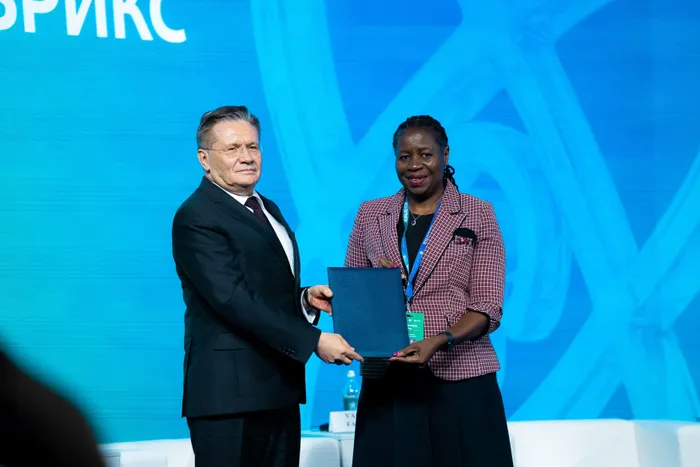
Alexey Likhachev, director general of Rosatom, and Elsie Pule, chief coordinator of the BRICS Nuclear Energy Platform.
Image: Supplied
Quantum technologies are set to play an increasingly important role in shaping the future of energy systems, with experts from BRICS nations calling for stronger collaboration in research, skills development and industrial applications during the inaugural BRICS Quantum Technologies Forum held in Moscow.
The forum, organised by Rosatom, brought together scientists, industry leaders and government representatives from BRICS member countries to explore opportunities for cooperation in one of the world's fastest-growing technological fields.
Discussions focused on how quantum computing, quantum sensing and quantum communications could support innovation across key industries, including energy, while also strengthening scientific partnerships among BRICS nations.
Speaking during the plenary session, participants highlighted the importance of international cooperation in accelerating technological development and building a skilled workforce capable of supporting future quantum industries.
Director General of Rosatom, Alexey Likhachev, said BRICS countries have an opportunity to combine their expertise and resources to advance quantum technologies and strengthen their economic competitiveness.
"BRICS is an influential international association with a broad and relevant agenda. Our task is to place quantum technologies firmly on that agenda," Likhachev said.
He noted that Russia has already achieved significant progress in the field, including the development of seven quantum computers based on priority technological platforms, dozens of quantum algorithms and a growing portfolio of projects focused on quantum computing, sensing and communications.
"This is expertise and experience that we are ready to contribute to international cooperation. I am confident that other BRICS countries will do the same. Together we are stronger," he said.
Likhachev added that by combining research efforts and implementing technology projects linked to industry and the broader economy, BRICS nations could strengthen their scientific institutions, businesses and national economies.
With energy security, technological innovation and economic competitiveness becoming increasingly interconnected, BRICS countries are positioning themselves to play a larger role in the global quantum race, while ensuring that future advances contribute to sustainable development and improved quality of life across member nations.
The growing relevance of quantum technologies for the energy sector was also emphasised by Elsie Pule, chief coordinator of the BRICS Nuclear Energy Platform.
Pule said members of the platform had unanimously recognised the strategic importance of quantum technologies for the future of nuclear energy and broader energy security.
"Our mission is to ensure that advanced nuclear technologies contribute to improving quality of human life," Pule said.
She noted that early applications of quantum computing within Russia's nuclear industry had already demonstrated the technology's potential to improve the efficiency, reliability and performance of nuclear power generation.
"Knowledge and expertise in this field should be accessible to all participants of the BRICS Nuclear Energy Platform," she said.
Pule expressed hope that with Rosatom's support, initiatives focused on sharing quantum expertise and advancing collaborative research programmes would be developed in the near future.
"We hope that, with Rosatom's support, initiatives aimed at sharing quantum expertise and advancing collaborative research will be developed in the near future, helping us fulfil our mission of serving both technological progress and humanity," she added.
The Moscow gathering builds on growing cooperation among BRICS countries in the nuclear energy sector.
Earlier this year, an expert session of the BRICS Nuclear Energy Platform was held during the Africa Energy Indaba 2026 in Cape Town, one of Africa's largest energy conferences.
A key outcome of that meeting was the signing of a memorandum of understanding between Necsa and Rosatom aimed at strengthening cooperation in workforce development and specialist training for the nuclear and related industries.
The agreement was viewed as an important step in building the skills pipeline required to support emerging technologies and future energy systems.
Participants at the Moscow forum said such partnerships would be critical as quantum technologies move from research laboratories into practical industrial applications.
BUSINESS REPORT