

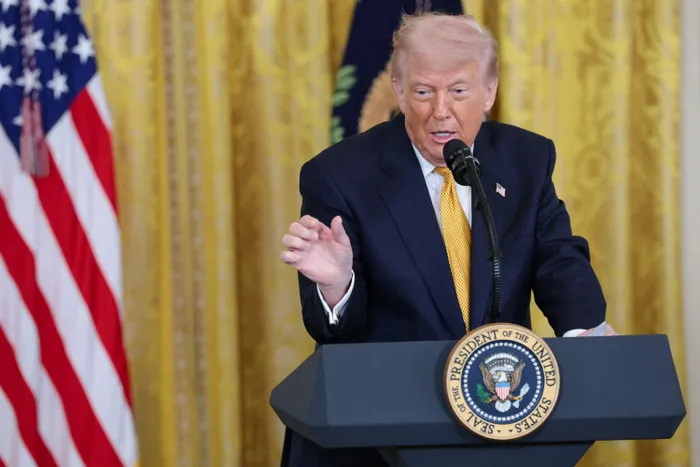
However, US President Donald Trump cautioned that there was “no rush” to finalise a deal, adding that the US would maintain its blockade of the Strait of Hormuz until a formal agreement had been concluded.
Image: Anna Moneymaker / Getty Images via AFP
Hopes of a peace deal between the United States and Iran sent oil prices sharply lower on Monday, with Brent crude futures falling nearly 5% to trade below the psychologically important $100 per barrel level.
The decline extended last week’s losses as reports suggested Washington and Tehran were moving closer to an agreement that could ease tensions in the Middle East and potentially reopen the Strait of Hormuz — one of the world’s most critical energy shipping routes.
According to reports, the proposed agreement could include the reopening of Hormuz, the release of frozen Iranian assets and further negotiations aimed at limiting Tehran’s nuclear programme.
However, US President Donald Trump cautioned that there was “no rush” to finalise a deal, adding that the US would maintain its blockade of the Strait of Hormuz until a formal agreement had been concluded.
The prospect of easing tensions nevertheless boosted investor confidence across global markets. Asian equities rallied in early trade, with Japan’s Nikkei climbing more than 3%, while the Shanghai Composite edged 0.5% higher. Trading activity remained subdued due to public holidays in Hong Kong and South Korea.
The Strait of Hormuz is responsible for transporting roughly one-fifth of global oil and liquefied natural gas shipments, making it one of the most strategically important waterways in the global energy market.
Any reopening of the route would significantly improve global supply conditions and reduce fears of prolonged disruptions.
The recent Iran conflict and the dual blockade of Hormuz have severely strained energy markets, forcing several Middle Eastern producers to suspend millions of barrels per day in crude output. Analysts say a successful agreement could rapidly reverse some of the supply concerns that had pushed oil prices sharply higher earlier this month.
Bianca Botes, managing director at Citadel Global, said optimism surrounding a potential US-Iran peace deal had improved market sentiment and increased investor appetite for risk.
“Despite US President Donald Trump saying there was “no rush” to reach a deal, US stock futures rose sharply on Sunday night as easing Middle East tensions and lower oil prices lifted the outlook,” Botes said.
The US markets are closed today for the Memorial Day public holiday.
As oil prices retreated, the South African rand strengthened on improved global sentiment, opening the week at R16.33 against the US dollar. Meanwhile, gold rose 1% to $4,558 an ounce as investors continued to seek safe-haven assets amid ongoing geopolitical uncertainty.
BUSINESS REPORT