

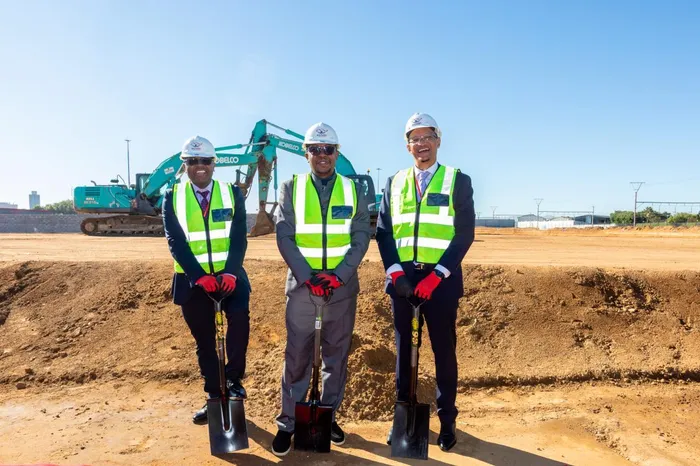
Minister of Trade, Industry and Competition, Parks Tau, with the Director-General of the Department of Science, Technology and Innovation, Dr Mlungisi Cele, and Biovac CEO, Dr Morena Makhoana, at the Biovac Pharma facility in Cape Town.
Image: Supplied
South Africa is strengthening its position as a continental leader in vaccine manufacturing following the expansion of the Biovac vaccine production facility in Cape Town, a project the government says will boost health security, industrialisation and economic growth across Africa.
Biovac is a South African-based biopharmaceutical company established in 2003 in partnership with government to build local vaccine manufacturing capability. The company plays a strategic role in strengthening South Africa and Africa’s health security through the production and supply of vaccines.
Speaking at the soil-turning ceremony for the facility expansion on Monday, Minister of Trade, Industry and Competition (the dtic) Parks Tau said the investment signals Africa’s growing role in global healthcare manufacturing.
The visit formed part of the dtic’s stakeholder engagement programme ahead of the 2026/27 Budget Vote and highlighted government-backed industrialisation and localisation initiatives in priority sectors.
Tau said the expansion of the Biovac end-to-end vaccine manufacturing facility sends a powerful signal to the world: that Africa is increasingly becoming a producer, innovator, and strategic partner in global healthcare manufacturing.
“One of the lessons from COVID-19 health and economic pandemic experience is that Africa must build stronger regional pharmaceutical, medical device, in-device validation, diagnostic and vaccine manufacturing capabilities to ensure greater health security, resilience, and self-reliance,” said Tau.
“Despite our challenges and high import dependence, South Africa has both the capability and the responsibility to play a leading role in this continental effort.”
African countries import 70–100% of finished pharmaceutical products and about 99% of vaccines, with less than 1% of vaccines used on the continent produced locally. This reliance leaves health systems vulnerable to global supply disruptions, price shocks, and export restrictions—risks that were brought into sharp focus during the COVID-19 pandemic.
The expansion project will allow Biovac to manufacture vaccines for cholera, polio, pneumonia and meningitis, with the facility expected to produce between 30 million and 40 million doses annually once completed in 2028.
The project is also expected to create more than 340 skilled jobs and around 7,000 indirect employment opportunities.
Tau said the investment directly supports government’s industrialisation agenda by deepening local pharmaceutical production, strengthening technology transfer and expanding advanced manufacturing capacity.
“Importantly, this investment aligns strongly with the African Union’s aspirations for health sovereignty, the Partnerships for African Vaccine Manufacturing initiative, and the African Continental Free Trade Area’s objective of building regional value chains and strategic industrial capability across the continent,” he said.
Biovac CEO Morena Makhoana on Monday said the government support remained critical to the company’s ambition of becoming a fully integrated vaccine manufacturer.
“Whilst Biovac works and is being supported by global partners either in developing new products, technology transfers, and innovative financing, there is nothing that can replace home-grown support,” Makhoana said.
“This moment that we celebrate with the South African government is truly important to demonstrate that the local ecosystem in South Africa led by our government is equally and truly supportive of our quest to be an end-to-end vaccine manufacturer of equal standing to our international peers.”
The project has received strong backing from international development finance institutions and European partners, including the European Investment Bank (EIB), the International Finance Corporation (IFC), Proparco and the Industrial Development Corporation (IDC).
Last month, Biovac received a R1.47 billion investment from the EIB Group, the European Commission and the IFC, to become Africa’s first multi-vaccine manufacturing site.
The IFC this month also secured additional private capital investment of $20 million (around R330 million) from French development finance institution Proparco as well as $20m in backing from private sector credit insurers for Biovac.
David McAllister, chairperson of the European Parliament’s Foreign Affairs Committee, said the European Union’s €95 million contribution to Biovac represented the largest financing package in the company’s history.
“Our contribution demonstrates concretely the impact of the European Union’s Global Gateway in Africa’s health security, as well as in building resilience and reducing dependencies,” McAllister said.
“Beyond financing, this is about transformational impact on skilled jobs, industrial value chains, local beneficiation and EU–Africa private sector partnerships, fully aligned with South Africa’s local manufacturing ambitions.”
The expansion also supports the African Union Vision 2040 target of producing 60% of vaccines locally in Africa and forms part of the EU-South Africa Comprehensive Trade and Investment Partnership.
BUSINESS REPORT