

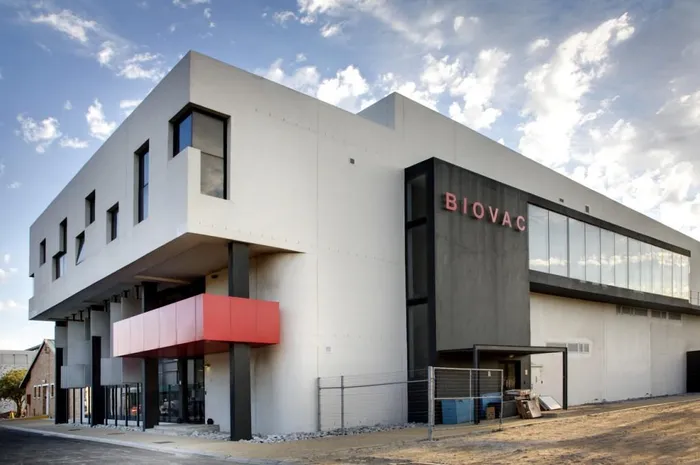
Biovac builds Africa's first end-to-end multi-vaccine manufacturing site with backing from the European Investment Bank Group, European Commission and the International Finance Corporation.
Image: Supplied
Biovac, based in Cape Town, will become Africa’s first multi-vaccine manufacturing site after a R1.47 billion investment by the European Investment Bank (EIB) Group, the financing arm of the European Union, the European Commission and the International Finance Corporation (IFC).
The “quasi-equity” €75 million investment will also enable an additional $20m senior loan, as well as further senior financing from the IFC, a statement said Thursday. The investment is backed by a European Commission EFSD+ guarantee under the Human Development Accelerator (HDX), part of the EU's Global Gateway strategy.
The EFSD+ guarantee acts as a safety net for lenders, covering potential losses if projects fail. In blended finance operations, the EU combines a small grant contribution with loans to attract additional public and private funding, maximising the impact of projects.
“We are proud to partner with the European Commission, EIB Group and IFC on this transformative greenfield project - a state-of-the-art multi-vaccine facility. Expanding local vaccine development and end-to-end manufacturing on African soil for global supply has always been Biovac’s vision, and this funding enables us to accelerate it,” said Biovac CEO Morena Makhoana.
He said the new facility would ensure a reliable supply of life-saving vaccines for Africa and expand the company's role in building skills, advancing technology transfer and driving vaccine innovation that will benefit generations to come.
Biovac is a South African biopharmaceutical company established in 2003 in partnership with the South African government to develop local vaccine manufacturing capability. Biovac currently manufactures and supplies routine paediatric vaccines and has delivered more than 450 million vaccine doses across Southern Africa, including COVID-19 vaccines.
More than 340 skilled and 7,000 indirect jobs will be created through the expansion, providing a major boost to vaccine self-reliance and regional health resilience, said Makhoana.
Around 50% of the manufacturing equipment for the new facilities will come from European suppliers, underscoring industrial partnership between Europe and Africa and ensuring mutual economic benefits.
The facility, expected to be completed by 2028, will initially produce the oral cholera vaccine and later expand to include vaccines for polio, pneumonia and meningitis, a statement said Thursday.
Once operational, it could address about 40% of the global cholera vaccine supply gap and supply regional markets through procurement channels such as UNICEF and Gavi, the Vaccine Alliance.
EIB President Nadia Calviño said: “With this project, alongside our partners, we are making history. The European Investment Bank is very proud to support the production of vaccines in Africa, for Africa, in what will be the first facility of its kind on the continent. This will save lives: protect millions of children from serious illnesses and equip scientists and health workers to safeguard their own communities.”
“We are using our guarantee... to unlock private and multilateral investment in a facility… that is health sovereignty combined with real development impact. And it is exactly the model we are replicating through the Global Health Resilience Initiative, launching before the summer,” said Jozef Síkela, EU Commissioner for International Partnerships.
IFC Regional Vice President for Africa, Ethiopis Tafara said: “Africa has a significant market in scaling resilient, high-quality vaccine manufacturing and strengthening long-term health security across the continent. Building local manufacturing capacity is both a development imperative and a strategic investment in resilience.”
Tafara said the innovative financing demonstrated how multilateral development banks could work together to unlock transformative investments and lay the foundations for a sustainable vaccine manufacturing industry in Africa.
Kalpana Kochhar, Interim President, Global Policy & Advocacy at the Gates Foundation, said: “Expanding vaccine access and advancing health equity remain urgent priorities. Through our partnership with the EIB and the European Commission as part of HDX, we support efforts to make vaccine supply more reliable, so that life-saving vaccines reach people quickly and affordably.”
The project directly supports the African Union’s Vision 2040 goal of achieving 60% local vaccine production and advances several United Nations Sustainable Development Goals. It is also aligned with the African Vaccine Manufacturing Accelerator (AVMA) initiative.
The IFC, a member of the World Bank Group, is the largest global development institution focused on the private sector in emerging markets. It works in more than 100 countries. The IFC committed a record $71.7bn to private companies and financial institutions in developing countries, leveraging private sector solutions, in 2025.
Biovac’s first South African production of paediatric vaccine five years ago was the first time since the mid-1990s that any sterile manufacturing of human vaccines had been done in South Africa.
BUSINESS REPORT