

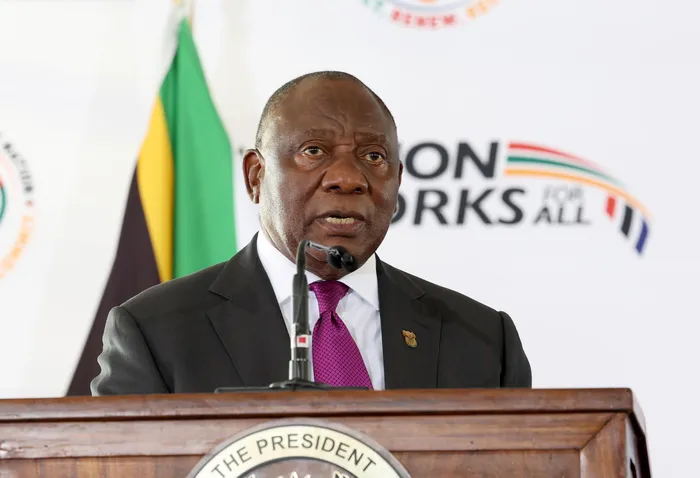
President Cyril Ramaphosa conceded that South Africa still has a significant distance to travel before investment levels return to what is needed to stimulate sustained economic expansion.
Image: File
President Cyril Ramaphosa has defended South Africa’s investment drive, acknowledging that turning investment pledges into meaningful economic growth and jobs remains a difficult and long-term process.
In his weekly newsletter on Monday, Ramaphosa pushed back against criticism that the country’s investment conferences and summits are merely symbolic events, insisting they are beginning to produce tangible economic activity despite persistent economic headwinds.
Ramaphosa said investment was “a long-term commitment” and warned that moving from announcements and pledges to actual implementation, growth and employment creation takes years, particularly in capital-intensive sectors such as mining, energy and infrastructure.
“Investment is a long-term commitment. Moving from pledges to large-scale growth and employment creation takes time, particularly in sectors where projects take years to reach implementation,” Ramaphosa said.
He conceded that South Africa still has a significant distance to travel before investment levels return to what is needed to stimulate sustained economic expansion.
This comes as South Africa’s unemployment crisis worsened sharply in the first quarter of 2026, climbing to 32.7% in the first three months of the year from 31.4% in the previous quarter after the economy shed 345,000 jobs.
“The reality is that we are a long way from where we need to be,” he said.
Ramaphosa pointed to gross fixed capital formation (GFCF), a key measure of investment in the economy, which currently stands at around 14% of gross domestic product. This is far below the 30% target set out in the National Development Plan for 2030.
Ramaphosa noted that South Africa last achieved stronger investment levels in 2008, when GFCF reached approximately 21% of GDP. At the time, investment was driven by the commodity boom, major infrastructure expansion ahead of the 2010 FIFA World Cup, and Eskom’s large build programme.
However, he said the global financial crisis and years of State capture severely damaged investor confidence and undermined private sector investment.
Ramaphosa said his administration has spent the past several years trying to reverse that decline by stabilising public finances, tackling the electricity crisis and implementing structural reforms aimed at improving the business environment.
Despite these efforts, he admitted there remained a disconnect between improved investor sentiment and actual investment flows into the economy.
“Yet there is still a disconnect between improved investor sentiment and greater investment,” he said.
Ramaphosa argued that government was now focused on narrowing the gap between investment commitments and implementation by improving project planning, funding and execution.
He said the message government has consistently taken to investors is that South Africa is working to create policy certainty and better conditions for growth.
The president highlighted that since the launch of the country’s investment drive in 2018, government has secured investment pledges worth R1.5 trillion, with R634 billion already invested into projects including factories, mines, data centres and power plants.
Among the projects cited were BMW’s R4.2 billion investment to electrify its Rosslyn plant in Gauteng, Tetra Pak’s R500 million expansion in KwaZulu-Natal, and the development of the Newlyn PX terminal at the Port of Durban.
Ramaphosa also referenced the Ivanplats Platreef mine in Mokopane, which emerged from a R2.8bn investment conference commitment.
Beyond infrastructure and industrial projects, Ramaphosa said investment was also supporting skills development and preparing young South Africans for a changing economy increasingly shaped by artificial intelligence and digital technologies.
He cited Microsoft’s partnership with the Youth Employment Service to provide AI-related skills training as part of the company’s R5.4bn investment in cloud and AI infrastructure in South Africa.
At the same time, Ramaphosa called on domestic companies to play a leading role in rebuilding investment momentum, saying local investors are often best positioned to understand South Africa’s economic conditions and opportunities.
According to the president, South African non-financial companies were holding around R1.8 trillion in reserves by July 2025, capital he believes should increasingly be channelled into productive domestic investment.
“As we forge ahead with efforts to attract new investment, we call on the local private sector to be at the forefront of rebuilding investment momentum in our economy,” Ramaphosa said.
He added that local business confidence would help attract more international investment into the country over time.
BUSINESS REPORT