

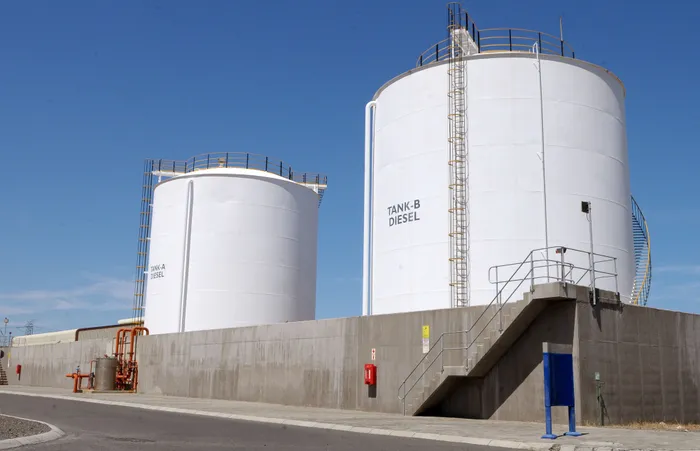
On-site diesel storage tanks at Eskom’s Ankerlig Power Station in Atlantis.
Image: Tracey Adams/Independent Newspapers
Eskom has announced disciplinary action against several employees implicated in irregularities linked to a diesel procurement and storage contract, warning that criminal charges could follow as investigations deepen into alleged governance failures and procurement breaches.
The power utility on Friday outlined the first key actions arising from an interim forensic investigation report into tender MWP2197GX, which relates to the supply of diesel to Eskom’s Open Cycle Gas Turbine (OCGT) power stations.
Eskom utilises diesel-fired capacity from two main OCGT stations, Ankerlig Power Station in Atlantis, and Gourikwa Power Station in Mossel Bay, both in the Western Cape.
Eskom also utilises diesel-fired capacity from two Independent Power Producer (IPP) stations as part of its broader operations but these IPP arrangements are not part of the current investigation or associated consequence management processes.
The investigation, launched in March 2025 by Eskom’s Group Investigations and Security division, was triggered by concerns over contract performance during periods of severe load shedding earlier last year, as well as whistleblower reports received through internal reporting mechanisms.
Eskom said an independent forensic firm has since completed an interim report, with the final report expected in mid-June 2026.
The power utility said the interim findings uncovered instances where employees failed to follow procurement and contract management processes.
As a result of the findings contained in the interim report, Eskom said it will commence with disciplinary proceedings against several employees who breached our procurement processes. Eskom added that it expects that more employees may be charged once the final report has been issued.
Mteto Nyati, chairman of Eskom’s board, said the utility would take an uncompromising stance against corruption and governance failures.
“We maintain zero tolerance for corruption and any breach of Eskom’s processes. This investigation was initiated proactively by Eskom management itself, demonstrating our commitment to uncover and address wrongdoing without external prompting,” Nyati said.
“We will seek to recover every rand of financial loss, while relentlessly executing our action plans to address historical misconduct, reinforce governance and embed ethical conduct at every level. The Board’s commitment to this is absolute and will not waver.”
The utility also confirmed that suppliers implicated in violating procurement rules could face disciplinary action under Eskom’s supplier review processes and, where warranted, criminal processes.
Dan Marokane, Eskom Group CEO, said the utility would continue strengthening accountability and governance systems while protecting the reputation of honest employees.
“The vast majority of Eskom’s employees are honest and hardworking, and we will not allow a few to tarnish the majority’s reputation. The ongoing resourcing drive to adequately capacitate the finance, internal audit and forensics functions to address key skills gaps within the business continues to attract talent to Eskom,” Marokane said.
“We are applying the same level of effort to ending years of governance and accountability failings as we did to ending load shedding, by continuously strengthening our controls as the landscape evolves.”
Eskom confirmed that the matter had been reported to the Directorate for Priority Crime Investigation, commonly known as the Hawks, in line with the Prevention and Combating of Corrupt Activities Act.
The utility also revealed that it had reinstated full-scale proactive assurance and probity reviews for high-value tenders after previously scaling back oversight measures in 2022.
Eskom said the central review panel responsible for procurement oversight on tenders exceeding R500 million had been discontinued on cost grounds, leaving the business vulnerable to irregularities because only limited anti-bribery and fraud checks were being conducted.
“From late 2025 proactive assurance and full scope probity reviews have since been reinstated,” Eskom said.
The utility stressed that diesel usage remains necessary during periods of constrained generation capacity and high electricity demand to stabilise the national grid.
However, Eskom said diesel expenditure has fallen sharply as generation performance improved and reliance on diesel-fired generation declined.
For the current financial year to date, from 1 April to 7 May 2026, diesel spending amounted to R469.24m. During the previous financial year, Eskom spent about R6.4 billion on diesel — significantly below the R11bn budgeted and nearly 81% lower than the R33bn recorded in the 2023 financial year.
Eskom said the reduction reflects improving operational stability and lower dependence on emergency generation measures.
BUSINESS REPORT