

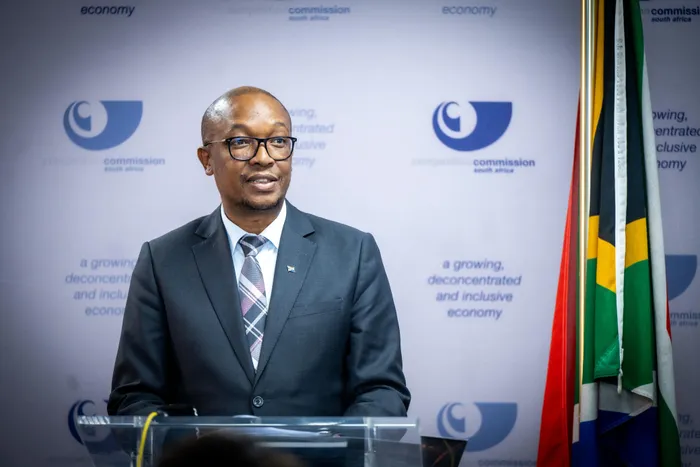
Minister Parks Tau addressing officials at the handover of the second Concentration Report of the Competition Commission hosted at the headquarters of the Department of Trade, Industry and Competition (the dtic) in Pretoria.
Image: Supplied
South Africa’s economy remains dominated by a small number of powerful firms, with the country’s competition watchdog warning that entrenched concentration continues to undermine growth, job creation and the ability of small businesses to compete.
In its 136-page second Concentration Report released on Tuesday, the Competition Commission said between one-third and one-half of the country’s 228 economic sub-sectors remain either highly or moderately concentrated, despite some improvement since 2017.
The report paints a detailed picture of an economy where large incumbents continue to dominate key industries such as mining, manufacturing, energy and transport, while small and medium enterprises struggle to expand.
The Commission said concentration remains particularly severe in sectors tied to energy commodities, including oil, gas, coal and iron ore. State-owned monopolies in electricity and transport also continue to shape the competitive landscape alongside concentrated private markets in areas such as sea transport and waste management.
Although the report noted signs of gradual improvement, it warned that economic participation is still far from inclusive.
“Economic concentration remains high,” the Commission said, adding that persistent market dominance can weaken competitiveness and limit opportunities for new entrants.
The findings are based on analysis of roughly 450,000 tax-registered firms between 2017 and 2021 and form part of government’s broader effort to de-concentrate the economy and stimulate inclusive growth.
The report found that the share of highly concentrated sub-sectors has declined by five percentage points since 2017, with 10 sub-sectors shifting from “high” to “moderate” concentration. Around two-thirds of highly concentrated markets recorded some reduction in concentration levels over the period.
However, the Commission warned that markets dominated by a single firm showed little movement, often because of exclusionary business practices that limit competition.
A major concern highlighted in the report is the weak position of micro, small and medium enterprises (MSMEs) in the economy.
While MSMEs account for 97% of all tax-registered firms in South Africa, they contribute only 22% of total turnover — significantly below the Organisation for Economic Co-operation and Development average of about 50%.
The report also identified what it called a “missing middle” in the economy, where too few firms successfully grow from small businesses into medium-sized companies. Most firms remain micro-sized, while medium-sized enterprises account for only around 4% of registered businesses.
According to the Commission, scaling up is particularly difficult in concentrated sectors where dominant firms control access to markets, distribution channels and supply chains.
The Covid-19 pandemic further worsened conditions for smaller businesses. During the pandemic period, the MSME exit rate reached 12%, resulting in a net 3% decline in the number of smaller firms. At the same time, 22% of small and medium businesses slipped into lower size categories, while larger companies proved more resilient.
The report also highlighted widening inequality between firms. The top 10% of companies increased their share of turnover to more than 90%, while the bottom half of firms accounted for less than 1% of turnover.
Despite these pressures, MSMEs remain critical to employment creation, accounting for 44% of jobs and being nearly twice as labour-intensive as large firms.
The Commission said reforms are needed to reduce barriers facing smaller firms, including restrictive distribution arrangements, burdensome licensing requirements and limited access to routes to market.
Competition Commissioner Doris Tshepe said the report would help guide future enforcement action and policy development.
“The Concentration Report forms part of the Commission’s broader research agenda. It is aimed at guiding competition law enforcement, policy development, and sector-specific investigations and market inquiries based on evidence,” Tshepe said.
“The Commission encourages academic and research institutions to engage in concentration research. It also commits to making its data available to support such endeavours and public discourse.”
Minister of Trade, Industry and Competition, Parks Tau, said his department has made it its priority to de-concentrate the South African economy through the national Industrial Policy.
Tau said South African’s evolving Industrial Policy anchored on Diversification, Decarbonisation, and Digitalisation is designed to open new sectors, create new entry points, and shift the balance of economic power.
“The report is correct in emphasising that supporting MSMEs is not sufficient on its own. We must simultaneously dismantle the barriers that prevent them from growing,” he said.
“That means confronting private sector market access barriers — buyer power, exclusive dealing, predatory pricing. And it means turning a hard eye on government-created barriers too: licensing regimes, permit systems, operating standards that have, too often, been weaponised to protect incumbents rather than serve the public interest.”
He added that there is an urgent need to conclude the framework for scaling township and rural enterprises through avenues such as the Transformation Fund so that MSMEs are not permanent supplicants to dominant firms, but genuine competitors and market-shapers in their own right.
BUSINESS REPORT