

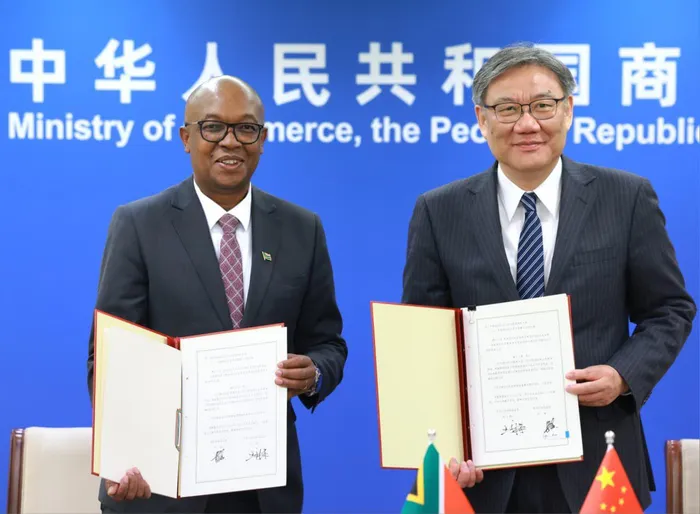
Minister Parks Tau and China’s Minister of Commerce, Wang Wentao, signed the China–Africa Economic Partnership Agreement (CAEPA), a landmark deal to grant South African exports duty-free access to the Chinese market while boosting investment into South Africa’s economy.
Image: Supplied
South Africa has begun to benefit from a major export boost amid China’s decision to introduce a temporary zero-tariff preference scheme for selected African economies, including South Africa.
The move, announced by Chinese President Xi Jinping earlier this year, sees qualifying South African goods exported to China enter the Chinese market free of customs duties from 1 May 2026 until 30 April 2028.
The signing of the China-Africa Economic Partnership Agreement (CAEPA) was a key breakthrough in providing South African exports with duty-free access to the massive consumer market.
The policy extends preferential treatment to 20 non-least developed African countries that maintain diplomatic ties with Beijing, complementing existing duty-free access already granted to least developed countries under the Forum on China-Africa Cooperation (FOCAC) framework.
According to China Xinhua News, 24 tons of South African apples became the first batch of imports to enter China at the stroke of midnight under a landmark initiative.
Minister of Trade, Industry and Competition, Parks Tau, said the development signals a strengthening economic relations between China and the African continent while opening meaningful opportunities for South African exporters to tap into one of the world’s largest consumer markets.
However, access to the zero-tariff regime will not be automatic. Exporters must comply with strict rules of origin requirements and provide valid certification to Chinese customs authorities.
The Department of Trade, Industry and Competition (the dtic), working alongside the South African Revenue Service, is currently finalising customs procedures and legislative adjustments to support implementation.
Tau cautioned that exporters who fail to secure a Certificate of Origin before shipment may face upfront costs. In such cases, importers in China will be required to pay a deposit, refundable once the correct documentation is submitted. Retrospective certificates will be allowed but must be clearly marked and will remain valid for one year from shipment.
While the scheme spans a wide range of products, certain categories may still be subject to conditions such as tariff-rate quotas. Exporters are therefore urged to familiarise themselves with detailed tariff schedules and compliance rules to maximise the benefits.
The dtic has positioned the initiative as a strategic lever to enhance South Africa’s export competitiveness, particularly in higher value-added goods, while supporting industrialisation and job creation. Sectors expected to benefit include agriculture, manufacturing and beneficiated products.
To support businesses, the department has activated its Export Help Desk as a central support hub and will publish a detailed FAQ guide to assist companies in navigating compliance and market entry requirements.
Tau said the scheme aligns with South Africa’s broader export diversification strategy, aimed at building economic resilience and reducing dependence on traditional markets.
“This preferential access offers a real opportunity for South African firms to scale up exports and deepen participation in global value chains,” Tau said, adding that the initiative marks a tangible outcome of recent FOCAC engagements and growing trade cooperation between Africa and China.
Last month, acknowledged that global trade conditions have become increasingly uncertain, with rising protectionism and disruptions affecting open economies like South Africa, but emphasised that the country has responded with agility rather than retreat.
Central to this response is the so-called “Butterfly Strategy,” which has seen South Africa redirect its trade efforts toward high-growth markets across Africa, Asia, the Middle East and Latin America.
BUSINESS REPORT