

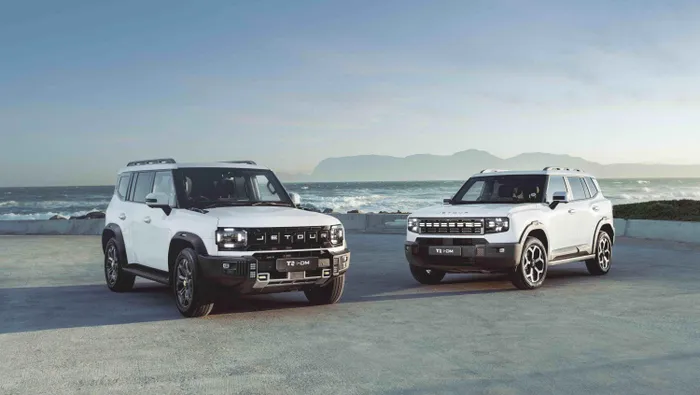
Jetour's T-Series is now available in plug-in hybrid form. The writer argues that South Africa’s domestic industry is being exposed to a more demanding and more competitive global market, and policy can no longer rely on inertia.That does not mean government should be passive. It does mean the r
Image: Supplied
By Thanda Sithole
South Africa’s automotive industry is being quietly but materially reshaped. A growing influx of lower-cost Chinese vehicle brands is changing the affordability equation for consumers, with many buyers now able to purchase a brand-new vehicle at a price once associated with the used market. For households under financial strain, that is an attractive proposition. For the domestic automotive industry, however, the implications are more complex.
Recent market data underscores the pace of this shift. According to National Association of Automobile Manufacturers of South Africa (naamsa), Chinese vehicle brands have rapidly increased their footprint in the local market, collectively accounting for over 9% of total new passenger vehicle sales in 2024, up from low single-digit levels just a few years ago. Brands such as Chery, Haval (Great Wall Motors), and BAIC have been key contributors to this growth, with Chery alone recording year-on-year sales growth exceeding 80% at various points in 2023 and 2024.
The shift is already becoming visible across the market. Lower-priced new vehicle options are beginning to place pressure on the used vehicle segment, where relative value has historically supported demand. Consumers who may have previously opted for a pre-owned vehicle are now increasingly able to access new models with more competitive pricing, attractive features, and, in many cases, better financing options.
From a motor finance perspective, this trend is not without upside. Greater affordability in the new vehicle market can support credit demand and stimulate fresh activity in a sector that has remained under pressure from weak household income growth, elevated borrowing costs and subdued confidence. In the short term, this may prove supportive for new vehicle finance and associated dealership activity.
But while the financing story may be constructive, the broader economic and industrial implications deserve more scrutiny.
South Africa’s automotive industry is not simply another consumer-facing market. It is one of the country’s most strategically important manufacturing sectors, a major employer, exporter and contributor to industrial output. The sector supports a wide ecosystem of component manufacturers, logistics providers, retail networks and downstream services. Pressure on the domestic market, therefore, has implications well beyond showroom floors.
The concern is not that Chinese brands are entering the market. Competition, in itself, is not the problem. In fact, increased competition can be healthy. It can improve affordability, raise product quality, expand consumer choice and force incumbents to adapt. In an economy where many consumers have been priced out of major purchases, lower-cost mobility solutions are not trivial. They matter.
The real concern is whether South Africa’s domestic automotive base is sufficiently competitive to absorb this shift without a meaningful erosion in local industrial capacity.
That question matters because South Africa is competing in a global automotive environment that is changing rapidly. Chinese manufacturers have become formidable competitors, not only because of price, but because of scale, supply chain integration, technological capability and speed to market. In several segments, they are no longer merely low-cost alternatives; they are increasingly credible mainstream contenders.
If that competitive pressure accelerates faster than local producers can adapt, the risk is not simply lower margins. It is a gradual weakening of domestic productive capacity, reduced model relevance, shrinking local value-add and, ultimately, pressure on investment and employment over time.
This naturally raises the policy question: should South Africa respond with higher import duties or other trade restrictions to limit the influx?
At first glance, the case for intervention appears straightforward. If lower-cost imports are placing local OEMs under pressure, tariffs may seem like a reasonable way to level the playing field and buy domestic producers time to adjust. For a country trying to preserve industrial jobs and protect its manufacturing base, that instinct is understandable.
But import duties are a blunt instrument, and blunt instruments often create as many problems as they solve.
Higher duties may offer temporary relief to domestic producers, but they would also raise costs for consumers, particularly lower- and middle-income households already facing strained affordability. They could reduce competitive discipline in the market, shield structural inefficiencies and delay the very adaptation that the industry ultimately needs. In the absence of broader competitiveness reforms, tariffs risk becoming a defensive policy response rather than a strategic one.
There is also the question of whether tariffs would address the root causes of the problem. South Africa’s automotive competitiveness is not determined by pricing alone. It is shaped by a broader set of structural constraints such as logistics inefficiencies, port bottlenecks, electricity insecurity (though this seems to have improved recently), input costs, localisation challenges and the general cost of doing business. These are not issues that can be solved at the border.
In that sense, the rise of Chinese imports is less a problem in itself than a symptom of a larger challenge. South Africa’s domestic industry is being exposed to a more demanding and more competitive global market, and policy can no longer rely on inertia.
That does not mean government should be passive. It does mean the response should be more thoughtful than blanket protectionism.
A more credible policy approach would be one that preserves the consumer benefits of competition while strengthening the domestic industry’s ability to compete. That includes reassessing whether existing industrial support frameworks remain fit for purpose, deepening localisation where economically viable, improving infrastructure and logistics performance, and ensuring the domestic sector is positioned for future product and technology shifts, including the gradual transition in vehicle platforms and propulsion systems.
In other words, the right question is not whether South Africa should resist competition. It is whether it can build an automotive ecosystem capable of surviving and adapting to it.
The growing presence of Chinese vehicle brands is exposing a genuine policy dilemma. Consumers benefit from affordability and choice, while domestic producers face a more intense competitive environment. Both realities are true at the same time.
The temptation will be to reach quickly for tariffs. But if the response is limited to import duties alone, South Africa risks protecting yesterday’s structure at the expense of tomorrow’s competitiveness.
The better response is harder, but ultimately more sustainable, improve the domestic industry’s ability to compete rather than simply trying to insulate it from competition.

Thanda Sithole is a senior economist at FNB and WesBank.
Image: Supplied
* Thanda Sithole is a senior economist at FNB and WesBank.
** The views expressed do not necessarily reflect the views of IOL or Independent Media.
BUSINESS REPORT