

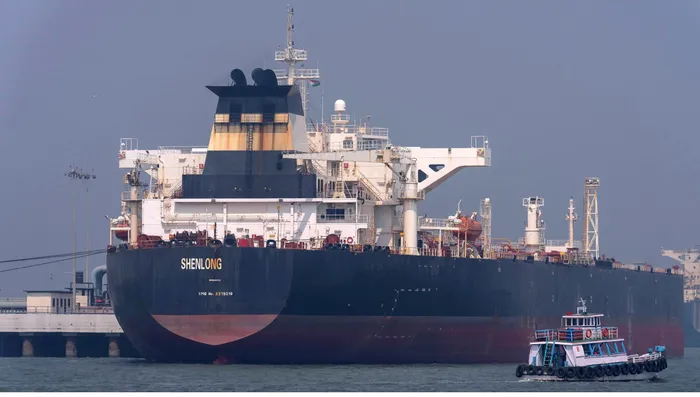
History of Weaponising The Strait of Hormuz Before the current war in Iran, nearly a fifth of the world’s oil traveled through the Strait of Hormuz. According to market and shipping data, traffic through the strait has slowed dramatically, with only a handful of vessels making the passage under constrained and risky conditions.
Image: AP Photo
United States Vice President JD Vance on Sunday declined to address mounting concerns over the full reopening of the Strait of Hormuz following stalled Iran talks in Islamabad, Pakistan, even as new data points to a deepening crisis in one of the world’s most critical oil chokepoints.
Speaking after a marathon 21 hours of negotiations in Pakistan, Vance confirmed that the US and Iran had failed to reach an agreement, with Washington insisting on firm guarantees that Tehran would not pursue nuclear weapons.
“The simple fact is that we need to see an affirmative commitment that they will not seek a nuclear weapon and they will not seek the tools that would enable them to quickly achieve a nuclear weapon,” he said.
“We’ve made very clear what our red lines are, what things we’re willing to accommodate them on and what things we’re not willing to accommodate them on. They have chosen not to accept our terms.
“The simple question is, do we see a fundamental commitment of will for the Iranians not to develop a nuclear weapon — not just now, not just two years from now, but for the long term? We haven’t seen that yet.”
But when pressed by reporters on whether tensions could escalate around the Strait of Hormuz — a vital artery for global oil flows, Vance avoided the question entirely.
The omission comes at a time when conditions in the Strait of Hormuz remain highly unstable despite a recently announced two-weeks ceasefire between the US and Iran.
Iran’s Foreign Ministry spokesman Esmaeil Baqaei said on Sunday that the two sides reached a consensus on some issues, but they held different views regarding two to three important matters. Baqaei said that the talks covered some new issues with their own complexities, such as the Strait of Hormuz.
According to market and shipping data, traffic through the strait has slowed dramatically, with only a handful of vessels making the passage under constrained and risky conditions.
Leonard Fisher-Matthews, deputy head of European freight pricing at Argus Media, said operational uncertainty remains high due to conflicting signals from Washington and Tehran.
“Political ambiguity persists: Conflicting US-Iran statements over Hormuz status together with an absence of protocols have created continued operational uncertainty. Shipowners and operators await technical details from the US and Iran on how to transit the strait of Hormuz safely,” he said.
“Only around 10 vessels have crossed the strait with AIS switched on since the ceasefire announcement, with six passing eastbound and four going westbound. An average of 11 vessels/day transited the strait in the five days before the ceasefire, compared with pre-war levels of approximately 125 daily transits. Approximately 800 vessels carrying crude oil, refined products, metals and other goods remain trapped west of the strait of Hormuz.”
Analysts suggested that disagreements over navigation rights and security arrangements may have contributed to the breakdown in talks, although Vance declined to confirm specifics.
The implications for global energy markets are significant. The disruption has seen oil prices rise to around $120 per barrel (bbl), with Middle Eastern barrels and refined products trading at levels never seen before.
Malcolm Melville of Schroders said the crisis has already disrupted oil supply chains and is likely to keep prices elevated in the near term.
“The volume of ships passing the Strait needs to surge in the coming two weeks for the oil market to be convinced that the crisis is over,” he said. “It is not enough if vessel numbers increase to 20 or 30, given that pre-war numbers were in the region of 130-150.”
Melville said if the vessel number surges to 75% of pre-war levels, then that represents a near normalisation of flows given the current use of pipelines that were not previously running at full capacity.
However, even then a full recovery in production could take months, given the scale of disruptions and damage to infrastructure.
Melville added that the crisis has exposed structural vulnerabilities in global energy supply and could lead to increased demand for strategic reserves, further supporting oil prices over the longer term.
The US Department of Energy recently announced the withdrawal of 8.5 million barrels of oil from the country's Strategic Petroleum Reserve (SPR) in an attempt to reduce fuel prices.
This is the second attempt by the Trump administration to contain the increase in fuel prices, bringing the country's strategic oil reserves to the lowest level in 44 years as it currently holds about 413.3 million barrels of oil.
BUSINESS REPORT