

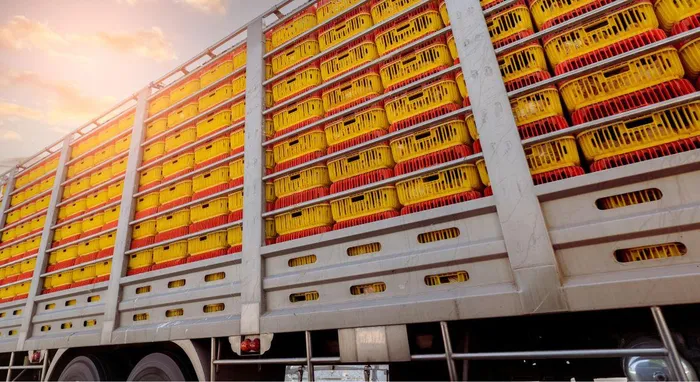
Imports create the “gap” they claim to fill. Dumped and subsidised chicken undercuts local producers, limiting domestic growth while offering no price relief to consumers, argues FairPlay Movement.
Image: Supplied
By Francois Baird
Chicken importers keep saying that their imports are essential because South Africa’s poultry producers are unable to meet local demand. They’re wrong, but that doesn’t stop them from repeating this mantra. The latest example is a lengthy justification of chicken imports in the March newsletter of the Association of Meat Importers and Exporters (AMIE).
“Because poultry consumption is so high, local production cannot meet demand,” it states. Importers go on to say that this perceived inability of South Africa’s chicken producers to supply the local market is why imports – especially mechanically deboned meat (MDM), chicken offal and frozen chicken portions – “play an important role in maintaining a stable supply and keeping prices affordable”.
As the poultry industry frequently points out, what imports really do is to limit local production, because key products such as frozen chicken portions come in at low and often dumped prices and are then sold at similar or slightly lower prices than local chicken. Importers score, but consumers see no benefit.
Importers, however, are celebrating a production gap they have helped to create.
Imports of MDM are indeed necessary, but only because most local producers choose not to make this product – a paste used in the production of processed meats such as polony and sausages. Local production is limited, and MDM comprises more than half of South Africa’s chicken imports.
In January 2026, MDM made up 60% of imports, with offal contributing a further 29%. Offal imports include chicken heads, feet and livers, and this is an area where rising South African production volumes mean increased local supply.
The most contentious area is bone-in chicken portions such as leg quarters, which made up 8% of January chicken imports. These frozen portions compete with locally produced packs of individually quick frozen (IQF) chicken, which comprises nearly half of local chicken production.
Here, the competition is fierce but often unfair – unsubsidised local chicken versus chicken imports from subsidised industries are often dumped below production cost.
South Africa has imposed anti-dumping duties against nine producer countries – Brazil, the United States and seven European countries. Imports from the US escape these duties in terms of a quota imposed on South Africa under the African Growth and Opportunity Act trade agreement.
Furthermore, South Africa’s poultry industry has emerged as one of the most globally competitive producers, now ranked second most competitive in the world behind Brazil and ahead of the United States and Europe.
Local chicken production is also rising – it has increased steadily since the introduction of the poultry master plan in 2019. And local producers have shown that they can ramp up production to meet unexpected shortages, such as during the Covid pandemic, the 2023 bird flu outbreaks when millions of fertilised eggs were imported, and last year when a nine-week bird flu ban halted chicken imports from Brazil.
For importers to say that local producers cannot meet local demand is less than accurate. They either choose not to, as is the case with MDM, or are held back by dumped imports.Further production increases will result in more import substitution.
This would happen even faster if there was a level playing field and South Africa’s highly competitive chicken producers could compete on fair terms against foreign imports.

Francois Baird is the founder of the FairPlay Movement, an organisation that fights trade dumping and campaigns for fair competition and a level playing field in trade.
Image: Supplied
* Francois Baird is the founder of the FairPlay Movement, an organisation that fights trade dumping and campaigns for fair competition and a level playing field in trade.
** The views expressed do not necessarily reflect the views of IOL or Independent Media.
BUSINESS REPORT