

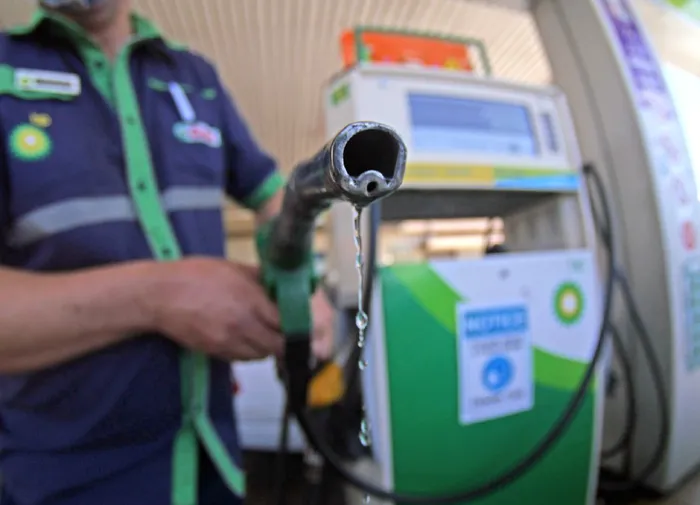
Early estimates are suggesting a rise of R4.74 per litre for petrol and R7.73 per litre for diesel, although some of this may be cushioned by government intervention.
Image: File
South Africa’s inflation rate eased further in February, offering continued relief to consumers and reinforcing expectations of a stable interest rate environment, at least in the near term.
Data from Statistics South Africa (StatsSA) on Wednesday showed that annual consumer inflation slowed to 3% in February, down from 3.5% in January and slightly below market expectations of 3.1%.
This marks the lowest level since June 2025 and aligns with the South African Reserve Bank’s newly adopted 3% inflation target.
The decline was largely driven by a sharp drop in fuel prices, which pushed transport costs lower and helped offset upward pressure in other categories. Fuel prices fell by 10.1% year-on-year, compared to a 3.7% decline in January, with petrol prices dropping by 65 cents per litre in February.
Food price inflation also moderated, rising by 3.7% compared to 4.4% in January.
Core inflation, which strips out volatile items such as food and fuel, also eased to 3% from 3.4% in January, pointing to a broader moderation in underlying price pressures.
On a monthly basis, consumer prices rose by 0.4% in February, up from 0.2% in January but still well below the 0.9% increase recorded in February 2025.
Stats SA chief director of price statistics Patrick Kelly attributed the relatively subdued monthly increase to a combination of factors, including delayed medical aid price adjustments, lower fuel costs and softer increases in healthcare services.
Kelly said the delay in medical aid contribution increases had a notable impact on the inflation print. However, Kelly cautioned that these delayed increases are likely to feed into inflation later in the year, potentially lifting headline figures in subsequent months.
Despite the encouraging February data, economists warned that the inflation outlook is becoming increasingly uncertain due to rising global oil prices linked to geopolitical tensions in the Middle East.
Investec chief economist Annabel Bishop said the full impact of recent fuel price increases will only begin to reflect in inflation data from April.
Bishop noted that petrol prices are currently pointing to a sharp increase in April, with early estimates suggesting a rise of R4.74 per litre for petrol and R7.73 per litre for diesel, although some of this may be cushioned by government intervention.
“Consumer price inflation is forecast at 3.2% year-on-year for the first quarter of 2026, as the impact from the war will not come through in the main yet,” she said. “Instead, it is expected to push inflation closer to 4% in the second quarter.”
Standard Bank’s head of South Africa macroeconomic research, Dr Elna Moolman, said February’s inflation data largely predates the recent oil price shock and associated currency weakness.
“Inflation was still very benign in February, exactly matching the Reserve Bank’s new inflation target of 3%,” she said. “But the longer oil prices stay high or the rand remains weaker, the higher the risk that this will result in more indirect inflation pressure beyond just fuel prices.”
Moolman added that while a short-lived spike in fuel prices may only have a temporary impact, prolonged pressure could broaden inflation and complicate the interest rate outlook.
FNB senior economist Koketso Mano echoed these concerns, warning that inflation is likely to edge higher in the coming months.
“Headline inflation is expected to increase slightly in March to around 3.1% year-on-year, with monthly pressure driven by services inflation and higher fuel prices,” he said.
Mano added that while inflation had been expected to remain close to the 3% target for much of the year, the evolving geopolitical situation poses a clear upside risk.
For now, financial markets expect the Reserve Bank to keep interest rates unchanged in the near term, as policymakers assess the balance between still-contained inflation and emerging global risks.
This comes as the National Energy Regulator of South Africa also announced an 8.76% increase in Eskom tariffs from 1 April for the 2026/27 financial year, which is higher than the initial 5.36% hike for the 2026/27 financial year.
Nedbank economist Johannes Khosa said that taken together, these developments point to a higher inflation trajectory.
“We now expect headline inflation to average 4.0% in 2026, revised up from 3.4%,” Khosa said.
“In response to this sudden deterioration in the inflation outlook, we expect the South African Reserve Bank to pause its easing cycle, keeping interest rates unchanged until the second half of 2027.”
BUSINESS REPORT