

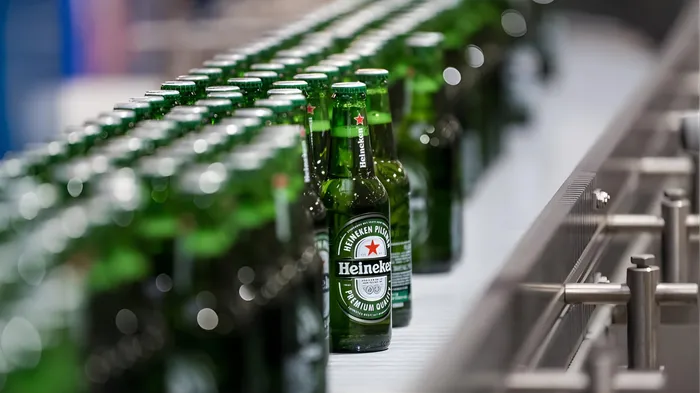
The brewer’s Sedibeng, in Midvaal south of Johannesburg, operation produces up to 8.5 million hectolitres annually and houses the group’s largest solar plant – 14,000 panels generating 30% of its own power to bypass load shedding. It was officially opened in March 2010.
Image: Heineken
As Heineken pivots into a new growth phase – EverGreen 2030 – the company is cutting between 5,000 and 6,000 jobs across the globe to become leaner and achieve as much as €500 million (9.5 billion) in gross savings.
However, it looks like South Africa may be spared this shift to aggressive efficiency and futureproofing, given that it was a rare bright spot when compared to its other operations such as Europe.
The brewer’s Sedibeng, in Midvaal south of Johannesburg, operation produces up to 8.5 million hectolitres annually and houses the group’s largest solar plant – 14,000 panels generating 30% of its own power to bypass load shedding. It was officially opened in March 2010.
While the global headline is about 6,000 job cuts, the South African business is currently being hailed as a "growth engine”. In the AB InBev competitor’s full-year results to December, it explicitly named South Africa as one of the top-performing markets in 2025.
While global beer volumes fell, South Africa recorded "excellent growth" and "solid beer volume" increases. At the same time, Heineken gained or held market share in South Africa, throughout 2025, largely driven by the premium segment.
Then there’s the Amstel ‘factor’ as it was cited as one of the strongest growing brands in the region, alongside the core Heineken brand.
CFO Harold van den Broek stated on a media call earlier, as reported by Reuters, that cuts are focused on "Europe and non-priority markets”. Since South Africa is classified as a "priority growth market," it is currently being protected from the brunt of the retrenchments.
South Africa could well be a major test case for Heineken’s “Future Fit" pillar of the new strategy given that load shedding, has resulted in in South Africa being a leader in solar transition. Heineken is pushing for more breweries to go off-grid to ensure production stability.
At the same time, South Africa is designated as a "water-stressed area," with Heineken having previously committed to reaching a water usage ratio of 2.4 hl/hl (hectolitres of water per hectolitre of beer) at local plants by 2030.
CEO Dolf van den Brink, said on the back of the results that, “as EverGreen 2025 concludes, we have made meaningful progress and advanced major transformations that strengthen our fundamentals.
"EverGreen 2030 builds on this with a sharper strategy, clearer resource allocation, and a stronger focus on value creation." the CEO said.
Van den Brink said Heineken’s first priority was to accelerate growth, funded by stepped up productivity and operating model changes that will involve a significant cost intervention over the next two years.
“This will unlock stronger people productivity and enable greater speed and efficiency. At the same time, we remain prudent in our near-term expectations for beer market conditions,” the CEO said.
IOL BUSINESS