

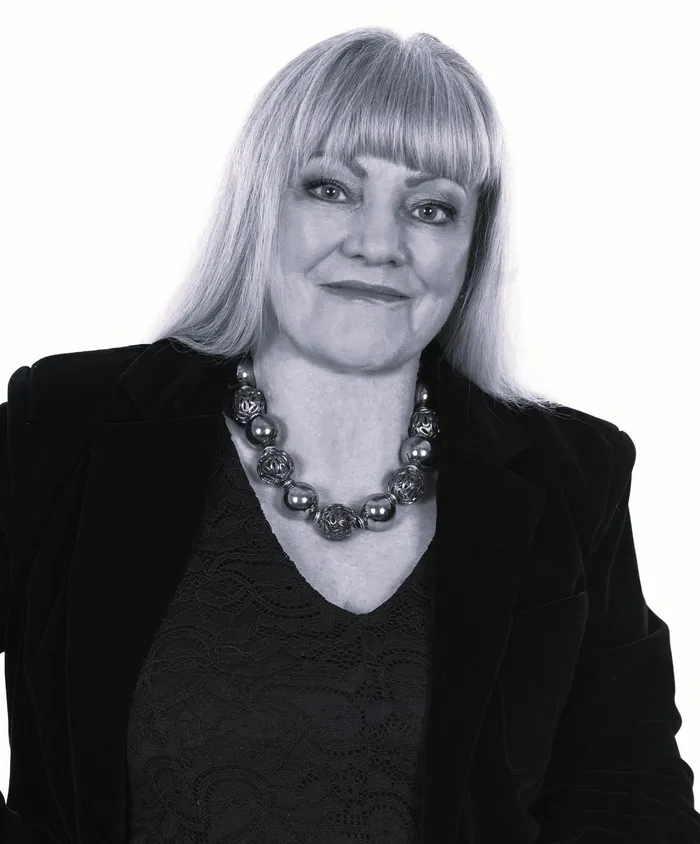
Mara Glennie, founder of the prominent TEARS Foundation.
Image: Supplied
The South African government’s failure to tackle gender-based violence (GBV) is a catastrophic betrayal that is costing women their lives, a leading frontline charity has warned.
In a scathing indictment of state paralysis, Mara Glennie, founder of the prominent TEARS Foundation, demanded an immediate end to "symbolic activism" and called for a radical institutional restructuring to wrest control of the crisis away from failing government ministers. Despite South Africa maintaining one of the highest femicide rates globally, landmark legislation remains trapped in bureaucratic limbo while the criminal justice system buckles under a staggering backlog of more than 140,000 unprocessed DNA samples.
"We cry for my beloved country for the failure to address gender-based violence," Glennie said, launching an unprecedented attack on what she described as the state's "second pandemic." "South Africa does not lack well-written policies; it lacks political courage and functional implementation. We will no longer sit quietly while structural incompetence costs lives daily."
Independent oversight reviews and parliamentary audits reveal a state response crippled by internal mismanagement, underfunding, and logistical chaos. The most severe failure lies within the South African Police Service (SAPS) Forensic Science Laboratory. A parliamentary probe recently confirmed that hundreds of rape and murder cases are being routinely thrown out or struck off court rolls because the state cannot produce timely DNA and toxicology results.
The crisis has been driven by basic operational failures, including expired supplier contracts, unmaintained laboratory equipment, and a failure to purchase essential chemical reagents. The burden has heavily concentrated in Gauteng because vital regional hubs, including the flood-damaged KwaZulu-Natal forensic laboratory, have been left non-functional for years. Furthermore, specialized sexual offences courts lack permanent staff, leaving victims trapped in a multi-year cycle of court postponements.
On the ground, the reality for survivors is grim. An investigation by the Public Protector South Africa (PPSA) exposed critical structural deficiencies within the Department of Social Development and the police. Police stations frequently lack vehicles and basic rape evidence kits, preventing officers from responding to domestic emergencies or securing vital crime scenes.
Furthermore, billions of rands are pledged on paper, yet local crisis centres and temporary shelters face immediate closure because state subsidies have been frozen. This operational disconnect is worsened by the fact that there is no functional, shared electronic data management network between the Department of Justice, SAPS, and Social Development, causing vital evidence to get lost across departments.
Celeste Louw, general manager of the TEARS Foundation, warned that the state’s architecture treats GBV as a secondary administrative issue rather than a national state of emergency. Louw stated that the government is paying mere lip-service to true reform and that its institutional paralysis costs lives, adding that the National Strategic Plan—once heralded as a blueprint for eradication—is now being weaponized as a public relations shield to protect political reputations.
For survivors who do step forward, the process itself causes further harm. Victims continually report facing insensitivity, victim-blaming, and poor treatment by police officers during initial statement-taking.
This systemic hostility, combined with exhaustion over prolonged trials and severe financial strain, has resulted in massive case withdrawal rates. Rights groups, including the Commission for Gender Equality, note that these withdrawals are rarely voluntary, but are instead forced by a broken system that grinds victims down.
The crisis is even more acute outside major cities, as current implementation frameworks are heavily designed for metropolitan hubs, entirely abandoning women in deeply rural areas who lack access to transport or basic cellular networks.
Insisting that the current system is beyond incremental repair, civil society leaders are demanding an immediate structural overhaul. The TEARS Foundation has laid out a series of non-negotiable demands to structuralise accountability, starting with the creation of an independent oversight body outside of ministerial control, reporting directly to Parliament with independent budgetary authority.
Furthermore, they have called on the National Treasury to isolate and protect funding exclusively for grassroots civil society organisations handling frontline trauma care, alongside the immediate implementation of independent performance reviews for all police stations and care centres failing to enforce protection orders.
"The pain, anger, and heartbreak felt across South Africa regarding the national crisis of GBV and femicide is a heavy reality shared by millions," Glennie said. With the state's response fractured across competing, underfunded departments with zero central accountability, the message from the frontline is clear: the current bureaucratic architecture is no longer a safety net - it is a hazard.