

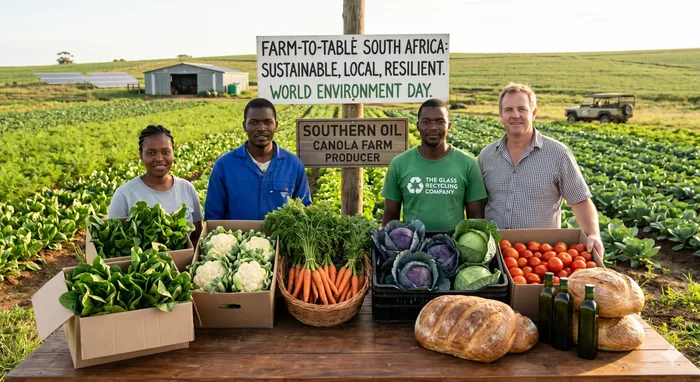
World Environment Day: Why South Africa’s ‘Farm-to-Table’ shift is about survival, not status.
Image: AI Generated/Gemini
As South Africa marked World Environment Day on 5 June, a profound structural shift is quietly transforming how the nation views its landscapes, its lodges, and its plates. Once dismissed as a premium lifestyle buzzword for affluent foodies, the concept of "farm-to-table" has rapidly evolved into a strategic necessity. In a country navigating severe economic headwinds, volatile global supply chains, and a changing climate, localized sustainability is no longer an optional luxury—it is a baseline survival strategy.
South African consumers are increasingly driving this transformation. Driven by a growing commitment to proactive health management and sustainability, 75 per cent of local consumers now demand cleaner, more transparent food production, whilst 42 per cent cite health benefits as the primary reason they switch brands. Yet, beneath this wellness-driven trend lies a stark socioeconomic reality: roughly 16 million South Africans suffer from inadequate food access.
"Beyond being a buzzword, farm-to-table has an integral role in connecting sustainable farming practices, building resilient food systems and local food sourcing while lessening pressure on the supply chain and reducing carbon footprint," said Zander Spammer, agricultural resource manager at Southern Oil. Spammer highlights the local canola industry—boasting over 600 dedicated producers—as a prime blueprint.
"Beyond farming, canola supports local processing capacity and provides protein rich feed for the livestock sector, creates additional jobs and strengthens rural economies - a tangible benefit of how supporting local agriculture filters beyond the farm gate."
This emphasis on localized foodsheds arrives at a critical moment. Industrial agriculture accounts for roughly 35 per cent of global greenhouse gas emissions, with animal farming consuming a staggering 77 per cent of global agricultural land when grazing is included. Furthermore, South African agriculture drains 66 per cent of local groundwater supplies. With parts of the country facing chronic water scarcity, continuing with resource-heavy, chemically dependent monocropping is untenable.
The danger of this global dependency was brought into sharp focus this year. With geopolitical conflict in Iran choking shipping lanes through the Strait of Hormuz, the global supply of chemical fertilizers has been severely disrupted. South Africa relies on these Gulf imports for 51 per cent of its fertilizers. This external shock exposes the deep structural vulnerabilities of industrial farming, proving that our next domestic food crisis can be incited by an armed conflict half a hemisphere away.
"Nature isn’t just the backdrop to human life, it’s the foundation that sustains us," said Gill Simpson, Executive Director of the Wild Rescue nature reserve.
"Conserving our biodiversity goes hand-in-hand with fortifying our food systems and agricultural resilience... Reserving sections of otherwise cleared farmland for indigenous plants and allowing these areas to rewild is highly beneficial due to the pollinators, mycelia, microorganisms and other natural allies that return."
True resilience requires merging modern ecological science with traditional African agricultural wisdom. By utilizing native, climate-adapted crops and allowing sections of cleared land to rewild, farmers can invite back the biodiversity necessary to fortify crops naturally against erratic weather, such as the upcoming El Niño phenomenon expected to impact the 2026–27 summer crop season.
This ethos of verified, localized impact is also transforming South African tourism. A pioneering pilot scheme led by travel company kimkim, alongside ETC Africa and the Wilderness Leadership School, is currently supporting 25 local tourism properties to actively measure and manage their environmental impact. Preliminary data reveals that off-grid safari lodges achieve half the per-bed-night emissions of their on-grid counterparts.
"The greatest environmental challenge isn’t travel it’s disconnection," said Duncan Pritchard, Director of ETC Africa. "Measuring a property’s carbon footprint gives that commitment a measurable backbone and the early data from this pilot has been revealing." By prioritizing locally sourced food and indigenous guides, ethical tourism ensures that local communities have a tangible financial incentive to safeguard vital climate infrastructure like the Kruger National Park.
Ultimately, sustainability must make financial sense. From lowveld safari lodges to grassroots urban recycling networks—where initiatives by The Glass Recycling Company are turning discarded bottles into immediate cash for collectors—South Africans are proving that environmental stewardship can drive economic empowerment.
"What some people see as waste can become an earning opportunity for someone else," said Shabeer Jhetam, CEO of The Glass Recycling Company.
This World Environment Day, the message is clear: we cannot simply rely on the premium organic aisle to save us. To secure our future, we must look to our own soils, shorten our supply chains, and build a food system that puts back into the environment exactly what it takes out.